










Narova Foam Beetle
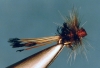
Russian Dmitri Tseliaritski's Narova foam dry fly is an easy and robust pattern template for terrestrials, beetles in particular


Russian fly tyer Dmitri Tseliaritski is quite an innovative fly tyer whose new patterns I always check when he posts them on Facebook.
This particular pattern was simply labeled Narova Dry Fly, and is a fairly simple construction using foam to form the body and shell of a beetle imitation.
Dmitri forms a compound body and shell consisting of foam, dubbing and a rib, and does so on a needle in such a fashion that the finished body/shell can be slid off the needle and tied in on the hook in a manner that reminds of the foam bodied mayflies seen quite often. But once the body has been secured, Dmitri bends the foam back over the body and ties it down, forming a shell and providing a lot of buoyancy in the fly. Since the hook is fairly short and winds up “hanging” under the body in the surface, the fly ends up with an almost detached hook and a fairly large gape leading to good hooking abilities.
Dmitri Tseliaritski

Peacock Narova
|

Orange Narova
|

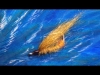
Golden Narova
|

Step 1 - start thread
|

Step 2 - tie down foam
|
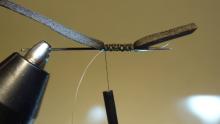
Step 3 - tie in ribbing
|

Step 4 - dub body
|

Step 5 - wrap ribbing and whip finish
|

Step 6 - the finished compound body
|

Step 7 - tie in hair
|

Step 8 - tie in body
|

Step 9 - trim foam
|

Step 10 - add dubbing
|

Step 11 - bend foam and tie down
|

Step 12 - CDC dubbing loop
|
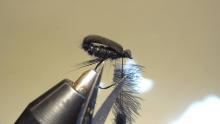
Step 13 - trim butts
|

Step 14 - wrap and whip finish
|
Color and material variations are basically endless. The examples shown here all use black foam, but you can use other colors to imitate more colorful naturals. Likewise you can vary the color of the dubbing, uses peacock herl, add a rib to the body or not, uses CDC or ordinary hackle. On this page you can also see a caddis pattern tied using the same technique. By making a longer body and adding antennae, you get an excellent and high floating caddis pattern.
The flies are fished on fairly thin leaders, preferably attached with a loop know, which allows the fly to move freely and positioning itself properly in the water. Being a good imitation of a terrestrial, the fly is well suited for fishing during warm and dry periods, placed close to the banks or further out on windy days, looking like a small insect that has dropped onto the water. Consider twitching the rod tip slightly now and then to simulate the movements of a struggling insect.

Read more about why you should register.
Related content


More content from the front page
  |
 |
 |
 |
 |
 |


Since you got this far …

The GFF money box
… I have a small favor to ask.
Long story short
Support the Global FlyFisher through several different channels, including PayPal.
Long story longer
The Global FlyFisher has been online since the mid-90's and has been free to access for everybody since day one – and will stay free for as long as I run it.
But that doesn't mean that it's free to run.
It costs money to drive a large site like this.
See more details about what you can do to help in this blog post.

Comments
Hi Dmitri
Very nice, I will try brown/cinnamon color for this concept. Thanks Dmitri!
|| May you live all the days of life. ||