
Sand eels are very common in most waters around the world.
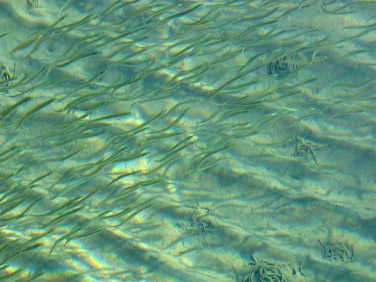
Sand eels are very common in most waters around the world. When we take sea trout and gut them 8 out of 10 of the ones, which have anything in their stomach, have sand eels or similar small fish in their stomach. The sand eels here vary from an inch in length to about 10 for the really big ones. I'll stay in the smaller range and make a fly, which can be handled on a one hand rod in my favorite 5-7 weight range, and will imitate the smaller near-shore sand eels nicely.
I love flatwing flies and have done so ever since reading Ken Abrames' books Striper Moon and A Perfect Fish, and what we need here lends itself very nicely to this tying style.
I know that a flatwing is no novelty, and that these flies have been used for ages in many parts of the world, but many tiers haven't opened their eyes to this simple, yet beautiful way of constructing elongated baitfish imitations. I have decided to simplify my flatwing in order to keep to the Mundane manifesto, so this fly is simpler than your usual large flatwing.
I know that a flatwing is no novelty


The main part of the fly will be hackle feathers in a light gray color. You can use almost any medium quality saddle for this, as long as the feathers are slender and not too tapered. Any cheap, low grade dry fly saddle will be fine.
I will use the straight part of the feather for the "wing", and some of the fluffy stuff to form the "body" and give some volume. Not much, but enough to move some water.
I also want some shine, and I get that from simple flash. I simply add a bit in the wing. Talking wing and body is kind of a misnomer here since the feathers are supposed to form the whole body of the fish with some volume up front and a lot of movement in the full length, but that's how we name fly parts.
Finally I want that typical dark back of the sand eel, which in my eyes is superiorly obtained with peacock herl. This brilliant material has it all: shine, the right color, the length and the movement. And it's inexpensive and easy to find, so it a perfect mundane fly material.
This pattern is a part of The Mundane Fly Project, which aims to create really simple patterns with few common materials.
There will be more on the project as more patterns get published.
- Log in to post comments
