


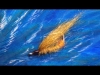





Mickey Finn
The Mickey Finn is one of the all time classic streamers. Simple, beautiful and fairly easy to tie - and a catcher.


A Mickey Finn or simply a Mickey, is originally not a fly, but a drink "spiced" up with a drug. It's most likely named after a bartender in Chicago.
The history of the Mickey Finn fly runs something like this: It was originally tied by Quebec fly tier Charles Langevin sometime in the 19th century. It was first known as The Langevin, but later renamed to The Assassin. This incarnation of the fly was popularized by outdoor writer John Alden Knight. Knight took another writer - Canadian Greg Clark - fishing and after such a trip, Clark announced that the fly was as dangerous as a Mickey Finn, referencing the drugged drink. This all took place back in the 30's and 40's and the name and the fame stuck, and the fly has been popular ever since.
It's one of those flies that seems to be able to catch almost anything, and has been responsible for catching browns, rainbows, salmon, bass and many more species.
It's one of those flies that seems to be able to catch almost anything
The fly is simple: a silver tinsel body and a wing made of yellow, red and yellow bucktail. Nothing fancy and no exotic materials, but still a fly with class and beauty like few others.
The color combination is classic and very characteristic, and it's obvious to adapt these colors to different other styles of flies and see what you get.
So after having tied the standard Mickey Finn, I will venture into the land of "Mickeyfication" and tie a number of different flies using the materials and colors: silver, yellow and red.
Classic Mickey Finn
As already mentioned the fly is pretty simple: no tail, a ribbed tinsel body and a wing in red and yellow. But simple as it may seem, it may be an easy fly to tie, but it's not an easy fly to get to look good. The style and "bareness" means that any error will be very obvious and really scream.
The keys to a good Mickey Finn are a smooth body with an even rib, a sparse wing with good separation between the colors and a small head.
A couple of tips to obtain this:
- Start the thread in the front and run the rib along the full shank length. A rib tied in in the rear will leave a bump.
- Make sure the thread base for the tinsel body is absolutely smooth. Use a peg or the round side of your scissors to smoothen it before wrapping the tinsel.
- Use Mylar tinsel and wrap it in two layers: from the front to the rear and back in touching turns, never overlapping.
- Have the rib on the underside, both the full length on tie-in, and the butt on tie-off. That keeps the base for the wing level.
- Use very sparse bunches of bucktail and few wraps to hold them.
- Keep the head small.
Follow the step-by-step photos below to see how that is obtained.
Polar Mickey
My own first variation on this fly was using Arctic fox in stead of bucktail to get a fuller and softer wing. I personally still prefer the original materials, and the bucktail might seem stiff and lifeless when dry, but once wet and in the water, it is very mobile and makes a fly with lots of life and movement. At the same time bucktail is a material that is very hassle free and almost never fouls.


Tying the classic

Step 1 - thread
|

Step 2 - rib
|

Step 3 - cover tib
|

Step 4 - and back
|

Step 5 - taper tinsel
|

Step 6 - tie in tinsel
|

Step 7 - start winding
|

Step 8 - and back
|

Step 9 - touching turns
|

Step 10 - tie down
|

Step 11 - trim tinsel
|

Step 12 - wrap ribbing
|

Step 13 - finish ribbing
|

Step 14 - tie down
|

Step 15 - trim rib
|
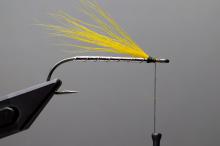
Step 16 - first yellow bunch
|

Step 17 - red bucktail
|
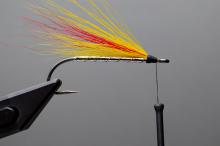
Step 18 - yellow bucktail
|

Step 19 - form head
|

Step 20 - varnish
|
Mickey Jiggy
Bob Popovics' Jiggy fly is an obvious contender for the Mickeyfication. Its basic shape is close and the wing material for the original is bucktail, so it's basically no more than using the yellow and red colors and you have the Mickey Jiggy. You can tie a ribbed tinsel body like I did here, or simply leave the hook bare as the original prescribes.

Clouser Mickey
If the Jiggy is an obvious contender, then Bob Clouser's Clouser Deep Minnow is almost more so. It also uses bucktail as the wing, so again simply using the Mickey Finn colors is the simple way of making a Mickey Clouser. Again the ribbed tinsel body is optional. It's barely visible under the winging material, and a streak of silver can be added in the form of a few straws of silver flash.

Thunder Creek Mickey
So if a multicolor bucktail wing is the key to being a potential Mickey Finn, then Kieth Fulsher's Thunder Creek flies are also obvious to tie in Mickey Finn colors. A yellow bunch below the hook and a yellow and red above all pointing forward. As they are folded back the red winds up under the yellow. Add eyes to the varnished or LCR'ed head, and you have a Thunder Creek Mickey. I have added a ribbed tinsel body here also, but it's hardly necessary - and barely visible anyway. You can use a silver hook to add the silver streak to the fly.

Salmon Mickey
The next variation is a very far cry from the original, but still bears an obvious resemblance due to the color scheme. The fly is tied on a tube in the general Scandinavian style and uses bucktail for the first wing section like the orginal, but the last wing section has been made with a zonker strip rather than a bunch of hair. The fly also has a hackle, which the original never had.

More Mickeys
Mike Martinek has adapted the Mickey Finn as a traditional whole feather wing streamer in the Carrie Stevens or New England style, and called the fly Mickey's Ghost. The body is simply the normal ribbed tinsel body, but the hair wing has been exchanged with a wing made from whole hackle feathers to create the characteristic vertical sides of the long NE streamers. Carrie Stevens actually originated a yellow/red streamer, which she called Mickey Doodle, and that might very well have been inspired by the Mickey Finn.
Below you also see the Bird Fur Mickey and a Mickey Biplane, which is tied as a flatwing streamer. The variations are literally endless - yellow over red over yellow over a silver body, and the heritage is clear.


We have covered the Mickey Finn before in our streamers section - both the traditional bucktail version, a marabou version and even a Woolly Bugger version.


Read more about why you should register.
Related content

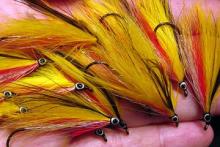


More content from the front page







Since you got this far …

The GFF money box
… I have a small favor to ask.
Long story short
Support the Global FlyFisher through several different channels, including PayPal.
Long story longer
The Global FlyFisher has been online since the mid-90's and has been free to access for everybody since day one – and will stay free for as long as I run it.
But that doesn't mean that it's free to run.
It costs money to drive a large site like this.
See more details about what you can do to help in this blog post.

Comments
I was always told th
I was always told the original Mickey Fin had a gold tinsel body. Looks like I was wrong. It is one fantastic pattern!.
Streamcaddis
I love the Micky Fi
I love the Micky Finn streamer. It works for me any the time I use it. One day I was wading up stream back to the lodge all of a sudden I had a good hit.The fly came loose and fell back in the river, so you could say I caught the fish trolling.
I tie mine on TMC 300's 8 and 6. Some times I use gold tinsel in stead of silver tinsel. You can slip me a Micky any time... Dave
Streamcaddis
nice article and so
nice article and so much variations
Martin, Great M
Martin,
Great Mickey Finn variations. There are many famous Mickeys in the world, but fly fishing's famous Mickey Finn has/will
outlive all of the others. Mickey Finn is a much kinder version of the original American Mickey Finn beverage. They both
hook their victims. Thank you for revisiting Mickey Finn. Kate