
The brook trout is native to North America. It is found from the Canadian Maritime Provinces, including offshore islands, Newfoundland, Labrador, and Quebec.
- Kelsey Brook Trout
- Brook Trout Deceiver
- Cains River Brook Trout
- Trout Fin
- Brook Trout Clouser
- Keith Fulsher's Thunder Creek Brooktrout
- Chief Needabeh
- Little Brook Trout
- Trout Fin Bucktail
- Parmacheene Belle
- Parmacheene Belle (Original)
- Parmacheene Belle (Orvis)
- Parmacheene Belle (Bucktail)
- Parmacheene Beau
- Little Brook Trout
- Black Marabou Brookie
- Litt'l Brookie
- Flatwing Brook Trout

Introduction: This feature is a the next installment of a series of articles being created as a group effort by members of the Streamer List to provide some background information on the species of forage fish we most commonly try to immitate with streamer patterns. Many thanks to the list members who contributed patterns and other information!
Brook Trout (Salvelinus fontinalis)
This description of the Brook Trout was submitted by Doug Saball
The brook trout is native to North America. It is found from the Canadian Maritime Provinces, including offshore islands, Newfoundland, Labrador, and Quebec. West through the Great Lakes drainage of Ontario, north to James and Hudson Bays including Belcher and Akimiski island, coastwise to northeastern Manitoba. Where it occurs in the Nelson and Hayes River systems and north along Hudson
Bay coast to Seal River. In the United States the brook trout is found from the Atlantic seaboard of Maine to Cape Cod, in the Appalachian Mountains southward to Georgia, west in the upper Mississippi and Great Lakes drainage to Minnesota, north to Canada. (1)
The brook trout has been successfully introduced widely throughout many parts of the world because of its appeal as a sport fish. These extended ranges include parts of western North America, South America (including the Falkland Islands), New Zealand, Asia, and many parts of Europe. (1)
The brook trout can usually be distinguished by body coloration alone. The back is olive-green to dark brown and sometimes black. Overlying the back are dark wavy or worm-like lines (vermiculations) which also appear on the dorsal and caudal fins. The sides are iridescent bluish or greenish with numerous large yellowish spots and a few smaller red spots encircled in a blue halo. The most identifying feature is the vivid milk-white leading edge followed by a black streak and then reddish coloration of each of the lower fins. The tail fin will also serve as an identifying characteristic as it is square or very shallowly forked. The teeth on the roof of the mouth are confined to only a small cluster near the front and do not occur along its length as in the Atlantic salmon, brown trout, and rainbow trout. Males at breeding time develop a hooked lower jaw (Kype) and their lower flanks become brilliantly suffused with reddish-orange. (1,2)
Juvenile brook trout are very similar in coloration to young Atlantic salmon. Both have dark and light alternating vertical bars, and the spots on the side are not pronounced in the brook trout. The distinction is the forked verses the squarish tail and the upper teeth in the brook trout.
Brook trout are cold water fish. They are never abundant in habitats that do not provide some water where temperatures are less than 60-65 degrees F. It is more rigid in its temperature requirements than rainbow or brook trout and as a rule will not be found in streams where 68 degrees F are exceeded for an extended amount of time. Temperatures above 77 degrees F are fatal if sustained for a prolonged period of time. In lakes and ponds with higher temperatures where brook trout are found usually cold water springs or other sources of cold water are near by.
The brook trout spawns in late summer or autumn depending on temperature and latitude. Through the southern reaches it spawns during September, October, or November, but it may take place as early as August in northern Canada and as late as December in the south. Spawning usually take place over gravel beds in the shallow headwaters of streams but may also be in gravelly shallows of lakes if spring upwelling and a moderate current are present. Mature brook trout may travel many miles upstream to reach sufficient spawning grounds.
The males usually arrive first and often outnumber females. Individual males may display some territoriality with aggression increasing when joined by a female. One male and female perform actual spawning; however, each may spawn with different mates during the reproductive period. The female clears away debris and silt from the nesting area by a series of rapid fanning movements of the caudal fin made while on her side. The circling and courting movements of the larger male produce currents that assist in cleaning the area. Both mail and female will dart ate any intruders to drive them away. Spawning occurs during the daytime, in contrast to night spawning by lake trout. (1)
Several different accounts of the spawning act have been recorded for brook trout. One account stated that the female turned on its side, flipped its tail several times and the eggs shot out. Another reported that the female took a position on the bottom of the nest, with pectoral and pelvic fins spread against the stones, and at her side the male arched his body to hold the female against the bottom and both vibrating intensely as eggs and milt were discharged.
There are several extrusions followed by a resting period. The eggs are adhesive for a short period after extrusion which allows those not lodged in gravel from being washed away. The number of eggs produced by a female varies with her size. A 4-inch fish produces less than 100 eggs; a 14 or 15-inch fish produces over 2,000 eggs, while a 22-inch fish will produce over 5,000 eggs. After spawning is completed the female covers the eggs with gravel in a similar manner as when she constructed the redd. Hatching takes about 140 days at 35 degrees F. (1)
A brook trout's rate of growth depends on the habitat it is in. A four year old brook trout inhabiting a perpetually cold spring brook may be only six inches in length and weigh only an ounce or so. However, a brook trout of the same age inhabiting a relatively rich lake habitat may be as much as four pounds. Brook trout are a relatively short-lived fish. Age studies throughout North America have demonstrated that brook trout more than three or four years of age are relatively rare. Individuals as old as seven years old are occasionally taken, but two and three year old fish make up the bulk of anglers catches. Maturity is not related to size. In a New Hampshire cold mountain streams fully mature specimens have been taken as small as 3 1/4 inches long. (3)
Brook trout are carnivorous and feed on a wide range of organisms. Young and medium sized trout eat large numbers of aquatic insect larvae and terrestrial insects. During the cold months they rely on insect larvae found on the bottom. In the warmer months the diet shifts to adult insects taken on the surface. Brook trout are a daytime feeder but during the summer feeding may be restricted to the cool of the morning and evening. Brook trout engage in a limited amount of cannibalism, eating their own eggs at spawning time and their own young in the spring. (1,2,3)
Etymology: Salvelinus - an old name for char; fontinalis - living in spring.
Common names: Brook trout, Eastern brook trout, speckled trout, aurora trout, brookie, square-tail, speckled char, sea trout, salters, sea-run trout, common brook trout, mud trout, coaster, eastern speckled trout, native trout, mountain trout, breac, and squaretailed trout. (1, 3)
Bibliography
(1) Bulletin 184; Freshwater Fishes of Canada, W.B. Scott, Crossman E.J., Fisheries Research Board of Canada, Ottawa 1973.
(2) Freshwater Fishes of New Hampshire, John F. Scarols, New Hampshire Fish and Game Department, division of Inland and Marine Fisheries, 1973.
(3) Fishes of Maine, Maine Department of Inland Fisheries and Wildlife, 4th edition, 1976.
Pattern Listing
Kelsey Brook Trout
Submitted By Lindsey Grandison

| HOOK | size 8, 4X long |
| THREAD | black |
| TAIL | white hackle, red over |
| BODY | chenille, medium size, dark green |
| RIB | gold tinsel |
| UNDERWING | sparse squirrel tail |
| OVERWING | furnace hackle |
| COLLAR | red and then white in front |
Lindsey's Comments On this Pattern
This is an old pattern I found by searching the past issues of flyfishing magazines. I use the program donated by Don Phillips to the American Museum of Flyfishing. It is available on the members section of their website www.amff.com. Once I found the listing I prevailed on the staff and Sara Wilcox kindly sent me the pattern. This help is but one of the many benefits of belonging to this organization, a custodian of our flyfishing heritage.
Brook Trout Deceiver
Submitted By Lindsey Grandison
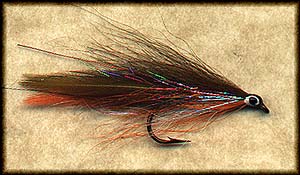
| BODY | none |
| TAIL | orange hackle inside of an olive hackle |
| THROAT | white bucktail, sparse |
| WINGS | orange bucktail on sides, sparse rainbow angel hair in center, sparse dark blue bucktail and then olive bucktail above, sparse |
| HEAD | black thread, white eye with a black pupil |
Cains River Brook Trout
Submitted By Roger Whitcomb
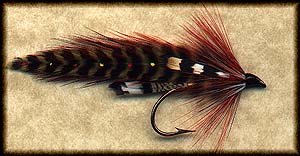
| HOOK | Mustad # 3906 Size 2 |
| THREAD | Danville prewaxed 6/0 , black |
| TAIL | White tipped (barred) Woodduck- long |
| BODY | Medium copper tinsel double wrapped |
| WING | two orange saddle hackles flanked by two black saddle hackles, flanked by olive grizzly hackles the same length as the black. Olive grizzly hackle spotted along stem with red & yellow lacquer. |
| CHEEKS | Medium to large Jungle Cock |
| HACKLE | Three turns orange followed by two turns black or olive grizzly followed by one or two turns of white. |
Roger's Comments On this Pattern
During July of 1994 I found this style of streamer to be very effective for blind casting to Landlocks & Rainbows that were surface feeding on smelt on Willoughby Lake in Northern Vt.Using a Cains River streamer as a dropper & skittering the dropper on the surface resulted in salmon & rainbows hitting both the dropper and tail fly. Fascinated by the streamer previously, I began to experiment with it and have found it to be effective for all trout species as well as landlocks. I use this style of streamer, both casting and trolling, tied with standard streamer hooks as well as the #3906. My favorite patterns are: Scotch Lassie, Kidder and a chartreuse version of the Highlander.
Trout Fin
Submitted By Bob Petti
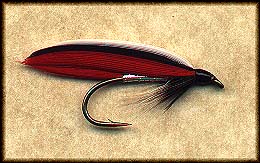
| HOOK | TMC 3761 |
| THREAD | Black |
| TAIL | Narrow slips of red goose shoulder - long |
| BODY | Flat Silver Mylar Tinsel |
| RIB | Oval Silver Tinsel |
| HACKLE | Pale Badger Hen |
| WING | Married slips of goose shoulder red, black, white (bottom to top) with the red dominant |
| HEAD | Black |
| COMMENTS | This fly differs from the traditional Trout Fin wet fly. I used the pattern as shown in Bates "Streamer Fishing and Fly Tying". I purposefully dressed the fly "long and sleek" to keep with the theme of streamers. |
Brook Trout Clouser
Submitted By Bill Stotz
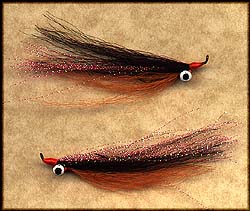
| THREAD | fire orange |
| BODY | none |
| EYES | Steel dumbell, painted white with black pupil |
| BELLY | Orange Bucktail |
| UNDERWING | A small bunch of pink Krystal Flash |
| WING | Black Bucktail |
| COMMENTS | On the second version, the underwing and wing materials were reversed. |
Keith Fulsher's Thunder Creek Brooktrout
Submitted By Chris DelPlato

| HOOK | Partridge CS5 size 4 - 8 |
| SHANK COVERING | Embossed gold tinsel (may be deleted and replaced with several strands of gold Krystal Flash) |
| LATERAL COVERING | Two well barred olive dyed grizzly hackles, tied on top of hook shank. Several bright orange bucktail hairs tied below hook shank. |
| TOP | Brown hairs from a blue dyed bucktail |
| BOTTOM | White bucktail |
| EYE | Cream lacquer with black pupil |
Chief Needabeh
Submitted By Stan Jakubaszek

| HEAD | Black |
| TAG | Flat silver tinsel |
| TAIL | A section of red duck or goose quill |
| BODY | Red silk or floss, with a red hackle "throat" tied one-third the way forward on the body. |
| RIB | Narrow flat silver tinsel |
| THROAT | A red saddle hackle tied on as a collar after the wing has been applied. Rather full. |
| WING | Two yellow saddle hackles flanked by two red saddle hackles |
| CHEEKS | Jungle Cock |
Little Brook Trout
Submitted By Stan Jakubaszek
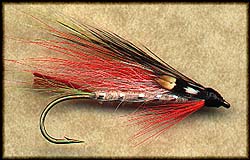
| HOOK | Size 6 |
| THREAD | Black |
| TAIL | A very small bunch of bright green bucktail, over which is a section of bright red floss. |
| BODY | wound with cream dubbing |
| RIB | Narrow flat silver tinsel |
| THROAT | A very small bunch of orange bucktail, the same length as the tail |
| WING | A very small bunch of white bucktail, over which is a very small bunch of orange bucktail, over which a very small bunch of bright green bucktail, over which is a bunch of barred badger hair |
| COMMENTS | Originated By Samual R. Slaymaker II of Gap, PA. |
Trout Fin Bucktail
Submitted By Phil Foster

| HOOK | Size 6, Mustad 9575 |
| THREAD | Black |
| TAIL | Golden Pheasant crest, curving upward |
| BODY | Flat silver mylar |
| RIB | Large oval silver tinsel |
| WING | Orange calf tail, then sparse black dyed squirrel tail, then sparse white calf tail |
Parmacheene Belle
Submitted By Wes Autio
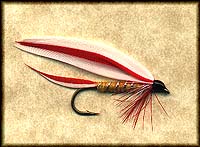
- Hook: Tiemco, TMC 5263, #6
- Thread: Uni-Thread, black, 8/0 and 6/0
- Tail: Married goose shoulder feather fibers, red over white
- Body: Yellow wool yarn, ribbed with oval silver tinsel
- Beard: Red and white hackle wrapped and pulled down
- Wing: Married goose shoulder feather fibers, white over red over white
- Head: Finished with black Cellire
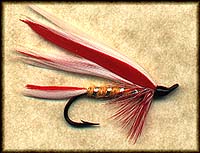
Parmacheene Belle (Original)
Parmacheene Belle (Orvis)
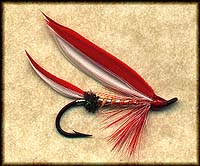
Parmacheene Belle (Bucktail)

Parmacheene Beau
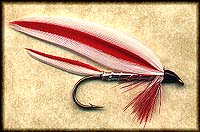
Wes's Comments On these Patterns
As fly fishermen and fly tiers, we continually search for the best fly for the particular situation. If someone tells me that fly X is just the one for the Y River in the month of Z, I search out its pattern, tie it, and give it a try. Sometimes it works, and sometimes it does not (probably more often the latter). For me, interest in these flies wax and wane, but I guess that this is the nature of the sport. It certainly adds to the enjoyment, both in tying and fishing. The flies, however, that I never lose interest in are the classics, the ones that have been used widely for many years and seem to really work, at least some of the time. Moreover, many of them are beautiful. The Parmacheene Belle is one of these flies. I don’t care whether or not it catches fish, I simply like it. Having been born and brought up in Maine, I have a particular interest in those flies tied for brook trout in Maine. The Parmacheene Belle was first tied by Henry Wells of Providence, Rhode Island in 1878 (the same year that the Royal Coachman was first tied) for fishing in the Rangely Region of western Maine. As Mr. Wells describes it, he and his regular guide, John Danforth, spent many hours tying and fishing various flies.
Often the fly-tying box is produced, and the word is, "Well, John, what shall we tease them with this afternoon?" Thus, on joint suggestion, very many different combinations have been tried, and so some seven years ago (written in 1885) was the "Parmacheene Belle" born.
It was supposed by Mr. Wells that the Parmacheene Belle mimicked a brook trout fin, a popular cut bait of the time, hence its inclusion in this collection of brook trout patterns. Its name came from Lake Parmachenee, in northern Oxford County in western Maine. (I have retained Mr. Wells’ spelling, which varies from the modern spelling of Parmachenee.) Mr. Wells liked the Parmacheene Belle very much and used it most of the time for fishing the area within which it was derived.
Place the whole catalogue of known flies on one hand, and this single fly on the other, and force
me to choose and confine myself to the choice, and for fishing in those waters I would choose the "Parmacheene Belle" every time.
Mr. Wells describes the fly in his writings, but the first color representation of the Parmacheene Belle appeared in Mary Orvis Marbury’s book, Favorite Flies and Their Histories. Various forms of the fly have been tied over the years, including those depicted in Bates’ Streamer Fly Tying & Fishing, in H. Clepper’s and R. Talleur’s magazine articles (listed in the bibliography), and in a number of books of trout fly patterns. However, I am unsure of what the original
version looked like. Wells’ description does not accurately match the rendering in Marbury’s book, even though Wells must have shared flies with C. F. Orvis, who tied the ones illustrated in the book. The flies tied for this article include one that resembles the C. F. Orvis version and a "best-guess" original version that combines Wells’ written description, the Orvis version, and some details mentioned in sections of Marbury’s book discussing other flies. The "modern" version of the Parmacheene Belle depicted here is tied after the one in Bates’ book. Additionally, Bates mentions the tying of a bucktail version. Although I found no pattern for the bucktail version, I assume that it was tied much like the one included here. The origin of the Parmacheene Beau is unclear to me. Bates attributes it to Mr. Wells, and Marbury states emphatically that it could not have been created by Mr. Wells. To further complicate the issue, Marbury describes the Beau as a Belle with jungle-cock-eye cheeks (eyes being clearly ridiculous on fly intended to imitate a fin), and Bates describes it as a Belle with a silver tinsel rather than yellow wool body. Regardless, it was derived from the Parmacheene Belle and very soon after the Belle’s inception. The Parmacheene Beau represented here is similar to Bates’ version.
Tying Instructions
- "Modern" Parmacheene Belle
1. Wrap a good base of thread (8/0) from the eye back to the bend of the hook.
2. Select a matched pair of red and of white goose shoulder feathers. The two individuals of each pair will have stems that curve in opposite directions. The best sections will be those that have long fibers with even ends. Select 1/16"-wide sections of fibers from the left side on one of the individuals and from the right side of the other in each pair. You should end up with two pieces of red and two pieces of white, all similar in size, except one piece of red and one of white curve one way and the others curve the opposite way.
3. When the feather pieces are tied onto the fly, the ends should curve upward. I will refer to the orientation of sections as they would appear on the fly. Of the four pieces of goose feathers, place the red and white pieces with similar curves together, with the red piece on top. The tips of the fibers should be even. Stroke these two pieces until the fibers join (marry) as if they were part of the same feather. You should end up with two sections, similar in width and each half red and half white.
4. Place these two sections "back to back," that is with the tips of both pieces curving inward and upward and with the tips aligned.
5. Carefully hold this tail section on top of the hook (the tail length should be about 2/3 of the length of the hook shank). Make a loose wrap of thread. Pinch the wrap, and hold the feather section very tightly while pulling upward to tighten it in place. Before letting go, make a few more similar wraps in front of the first one. Generally, I like to wrap thread around the but ends of the tail fibers to about 3/16" from the eye. Doing this makes it easier for me to create an even body.
6. Tie the oval tinsel and wool yarn on the underside of the hook 3/16" from the eye. Keeping both underneath, wrap the thread to the point at which the tail is tied in, being careful not to go behind the first tail wrap. Wrap the thread back to 3/16" from the eye. Wrap the wool from the tail to 3/16" from the eye, tie it off, and then rib the body with the oval tinsel. Tie this material off at 3/16" from the eye.
7. Select red and white hackle feathers that have fibers about 1.5 times the hook gape. Tie these in at about 3/16" from the eye, by the tips and with the white feather on top. Wrap the hackle as you would on a dry fly, first the white and then the red. Tie these off and stroke the feathers downward. Wrap thread back over some of the front hackle to make sure that it angles to the back of the fly. Sometimes, to make this process easier, I strip the barbules off one side of the feathers.
8. For the wing, repeat the process described above for the tail, except that the wing will have a white section on top. Also, each section should be about 1/8" wide. The tip of the wing should be approximately even with the tip of the tail. Before tying this in, I switch to 6/0 thread. I have a difficult time making this stay upright without holding the wing very tightly, and pulling the tying thread very hard, thus requiring the stronger thread. After tying the wing in place, make sure to wrap enough of the ends so that trimming the but ends of the fibers does not move the wing.
9. If a smaller head is desired, switch back to 8/0 thread at this point and finish the head. Apply a penetrating head cement, and finish with a glossy cement, like black Cellire.
Tying the Alternatives
The Orvis version of the Parmacheene Belle was tied much the same as the "modern" version described above. I tied it on a Mustad 36890 (#6) salmon hook, because I did not have any blind eye hooks. Of what I had available, the salmon hook best matched the hooks used in the late 1800's. This version included a peacock herl butt tied in before the body was wrapped.
Yellow mohair was used to wrap the body, rather than wool. The mohair was clipped a bit after wrapping. The body was ribbed with flat silver tinsel. Each side of the wing has only two sections (red over white), rather than three. Red thread (Uni-Thread 8/0) was used, and the head was lacquered with clear Cellire.
The "original" version is much like the Orvis version. I did not include the peacock herl butt,
and the wing was not made of married sections. It was tied on as two matched, wide, white sections and a thin red section held on each side. After tying the wing on, it was split. Marbury suggests that Wells preferred the wing to be split. I used black thread (Uni-thread 8/0) and black Cellire to finish the head.
The bucktail version was tied on a Tiemco TMC 300 (#6) hook. The body was constructed of yellow wool wrapped with oval silver tinsel, and the throat was mixed red and white hackle fibers. The wing has three equal portions of bucktail, white over red over white. The head was finished with black thread (Uni-thread 8/0) and black Cellire.
The Parmacheene Beau was tied in a similar manner to that described above for the Belle. The only variation is in the body. Rather than wool, the body was wrapped with flat silver tinsel ribbed with oval silver tinsel. Otherwise the fly is the same.
Bibliography
- Bates, J. D., Jr. 1995. Streamer Fly Tying & Fishing. Stackpole Books, Mechanicsburg, PA.
- Clepper, H. 1973. Homage to a Trout Fly. Trout 14(1):10-11, 34, 36.
- Marbury, M. O. 1892. Favorite Flies and Their Histories. Houghton Mifflin, Boston.
- Schullery, P. 1999. Royal Coachman, The Lore and Legends of Fly Fishing. Simon & Schuster, New York.
- Talleur, R. 1995. The Belle of Lake Parmachenee. American Angler 18(6):60-63.
- Wells, H. P. 1885. Fly-rods and Fly-tackle, Suggestions as to Their Manufacture and Use. Harper & Brothers, New York.
- Wells, H. P. 1889. Fly Fishing for Trout in the Rangely Region. p. 87-99. In: C. F.
- Orvis and A. N. Cheney. Fishing with the Fly. Houghton Mifflin, Boston.
Little Brook Trout
Submitted By Robb Nicewonger
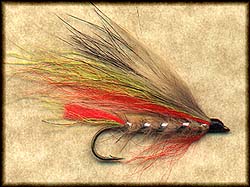
| HOOK | Size 6 |
| THREAD | Black |
| TAIL | A very small bunch of bright green fishair, over which is a section of bright red yarn. |
| BODY | dubbed white/cream fox fur |
| RIB | Narrow flat silver tinsel |
| THROAT | A very small bunch of orange bucktail, the same length as the tail |
| WING | A very small bunch of white bucktail, over which is a very small bunch of orange bucktail, over which a very small bunch of bright green fishair, over which is a bunch of barred badger hair. |
Black Marabou Brookie
Submitted By David Talley
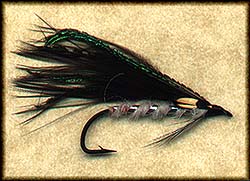
| HOOK | Ken Baker #6 |
| THREAD | Orange for body, black for head |
| UNDERBODY | Burnt Orange floss |
| TAIL | Black and white hackle fibres |
| BODY | Any cream colored dubbing (I used dog) |
| RIB | Medium tinsel |
| THROAT | Same as tail |
| WING | Black marabou, ala "White Marabou" fly |
| TOPPING | Peacock Swords |
| CHEEKS | Jungle Cock |
David's Tying Instructions
1) Start orange thread behind eye
2) Wind down to hook bend, attach tail and rib.
3) Create dubbing loop for body, but do not dub yet.
4) Bring thread back up to starting point, tie in floss.
5) Wind down and back
6) Loosely dub body with loop - the inttention is for the orange floss to show through the cream dubbing when the fly is wet.
7) Wind rib
8) Trim body if necessary
9) Attach throat, wing, topping and cheeks in usual manner.
The dubbing I used really turns transluscent when it's wet, hopefully letting the orange floss sort of "glow".
Litt'l Brookie
Submitted By Doug Saball

| HEAD | Black Thread |
| BODY | White Floss |
| RIBBING | Flat silver tinsel |
| WING | Yellow calf tail, then 2 Grizzly & 2 Olive hackles |
| TAIL, MID FIN, & THROAT | Married White/ Black/ Orange quill segments. (could use hair in stead of married wings) White & Black sections are the same width, which is 1/3 to 1/2 Orange width. |
| COMMENTS | I was taught this fly when I was a teen-ager but found the married wings difficult to work with. So I have tied few of them. |
Doug's Comments On Marrying Feathers
Marrying feathers is the process of uniting sections from differently colored wing flight quills, tails
or flank feathers. To produce married wings you need to have a matched pair (one from each side of the bird) of feathers for each color you require. In order to produce the married wing decide on the number of barbules required for each color to produce a wing of the proper width for the size of fly you are tying.
Take your first color and cut out a group of about ten to fifteen barbules. Cut out a similar width of the second color. Even the tips of the two sections and hold the butts of the sections close together between the thumb and first finger of your right hand. With the thumb and first finger of your left hand, gently stroke the feather sections upward, making the sections adhere to each other. Take similar sections from all left-hand feathers and form the other wing. Slide the two sections together so that the barbules lock together. If you try to marry barbules from opposite sides of the feather you will find that they do not truly interlock and will separate easily). To separate off the required width of the second color counts up the number of barbules required and slide a darning needle along the joint just above the last barbule required. This will separate off the required width. Repeat the process with any other colors required. Finally when all colors have been married adjust the width of the first color using your needle. You will find it fairly easy to marry larger widths of feather but if you try this with only one or two barbules you will have difficulty.
Tying instructions
(1) Wrap a layer of white thread along the shank of the streamer hook from behind the eye of the hook to the bend.
(2) Tie in the married tail with 3 loose lops to prevent the married sections from separating. Continue to tie in the tail with tighter wraps.
(3) Tie in the white floss and silver ribbing.
(4) Wrap the thread toward the eye.
(5) Wrap the floss to form the body to the mid section.
(6) Tie in the mid fin with the same technique that was used for the tail. Make sure that the fin points in the down direction.
(7) Continue to wrap the floss to form the mid section to the eye, and secure with the thread.
(8) Carefully wrap the tinsel with five wraps to form the ribbing, and secure it near the eye
(9) Attach the yellow calf's tail underwing so it extends to just above the bend of the hook.
(10)Attach the two grizzly hackle wings flanked with the two olive hackle wings. This step can also be done Rangeley style by cementing the grizzly and olive hackles before attaching.
(11)Tie in and finish with a black head.
Flatwing Brook Trout
Submitted By Bob Skehan

| HOOK | Mustad 94720, size 4 |
| TAIL | Two small matched olive-dyed mallard flank feathers, mounted vertically. |
| BODY | Pearlescent braided mylar tubing secured at both ends with olive thread. |
| THROAT | Sparse orange, then black, then white calf tail. |
| WING | 4-5 strands of peacock herl, then sparse orange calf tail, then a single olive-dyed mallard (well-barred) flank feather tied flat on top. |
| DORSAL FIN | Two small matched olive-dyed mallard flank feathers with half the barbules stripped, then mounted vertically. |
| HEAD | Olive Thread |
| EYES | Silver prismatic stick-ons. |
Raske's Comments On This Pattern
When the interest in this feature started gaining momentum, I immediately knew I wanted to include something "new". Given the effectiveness of the smaller flatwing streamers in casting sizes, and the larger flatwings such as Joe's Smelt for trolling, I was struck by the absence of a brook trout fry in this style. I decided to make one.
At first I though of making a huge teal-strip "look alike", but when rummaging around in my bag of olive mallard flank I noticed a small feather that looked just like a brookie tail. I quickly found a match to that one, and since they're not really appropriate for use as Teal Strip wings, I used them to simulate a tail. I have no idea how this will affect the streamer as it is dragged through the water, but would assume that if mounted properly, it would ride correctly with hook point down.
I used the pearlescent mylar tubing for the body because it's darn fishy.
Emulating the trout fin patterns, I chose the tri-colored throat to simulate a brook trout pectoral fin. (I know....brook trout fry don't have spawning colors....so sue me.)
To add support, color, and contrast to the wing, I chose to use some magical peacock herl. The
orange calf tail there adds the color and support.
I planned to simply finish off the head at this point, but thought the pattern needed a dorsal fin. I found a slightly larger pair of olive-dyed mallard flank feathers from the bag, placed them concave sides together, and stripped off the barbules on the bottom half of the feathers. This was then tied vertically on top of the wing at the head.
Finally....I applied prismatic stick-on eyes which were nicely in proportion to the streamer overall. A couple coats of epoxy, and it's done!
- Log in to post comments
