
A recent article in Fly Tyer magazine sparked quite a debate on the streamer list about the use of this popular and effective saltwater fly in fresh water. The debate found the authors "defending" the fresh water deceiver and prompted us to write a small
- Traditional New England Deceivers
- Will's Traditional New England Deceivers
- PINK LADY DECEIVER
- RIPOGENUS DECEIVER
- MAGOG DECEIVER
- MORNING GLORY DECEIVER
- MAGOG FLATTAIL DECEIVER
- RIPOGENUS HALF & HALF
- Untraditional Deceiver Patterns
- Robb's Untraditional Deceiver Patterns
- BASIC WHITE DECEIVER
- FLAT WINGED BLACK DECEIVER
- GOLDFISH DECEIVER
- PERCH DECEIVER
- JIG-N-PIG DECEIVER
- CAYAGUA LAKE HALF & HALF
A recent article in Fly Tyer magazine* about deceivers sparked quite a debate on the streamer list about the use of this popular and effective saltwater fly in fresh water. The debate found the authors
"defending" the fresh water deceiver and prompted us to write a small feature on some of our own deceiver patterns.
The deceiver was first tied by Lefty Kreh in the 50's for striped bass in the Chesapeke Bay. The fly was extremely successful and soon spread to all saltwater environments and even into the freshwater world. The original fly has been changed and modified numerous times; however, there are two telltale signs that you're looking at a deceiver. First is the wing placement--the saddle hackle wing is positioned near the bend of the hook. Second is the hair collar which surrounds the wing and prevents it from fouling. As with most saltwater patterns, flash is usually added somewhere in the pattern. Whether you scale down saltwater versions of this fly, adapt other traditional streamer patterns, or create new patterns, you should experiment with this fly in fresh water--its a good one.
*(Fly Tyer, vol. 5, no. 1, Spring '99)
Traditional New England Deceivers
- Will Taylor
One can legitimately question the need for any "new" fly for landlocked salmon or trout fishing. In the smelt-filled rivers & lakes of Maine, a handful of traditional New England streamer patterns provide perfectly credible forage fish immitations in the waters and water conditions encountered. Pattens in blue dunn, blue, pink, yellow, white or purple, with some peacock herl & golden pheasant crest for flash, will keep one in business all season; I would feel very well-equipped with a casting-streamer selection of Gray Ghosts, Ripogenus Smelts, Pink Ladys, Barnes Specials, Black Ghosts and Magog Smelts. So why introduce Deceivers to the streamer wallet?
Why not?
Rainbow smelts are very long, slender fish, very active swimmers, with incredible multichromatic flash. If one were to start ground-up to design an immitation, you could hardly do better than to begin with Lefty's Deceiver for a body-plan. This is a pattern that has proven itself many times over as an imitation or general slender-minnow attractor for a wide varity of saltwater gamefish. With deserved respect for the color combinations that have proven themselves over time on landlocked salmon,
I've designed the following Deceivers, each named for the classical streamer pattern that inspired it.
Deceivers have several unique features to recommend them to fishing and to the tying bench:
- They tie up a lot quicker & easier than a traditional feather-wing streamer
- They're a good way to use up some of those saddle hackles not suitable for traditional streamers
- They very optimally marry the properties of feather-wing and hair-wing streamers
- They allow the use of modern flash materials that would look gaudy and out of place when merely added to traditional patterns
- They're very tough, and stand up well to abuse in casting & catching fish
- They have a very narrow, fishy profile, particularly well-suited as a smelt immitation
- Varying the dressing density and hook weight can produce flies that fish near the surface or sink quickly for deeper pools
- They cast like a dream & the wings never foul around the hook
Deceivers will never displace the classical New England streamers in my streamer wallet; I enjoy tying and fishing those traditional patterns far too much for that to be a temptation. But they are earning a place alongside their long-hooked siblings.
Will's Traditional New England Deceivers
PINK LADY DECEIVER
Submitted By Will Taylor

| THREAD | white 6/0; change to black for the head |
| HOOK | TMC 7999 #6 |
| TAIL | two pink saddle hackles, flanked by 2 grizzly saddles; then 2 strands pearl flashabou and 2 strands pearl krystal flash each side |
| BODY | white tying thread, lacquered to secure the tail materials |
| COLLAR | ventrolateral, white bucktail; dorsal ("wing"), 3 strands each side pink krystal flash topped with pink bucktail |
| TOPPING | 4 strands fine peacock herl |
| THROAT | small bunch yellow krystal flash, cut short |
| HEAD | black thead; cement with penetrating head cement, finish with Loon Outdoors Black Hard Head Fly Finish |
| EYES(OPTIONAL) | painted on head, white with black pupil |
Will's Comments:
This pattern was inspired by Carrie Stevens' Pink Lady, one of my favorite casting streamers for landlocked salmon. (That pattern originally had a pink & grizzly wing, although it often is tied nowadays in orange for some reason).
RIPOGENUS DECEIVER
Submitted By Will Taylor

| THREAD | white 6/0; change to black for the head |
| HOOK | TMC 7999 #6 |
| TAIL | two light blue or kingfisher blue saddle hackles, flanked by 2 grizzly saddles; then 2 strands pearl flashabou and 2 strands pearl krystal flash each side |
| BODY | white tying thread, lacquered to secure the tail materials |
| COLLAR | ventrolateral, white bucktail; dorsal ("wing"), 3 strands each side yellow krystal flash topped with medium grey bucktail |
| TOPPING | 4 strands fine peacock herl |
| THROAT | small bunch red krystal flash, cut short |
| HEAD | black thead; cement with penetrating head cement, finish with Loon Outdoors Black Hard Head Fly Finish |
| EYES(OPTIONAL) | painted on head, white with black pupil |
Will's Comments:
This pattern was inspired by Eddie Reif's Ripogenus Smelt, a popular casting and trolling streamer for landlocked salmon in Maine, and one of my favorite blue patterns.
MAGOG DECEIVER
Submitted By Will Taylor
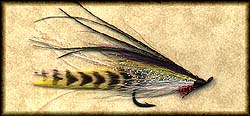
| THREAD | white 6/0; change to black for the head |
| HOOK | TMC 7999 #6 |
| TAIL | two yellow saddle hackles, flanked by 2 grizzly saddles; then 2 strands pearl flashabou each side |
| BODY | white tying thread, lacquered to secure the tail materials |
| COLLAR | ventrolateral, white bucktail; dorsal ("wing"), 3 strands each side silver krystal flash, topped with sparse yellow and then purple bucktail |
| TOPPING | 4 strands fine peacock herl |
| THROAT | small bunch red krystal flash, cut short |
| HEAD | black thead; cement with penetrating head cement, finish with Loon Outdoors Black Hard Head Fly Finish |
| EYES(OPTIONAL) | painted on head, white with black pupil |
Will's Comments:
This pattern was inspired by the Magog Smelt, one of my favorite hairwing streamers. I caught my first landlocked salmon on a tandem Magog Smelt trolled from my canoe, and have always since felt it to be a "lucky pattern." This pattern takes tremendous liberty in translating the features of the original pattern into a Deceiver, though perhaps not so much as my Coppermgaumoc Smelt does in translating it into a flatwing.
Inspired by Bob Petti's suggestion of tying a soft-hackle collar to imitate the colors of the traditional pattern's shoulder, I have recently experimented with adding a teal flank collar to this pattern, tying the feather in by the tip, folding & winding the collar, and tying back along the hair collar (see the Morning Glory Deceiver for an example).
MORNING GLORY DECEIVER
Submitted By Will Taylor

| THREAD | white 6/0; change to black for the head |
| HOOK | TMC 7999 #4 salmon hook |
| TAIL | one rather full silver pheasant crest feather, nearly as long as tail, curving up; then two pairs yellow saddle hackles; flanked on each side by 2 strands pearl flashabou and 2 strands orange krystal flash |
| BODY | white tying thread, lacquered to secure the tail materials |
| COLLAR | ventrolateral, yellow calftail; ventral, small bunch white calftail; dorsal ("wing"), 3 strands each side red krystal flash, topped with a small bunch of yellow bucktail |
| THROAT | short silver pheasant crest feather, curving up |
| SOFT HACKLE COLLAR | two golden pheasant red body feathers, tied in by the tip, folded and wound as a collar and tied back to lie on the hair collar |
| HEAD | black thead; cement with penetrating head cement, finish with Loon Outdoors Black Hard Head Fly Finish |
| EYES (OPTIONAL) | painted on head, white with black pupil |
Will's Comments:
Inspired by Carrie Stevens' Morning Glory. Bob Petti came up with this pattern on paper & posted it to the Streamers@ mailing list, & I couldn't wait to get home to tie one up. I subjected Bob's pattern to the folk process (i.e., I forgot his recipe & had to wing it) & came up with this. At the heart of this pattern is the soft-hackle collar (the traditional pattern uses red Golden Pheasant body feathers as shoulders). Bob in turn credits this inspiration to Jack Gartside's soft-hackle
streamers.
Since Bob introduced me to this idea, I've experimented with adding soft-hackle collars to some of my other Deceivers (mallard flank on the Pink Lady; Teal flank on the Ripogenus and Magog Deceivers); and I think this idea & a few boxes of RIT will inspire a number of new patterns.
MAGOG FLATTAIL DECEIVER
Submitted By Will Taylor
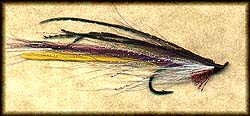
| THREAD | white 6/0; change to black for the head |
| HOOK | TMC 7999 #6 |
| TAIL | very sparse white bucktail, nearly the length of the desired tail; then one yellow saddle hackle, tied in flat, chicken-side up; then 4 strands pearl flashabou; followed by small bunch purple bucktail |
| BODY | white tying thread, lacquered to secure the tail materials |
| COLLAR | ventrolateral, white bucktail; dorsal ("wing"), 3 strands each side silver krystal flash, topped with sparse yellow and then purple bucktail |
| TOPPING | 4 strands fine peacock herl |
| THROAT | small bunch red krystal flash, cut short |
| HEAD | black thead; cement with penetrating head cement, finish with Loon Outdoors Black Hard Head Fly Finish |
| EYES (OPTIONAL) | painted on head, white with black pupil |
Will's Comments:
This is a variation on the Magog Deceiver. The flattail configuration allows the color-layering in the
wing to extend the length of the fly, into the tail.
I was introduced to this flattail style in Ray Bondorew's Striped-Bass streamers. In addition to allowing vertical layering of colors the length of the fly, this style has wonderful action in the water and presents a wider silhouette when viewed from below.
RIPOGENUS HALF & HALF
Submitted By Will Taylor

| THREAD | pale yellow 6/0 |
| HOOK | two light blue or kingfisher blue saddle hackles, flanked by 2 grizzly saddles; then 2 strands pearl flashabou and 2 strands pearl krystal flash each side |
| TAIL | two light blue or kingfisher blue saddle hackles, flanked by 2 grizzly saddles; then 2 strands pearl flashabou and 2 strands pearl krystal flash each side |
| BODY | pale yellow tying thread, lacquered to secure the tail materials |
| EYES | steel dumbell, yellow with black pupil, tied in on top the hook 1/3 the shaft length back from the eye, so the fly will ride inverted (bead-chain eyes may be used for a shallower-running fly). Please don't use lead eyes - it is very toxic to waterfowl. |
| BELLY | white bucktail, 1/3 to 1/2 the length of the tail |
| UNDERWING | yellow krystal flash, 3 strands each side, slightly beyond the bend of the hook |
| WING | medium grey bucktail; tied somewhat longer than the collar of a typical Deceiver, nearly 2/3 the length of the tail |
| THROAT | small bunch red krystal flash, cut short |
| HEAD | pale yellow tying thead; cement with nail lacquer, which will render the thread nearly transparent |
Will's Comments:
I really love this fly. As is the Ripogenus Deceiver, this pattern was inspired by Eddie Reif's Ripogenus Smelt. The style is basically that of Bob Clouser's Deep Minnow, with a Deceiver tail tied in at the bend of the hook. Great when you have to get down deep in heavy current, or a deep pool or lake.
Untraditional Deceiver Patterns
- Robb Nicewonger
For the creative tyer (or one who can't follow a pattern) the nicest thing about the deceiver is the flexibility of the pattern. One can take advantage of this and tie not only imitation of smelts, but
also other forage fish, leeches, small snakes, and attractor patterns as well. Materials for the tail can be the traditional saddle hackle, marabou, hen body feathers, rabbit strips, rubber legs, etc. The collar can consist of any type of natural or synthetic hair. While the heads can be nice and small or built up very large with prismatic stick-on eyes. Virtually any hook type can be used--regular shank length hooks for small, fat flies or long shank for thin, slender ones. I've included a few patterns that I developed primarily when I was living in the Finger Lakes region of New York. Although I've only been in New England for about a year, I'm sure these will translate well. Some of you more traditional streamer flingers will probably cringe at some of these patterns, but give 'em a chance. Tie a few up and I'm sure you'll be pleasantly surprised at the results.
Robb's Untraditional Deceiver Patterns
BASIC WHITE DECEIVER
Submitted By Robb Nicewonger
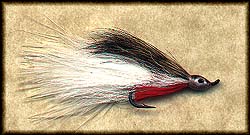
| THREAD | grey 6/0 |
| HOOK | Kamasan low water salmon hook #8 |
| TAIL | white marabou |
| COLLAR | sides and bottom white calftail, top natural squirrel (I used to use peacock herl but like the squirrel better - see the Fly Tyer article) |
| THROAT | 8 strands red floss |
| HEAD | built up grey thread, marked dark on top with a marker. Eyes are fabric paint - the whole head is given a coat of softex |
| COMMENTS | Tied as a small chub imitation. |
FLAT WINGED BLACK DECEIVER
Submitted By Robb Nicewonger
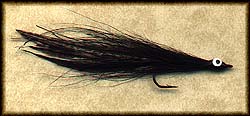
| THREAD | black |
| HOOK | Kamasan B940 salmon hook #4 |
| TAIL | 4 black variant saddles tied in flat covered with a few stands of black rainbow tiewell sparkle flash |
| COLLAR | sparse black bucktail with a few strands of tiewell sparkle flash on top |
| EYES | prismatic stick on |
| COMMENTS | This has been a very effective largemouth bass fly. It could be a minnow, a leech or when tied in lrger sizes (up to 2/0) a small snake. |
GOLDFISH DECEIVER
Submitted By Robb Nicewonger

| THREAD | yellow |
| HOOK | TMC 7999 #2 |
| TAIL | yellow marabou |
| COLLAR | mixed yellow and orange bucktail |
| HEAD | yellow with fabric paint eyes, 1 coat of softex |
| COMMENTS | Cayuga Lake holds a healthy population of gold carp. When they move into the shallows in the spring they are easy targets for predators. This fly accounted for several large bass and a few rainbows. |
PERCH DECEIVER
Submitted By Robb Nicewonger

| THREAD | grey 6/0 |
| HOOK | Mustad 3366 #4 |
| TAIL | 4 chartreuse hen body feathers |
| COLLAR | sides yellow bucktail, bottom orange bucktail, top fox squirrel |
| HEAD | black with fabric paint eyes, coat with softex |
JIG-N-PIG DECEIVER
Submitted By Robb Nicewonger

| THREAD | fluorescent orange |
| HOOK | Mustad 3366 #4 |
| TAIL | orange rabbit strip and sililegs (pumpkin speckled) |
| COLLAR | fox squirrel |
| HEAD | oversized orange thread |
Robb's Comments:
This fly was inspired by the classic bass bait rig of the same name. A jig-n-pig consists of a large jig with a rubber skirt baited with a piece of pork rind. Smallmouth anglers in Cayuga Lake did very
well with a crayfish colored set up. This is my attempt to recreate that.
Will's note - I cringed when I saw the name of this fly. But knowing Robb, I knew he just couldn't create a pork-strip disaster. This thing not only has rubber legs & rabbit, it looks good.
CAYAGUA LAKE HALF & HALF
Submitted By Robb Nicewonger
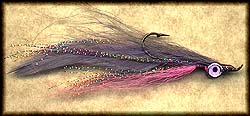
| THREAD | grey 6/0 |
| HOOK | Mustad 79580 #4 |
| TAIL | 4 grey saddles flanked by a few strands of rainbow krystal flash |
| EYES | Dumbbell |
| BODY | Rainbow braid |
| BELLY | Rainbow krystal flash under pink bucktail |
| TOP | Grey over lavender bucktail |
| HEAD | grey thread coated with silver Wet and Wild nail polish |
| COMMENTS | This pattern was tied to represent the larger rainbow smelt in Cayuga Lake and was very effective in the dead of winter fished at the warm water discharges of the power plants on the lake. |
- Log in to post comments
