
Most fly anglers will find that using macro in their photography can be truly thrilling. A lot of what we are interested in is small, and many will appreciate being able to capture small things. This article in the series about fishing photography covers macro photography from an angler's perspective.

Most plain out-of-the-box point&shoot cameras have excellent macro facilities and the bigger DSLR's can be equipped with macro lenses of a really superior quality.
Most fly anglers will find that using macro can be truly thrilling. Since a lot of what we are interested in, is small, we will appreciate being able to capture small things well in our pictures.
We like to look at bugs and other small food items - and of course our own flies.
Being in nature also exposes us to other interesting sights in the department of smaller things such as flowers and other details of our surroundings.
Before going ahead, let me just try to define the concept macro, so that you know what I'm talking about.
Macro is more than just going close.
A precise definition would have to do with the relation between the size of the object you're depicting and the size of the representation of it in the finished image. In the film world we measure this aspect as 1:1 meaning life size on the 24*36 millimeter film, 1:2 meaning half size and 2:1 meaning twice the real size on the "negative".
In digital we can't always use these terms because of the varying size of the image chips (sensors), so the definition comes to sound something like: macro is when a small object can be made to fill the whole picture from edge to edge.
This article will not deal with fly photography in detail.
We have a whole series of articles on scanning and photographing flies you can read as a supplement.


The key figure is then how small this small object is. I'm not going to go into details about the exact size in millimeters or fractions of an inch, but just say that useful macro requires the ability to take pictures of say artificial flies in such a way that a fairly large size fly like a size 4 or 2 will fill the whole image while excellent (some would say extreme) macro means that a small fly - say smaller than size 10 - can be enlarged to fill a whole image.
So in order to get real macro you need a camera with a true macro mode or a macro lens for your SLR. The closeup-option found on many lenses and cameras will not cut it. A standard zoom with the word "macro" printed on the lens is not it. Macro on point&shoot cameras is usually shown with a flower symbol. So unless your camera has this special position, you are probably not able to go as close as it's required to do real macro.
If you are looking for a camera and want macro, go for one that has a really small closest distance to the lens. Go for something in the 4-5 centimeters or 2 inches range, and prefer cameras that support down to 1 centimeter or less than half an inch. This will enable you to go sufficiently close.
OK, back to the subject at hand: taking macro pictures. Macro pictures call for two things: turning on the macro facility of the camera (or putting on a macro lens) and going close - real close. Cameras with good macro functions allow you to go as close as a centimeter or less than half an inch.
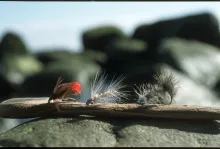
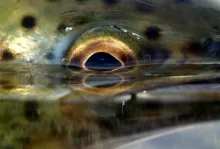
Going this close brings you into a very interesting world. Things look a lot different, when it's enlarged to such an extent, and seemingly boring subjects can suddenly become quite interesting. Typical examples are reel details, scales, details in nature like tree bark, plant parts and of course insects and flowers.
When you shoot a scene and want some real perspective, it can be a really good idea to change to macro setting, turn the camera to vertical position and get the foreground sharp and the background blurred. This will often give you a stunning depth in the image, and give a picture, which is much more interesting than a picture where the distance is sharp and the foreground blurred.
One thing you have to be careful with is light. The subject is often so close to the lens that the camera might cast a shadow on it. A flash could be a solution, but most times you are very limited in the use of flash. It is possible to use flash in a macro picture, but it usually requires that the flash is turned down a bit and that you can be sure that the light from the flash will reach the subject. Built-in flashes will have a hard time reaching subjects vary close to the lens, and at the same time there is a potential danger of overexposing the subject.
I have sometimes experimented with simply holding a finger or a small piece of white paper in front of the flash and then shoot. Sometimes it works, sometimes it doesn't.
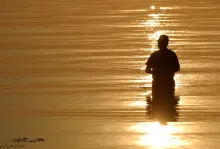
Remember to experiment with shooting into the light and getting light from different angles. And try softening scenes with harsh light using a white surface as a reflector.


My photography site called 500th.net might interest you if you like photographing.
- Log in to post comments



Must come fishing/ph
Must come fishing/photographing with you sometime - pictures are excellent
Helge,
Sure enoug
Helge,
Sure enough... but being in a cabin not too close to civilasation gave us two alternatives: these glasses (meant for bitters or schnaps) or sipping directly out of the bottle. Being fairly civilized we chose the least barbarian of the two...
Martin
Hi Martin, nice pict
Hi Martin, nice pictures, but what an unsuitable glas for the water of life.
Take care
Helge