Martin Westbeek
Medium
brown trout
rainbow trout (landlocked)
| Hook | dry fly, size 12 |
| Thread | 8/0 Gudebrod black |
| Body | black superfine dubbing |
| Legs | black (or brown) pheasant tail fibers |
| Wing | 1 mm packaging foam |
| Thorax | dubbed black Angel Hair |
| Hackle | Whiting hen, black |
- Take the thread to the of the hook, dub a body of about 60% of the hook shank
- Tie in two pheasant tail fibers on the left and right side of the fly. Traditionally, Bibio's have knotted legs, but these knots are a weak point, where the leg invariably breaks. So I don't bother, and tie in the fibers as is. I use two fibers left and right, and if one of these fibers breaks (these Oostvoorne rainbows can be rough on flies), I remove one of both fibers on the other side, too, in order to make the fly symmetrical again. Don't know if that makes any difference, but it somehow feels better.
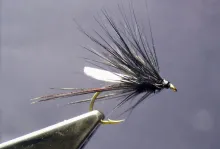
- Clip a wing from the foam (mine are about 12 mm long and 3 mm wide, to end at the hook bend) and tie that in. Seen from below the fly looks like shown.
- Take a hen hackle, stroke the fibers back, and clip the tip off. The little triangle of fibers makes it easy to tie the hen hackle in.
- Tie the hackle in, shiny side up.
- Bibios have a relatively big thorax and head, and Angel Hair is a nice material to dub if you want to produce volume without adding much weight. and Angel Hair does not absorb water. Take 2 or 3 strands, and dub the Angel Hair to the thread.
- Build up a shaggy thorax/head area. If you dub the Angel Hair loose it will take floatant very well.
- Take the hackle, double it by folding the fibers back, and wrap it 4 to 5 times. Build a nice head and clip off the thread.
- Stroke the hackle fibers to the left and right, clip off any remaining fibers on the underside of the fly if you wish, and you're done.