
One of the most effective methods of drifting a fly through deep pools in Great Lakes steelhead rivers is to use a slinky. You can buy slinkies from a shop, but you will pay a premium. The components are pretty cheap and they are very easy to make at home.
One of the most effective methods of drifting a fly through deep pools in Great Lakes steelhead rivers is to use a "slinky rig". One of the key ingredients, of course, is the slinky. You can buy slinkies from most steelhead shops, but you will pay a premium for them. On the other hand, the components are pretty cheap and they are very easy to make at home. You also have total control over the weight inside the slinkies, so you can make them as light or as heavy as you like. Indeed, you can make a variety of sizes to match whatever conditions you might find.
You don't need much in the way of special tools or components.
The only specialty stuff is the round shot and parachute cord. The shot I use is steel and is probably ball bearings of some sort (I bought it in a kit), but any round shot will do. Removable shot doesn't work as well 'cause the little tabs you use to open the shot tend to get caught in the cord as you're trying to load it. They will work in a pinch, though.
In a half-an-hour or so, you can make a season's worth of slinkies.

First, you gotta seal one end of the cord, so the shot won't fall out when you're loading it. Just hold it next to the flame until the ends begin to melt.

The edge of the cord gets molten, like this...

... and then you just crimp it shut with a pair of pliers...

... and this is what the end looks like after it has been crimped.

Now you cut the slinkie cord to length, Make it a little long, 'cause the edges tend to fray when you're putting in the shot.
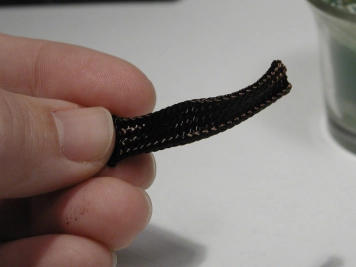
Load the shot in the open end. Notice how it frays a little bit?
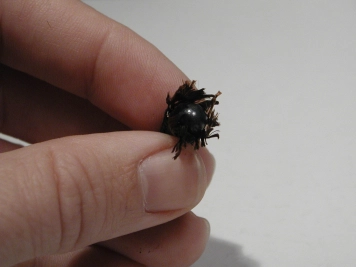
This slinkie has three shot inside. There's room for another, or you can just trim it now.

Trim some of the frayed ends...

...melt the end in the flame...
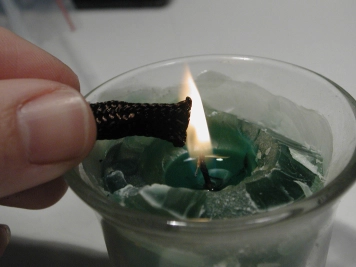
...crimp it shut...

...and you're done. Well, almost. You still have to put a hole in one end for the snap swivel.
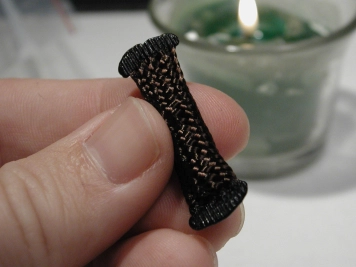
Since you're going to be heating the needle to melt a hole in the slinkie, you will need some sort of heat proof handle. Don't try to heat the needle while you're holding the needle itself. Mine is epoxied in a cork bottle stopper.

Heat the needle over the flame...
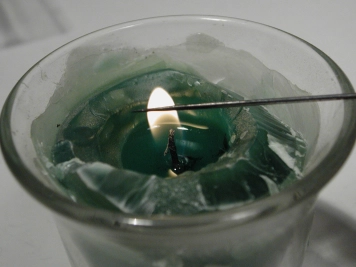
...and push the needle through the melted end of the slinkie. The needle has to be really hot to melt the hole, so it sometimes takes a couple tries before you get the needle hot enough to melt the hole.

You'll get a nice permanent hole in your slinkie like this, which will make changing slinkies much easier than if you just tried to punch the swivel through the cord itself.

That's it. I made this handful in about 15 minutes.

- Log in to post comments
