
The most sought after pattern on GFF's search page is John Barr's more than excellent nymph pattern the Copper John. Martin Joergensen describes his version here: how to tie it and fish it. And adds its hillbilly kin the much simpler Copper Joe.
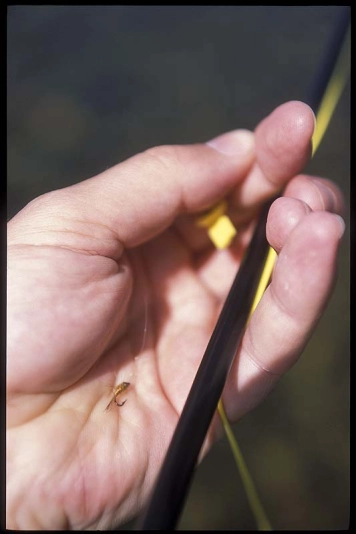
I first learned about the Copper John before a trip to visit GFF partner Steve Schweitzer in Colorado a couple of years ago. Steve recommended a bunch of patterns of which I knew all except for one - a pattern that Steve referred to as the Copper John.
Pattern found
When Kasper - the friend I was going with - and I looked around for pattern descriptions of this unknown fly, we had to seek a long time to find it. Steve came to our rescue with a copy of a magazine article. In his article "Hopper Copper Dropper" John Barr told the story about the fly, the pattern and the method for fishing it. The story has been even further expanded by Bob White as you can read in this comment below.
A variation
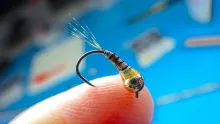
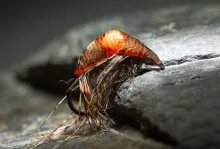
The pattern tied here is a bit different than the one shown in John Barr's article. Barr uses dubbing and not herl and he layers the copper in one layer only. The legs on his original also tend to extend far out on the sides of the body.
I love peacock herl, and even my first Hillbilly Copper Johns had herl thoraxes in stead of dubbing. I also find it logical and more straightforward to run the copper wire double - plus it adds further weight to the fly. My flies also tend to be more dense and less elongated than the originals - mostly because I tie them on a curved nymph hook rather than a straight shank wet fly hook that John Barr recommends.
Why?
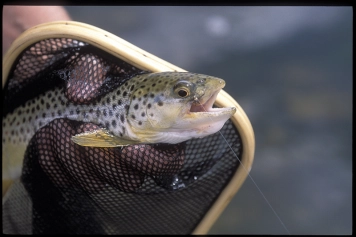
And why is this pattern so darned efficient then? Simple! With all respect to John Barr's effort to make an excellent generic nymph imitation, it is not the imitative strength or general good looks of the fly that makes it a killer. It's its weight. Simple as that. Density.
The compact weight of the fly brings it down where the fish are. The lack of too many extensions eases its sinking. No doubt its ability to look like something edible, entices fish to open their mouths over it. But it's first of all because the fly is in the same depth as the fish's mouth.
Even in small sizes down to hook size 16, 18 and 20, the fly manages to penetrate the water well and sink.
Complex
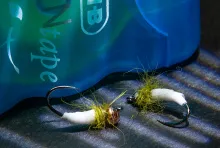
I only have one really big issue with this fly: it's far too complex for my taste. Especially when tied in sizes smaller than 16 it becomes a true menace. With a dozen materials and alone two plus epoxy for the back, it is more than I usually bargain for in a fly pattern. I have tied the flies much simpler lately, omitting everything but the bead, he copper and the herl and gotten what I refer to as a Copper Joe - a simpler and more outback version of the original. A rural fly compared to the stylish metropolitan vogue of the original Copper John.
As far as I can see it fishes as well as the original, but takes a fraction of the time to tie. It becomes in effect a Brassie with a bead - also known as a Beahead Brassie in the US - the well known British stillwater pattern juiced up with a heavy brass bead.
The original Copper John
John Barr's own Copper John is discussed in detail by the originator himself in his article "Hopper, Copper, Dropper" (March 2009: the link unfortunately doesn't seem to work anymore. All searches for John Barr on Fly Fisherman gives an error or the main page - but ... it seems that John Barr has retold the story on Umpqua's site. Let's see how long that lives).
This is his materials list for the original:
Hook: #TMC 5262 or equivalent
Thread: Black 6/0
Tail: Brown goose biots
Abdomen: Wapsi copper Ultra Wire
Thorax: Peacock herl
Wingcase: Thin Skin, pearl Flashabou, and epoxy
Legs: hungarian partridge or hen back or saddle
Bead: Brass
Weight: Lead wire
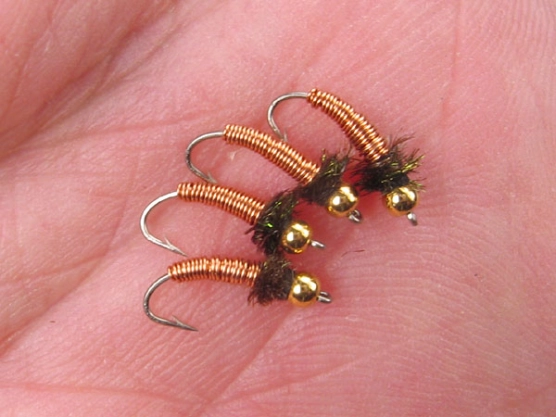
Both flies can be varied by choosing another color of copper wire. Wapsi has some really nice (and really expensive) copper wire that comes in a wealth of different hues. Chartreuse, red, yellow and black are natural choices, but other colors can be chosen according to wishes and taste.
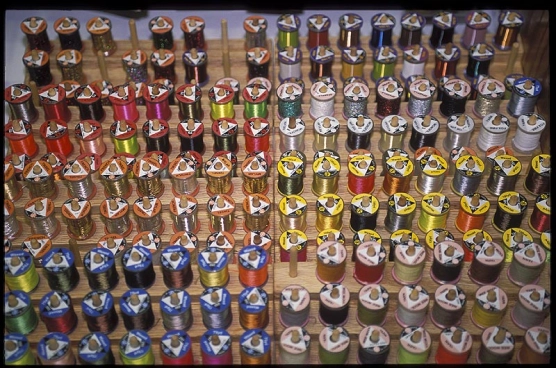


The fly shown in the tying sequence here is a huge Hillbilly Copper John. Usually the pattern is tied on hooks size 16 and smaller, while the fly shown is made on a size 12 hook, which will produce a large and very heavy nymph.
How to fish it
I prefer the Hopper-copper-no-dropper method where I tie a big hopper pattern or a large caddis - CDC&Elk is my favorite - to the tippet and tie a piece of even thinner tippet to the hook bend of this fly (New Zealand style). In this terminal tippet I tie a Hillbilly Copper John/Joe. The length from the hopper and down depends on water depth and current speed, but three feet or one meter is a good starting point.
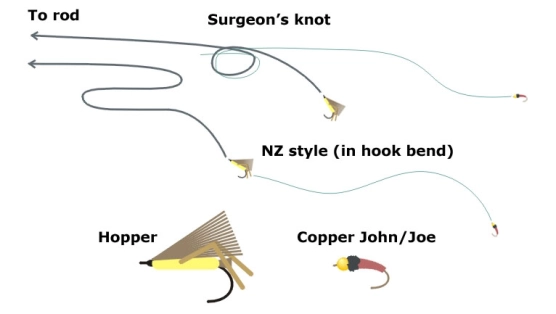
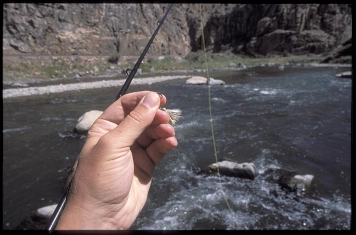
The rig is terrible to cast as the big, air resistant dry fly struggles for the power with the small, dense and heavy nymph. They seem to want to go each their way in every cast. But a slow casting rhythm and an open arc will help. And don't try to fish the flies too far from you.
Keep a close eye on the dry fly, which acts as your strike indicator. Fish will also occasionally go for the dry, so it serves a double purpose.
You might want to treat the dry fly with floatant in order to hold it high and carry the nymph for as long as possible. The rig is perfect for medium fast water of limited depth and can draw fish from almost any potential run.
- Log in to post comments


I have heard this story
I will say that I have heard this story about he Copper Bob and it certainly was a buzz in and around the Rocky Moutnain Front Range for years, nice to see Bob's take on it as well. As far as egostism by naming your flies, I am in the business to make money and get as many anglers fishing and tying my flies as possible which is why I write for several magazines like Fly Tyer and Fly Fisherman so that I can "spread" the word. I'm aware of the fact that many flies are built on age long concepts but I also strive to create truly "new" patterns and believe I have introduced concepts and techniques that can help others to do the same. I tend to be more forthcoming with info than most Signature Tiers and am always willing to share my thoughts on the subject and how I go about it. My new book will be an attempt at sharing many of those in one place. I know Bob Mead and he is a great guy so I mean no disrespect but there is no egotism involved with trying to make a living at what you do full time. I have no retirement fund and no guaranteed wages. I write, run my on-line store and fly shop and guide. That is my living and that has been my life so using a name on fly is just a way to further the word and get more royalties coming in. So to all of those tiers with names on flies, hey if you are trying to make a living, most are not then I don't think it is about ego, at least not for this tier with all do respect......Most importantly to me is to ensure the flies are durable and produce, unlike many one hit wonders....I am a fisherman who ties flies, so i can catch more fish and just try to pass on what I know.....
Vince Wilcox
God bless
www.wileysflies.com
Ahh, more enlightenment
Ahh, more enlightenment. Until I read this fine article and its comments I didn't know there was a Copper Bob, nor its creator Bob White, who from his letter seems like a pretty nice fellow and like somebody I'd like to fish with. It was refreshing to hear that Copper 'Bob' was so named by others and not its creator. Somehow though, Copper 'John' sounds less egotistical than Daves, Mikes, Jims, Jacks, Eds, Petes, or Billy Bobs "Hopper".. I would imagine that 'before the internet' many methods, materials, and techniques were used and/or developed by many independently... there is only so much you can do to a hook to make it look like a bug or a minnow. I don't know about you fellows, but I still find this manipulation of thread (wire) feathers and fur as fascinating today as I did sixty years ago.
Another good article
Another good article,again why do we argue over a name or what is a new spin on and good fly,can't we just tye flies and stop thinking one name is better than the next,I've been fly tying/fishing since 1977 " long time" seen good things come, good things go .I use a verision called the blonde john gold tail,gold body,gold dubbing thorax,molted oak thin skin wing case,pale hen hackle legs,gold bead,not a differnt pattern just one I tye to match the lighter nymphs in our area works great its not a new pattern just one tied to match the lighter nymphs.
Nothing new under the sun
Hi Martin,
I couldn't agree more that there's "nothing new under the sun". The Copper Bob/John/Joe all must page homage to Frank Sawyer, and his copper-bodied pheasant tail nymph.
Warm regards,
Bob White
Thanks for sharing
Bob,
Thanks for sharing your letter to John Barr and the "original" publishing magazine of the Copper John article. The quotes around original are not meant as a pun or an offense, but merely indicates that there is not much new under the sun when it comes to flies.
Most of what we can conceive in our minds and at our vices has been tied at least dozens of times before, and people coming up with something truly original are few and far apart. The mere thought of pattern protection, trademarks, copyright etc. on a fly pattern seems ridiculous to me - even though such schemes are known to exists. All that can be invented in this respect seems to have seen the light of day already - as your story also indicates.
Again: thanks for sharing, and I for one am glad that this did not develop into a dispute between John Barr and yourself.
Martin
A letter
I enjoyed reading about Martin Joergensen's "Copper Joe", and thought that the following letter might be of interest to your readers...
AN OPEN LETTER TO JOHN BARR - SENT TO JOHN BARR AND DAVID KLAUSMEYER, EDITOR OF FLY TYER MAGAZINE ON JUNE 8, 2005.
Dear John,
It was a pleasure to meet you at the Hooked on a Cure event. I'm glad that our paths finally crossed, and that we had the opportunity to compare notes about our respective fly patterns... The "Copper John" and the "Copper Bob".
I felt badly when you told me that some fly shop owners had communicated to you that you were being accused of violating the client/guide relationship, and had lifted the idea of for the "Copper John" from me.
Nothing could be further from the truth... I've never guided you in either Alaska, Argentina, or Chile. As I mentioned to you at the event... some folks take a perverse pleasure in stirring up the pot, and then sitting back and watching the ensuing show. Thankfully, we were able to meet, enjoy each other's company, and compare notes before anyone tried to poison our friendship.
I'm writing this open letter to you in an attempt to set the record straight... something I know that you'd like to do also. This is what I tell folks when I'm asked about the origin of the Copper Bob...
- I designed the "Copper Bob" in the winter months of 1988, while guiding in Argentina. The fly was inspired primarily by my needs as a guide, and by some of the ideas and nymph patterns that other guides and my fishermen shared with me. The "Copper Bob" was designed to be a "guide's fly"... one that is effective, easy to tie in quantity, durable, and allows clients to fish a nymph deeply without the encumbering (and often tangled) use of split shot.
- I introduced the pattern, with both one and two shades of wire (for segmented bodies) to Alaska that same year... the summer of 1988... with great success. It became a standard pattern at the lodge where I guided (Tikchik Narrows Lodge), and I gave away so many of them out to the other guides that it necessitated many a late night tying session. It was first tied commercially (exclusively for Tikchik Narrows Lodge) during the winter of 1990 by three or four fly tyers who guided in Alaska during the summer months, and lived in Missoula in the off season. All of these very talented guide/tyers contributed their own ideas and twists to the concept, and Interestingly enough... it was one of them who named the fly... up until that point... we simply called it a "Copper-Bodied Pheasant Tail". Many of these friends still actively guide and tie commercially in Montana and Alaska. Several other commercial tyers have been fulfilling the lodge's annual needs ever since.
- The Copper Bob quickly became more of a concept than a distinctive pattern... we tied it on short shanked hooks with heavy copper wire to imitate clinging and crawling mayfly nymphs... we tied it on long shanked hooks with finer wire to imitate swimming nymphs... We tied it tiny for midge pupa, and we tied it large to look like an immature stone flies. We made them light to imitate PMD's and sulphers, etc., and dark for other mayflies. We bended the concept to produce soft hackles... copper bodied wet flies... Damsel fly nymphs... and even Steelhead patterns. All of these patterns have been around since the beginning... but none with the notoriety and commercial success of the standard, Copper Bob.
- The original Copper Bob was tied without the bead head that your pattern utilizes, as bead headed nymphs were just coming onto the scene at the time. Even after bead headed nymphs became all the rage, I still preferred to guide and fish with the original pattern. I believe that this style affords the guide or fisherman a greater degree of flexibility, allowing it to be to fished plain, for mid depth drifts, and with whatever size and color bead added to the leader for deeper drifts. The bead slides down the leader while casting, eliminating the "ball and chain" effect of a split shot. I carry a selection of multicolored brass, copper, and tungsten beads for just this purpose.
If you try this... watch your tippet, as it'll gradually fray and need to be replaced periodically. Eventually, we began tying them in both styles... with and without beads... and with and without rubber legs.
The epoxy part was added later by my friends at the Montana Fly Company.
- When I'm asked why I didn't promote the concept/pattern, I remind folks that, at the time, I was a working guide in a very competitive area, and that my primary concern was to keep the fly a secret for as long as possible. Our guides were instructed never to leave any flies
in their boats, and to use the heaviest tippet possible, as to not leave the pattern in the jaws of the fish we hooked, where it might be found and copied by our competitors. The Montana Fly Company approached me about producing the pattern, primarily because, one of those early tyers of the pattern now works for them. He knew of it's origin, and was kind enough to ask if I'd mind lending my name to the pattern. Like you... I enjoy receiving a royalty for every one sold.
John, I can assure you that I was just as surprised to see the "Copper John" hit the market as you were to hear of the "Copper Bob"... and just imagine what Frank Sawyer would think if he could read this!
I'm very pleased that we finally had the chance to meet, and to share our stories. I hope that this letter will put any controversy to rest.
Now... let's go fishing!
Most sincerely,
Bob White
Whitefish Studio & Small Fry Cards
PO Box 261 - 240 6th Street
Marine on St. Croix, Mn 55047
651-433-4168
bob@whitefishstudio.com
Nice Article - Love the history
Never tried doubling the wire. Been using tungsten beads for additional weight instead of additional wire but now I'm curious. I prefer peacock herl as well. It has such dynamic light and color variations.
Thanks
-Kasey @ FoxTrick Flies