
Hook comparison charts are at best fickle or at worst too confusing and inaccurate to use. It is critical to remember that this chart does in no way list equivalent hooks but attempts to list hooks based on similar applications.


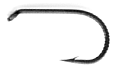
Hook comparison charts are at best fickle or at worst too confusing and inaccurate to use. It is critical to remember that this chart does in no way list equivalent hooks but attempts to list hooks based on similar applications.
Far too many variables exist today to compare hooks in any other way. Even with this in mind individuals will undoubtably find comparisons that they will disagree with. Much of the variation that exists is mainly due to the fact that little, if any, standardization exists today within the hook manufacturing fraternity.
A clear example is a hook labeled as 4 XF on the Redditch scale being comparable to the same hook listed as 1 to 2 XF on the Mustad scale. In addition to that, steel quality will cause shank diameter to vary causing the above scales to be further skewed. A careful read of both Stewart's "Hook Book" and Martin's "Micropatterns" would go a long way to helping the fly-tyer in understanding the subtleties of hook manufacture and classification. I am indebted to these authors for advancing my personal understanding of hook evolution and manufacturing.
When assessing hooks of like application an attempt was made to correlate the Redditch scale to the Mustad scale based on physical dimensions such as shank wire diameter and length, hook weight and in some cases hook gape. Though it required several months to complete this chart it is very possible that a hook model has been missed and not listed appropriately. Should this be the case be assured that it was not an intentional omission. Finally, I believe hook charts of this type will soon disappear. This will be due to the fact that fly-tyers will align themselves with a favorite hook manufacturer and comparisons will only serve an academic interest. Most major manufacturers already ensure they produce specialized hooks produced by their competitors.
Hook Comparison Chart
| Style | Type | Mustad | Tiemco | Daiichi | Dai-riki | Partridge | Talon | Orvis | Gamakatsu | Kamasan |
| Dry Fly | 1XF TDE |
94840 | 5210 | 11701180 | 305 | L2A E1A (1XL) |
D1310 | J1876 | P10 | B401 |
| 1XF SE |
94859 | 101 | 1110 | 310 | J4641 | |||||
| 1XF TUE |
94842 | 500U (1XS) |
1330 (1XS) |
L3B | S10-U | |||||
| 1XF BL |
94845 | 900BL | 1190 | L3AY | D1190 | J1877 | S10-B | |||
| 1XF Wide Gape |
80000BR | 100 | 1100 | L3A | J4864 | S10 | ||||
| 3XF TDE |
94833 | 5230 | L4A | D1130 | S10-3F | |||||
| 1XF1-2XS (Parachute) |
94838 | 921 | 1640 1310 |
E6A | J1509 | B410 | ||||
| 1XF 2XL (Hopper) |
94831 | 5212 | 1280 | 300 | H1A | J1638 | P10-2L1H | |||
| 1XF CC |
80050BR | 2312 200R |
1270 | 270 | K12ST | ST163C | J1510 | B220 | ||
| Wet Fly/ Nymph |
Std-1XLTDE | 3906 3906B |
93003769 | 15501560 | 060 070 |
G3A | W1100 W1100X |
J1641 | L10-2H | B175 |
| 2XL TDE |
9671 | 5262 | 1710 | 730 | H1A | ST142 | J1524 | B830 | ||
| 3XL TDE |
9672 | 5263 | 1720 | 710 | D4A | ST163 | J1526 | |||
| English Bait Hook | San Juan Worm | 37160 | 205BL (BL) | 1150 | SH2200 | |||||
| Egg Fly | 3-5XS | 9523 | 105 | 1510 | E217 | |||||
| Streamer | 4XL TDE |
79580 9674 |
9395 | 2220 | 700 | ST2224X | JA0176 | S11-4L2H | B820 | |
| 6XL TDE |
300 | 2340 | CS17 | ST2346X | J1511 | |||||
| 8XL TDE |
94720 | CS15 | ||||||||
| Swimming Nymph | 1XF 3XL |
80150BR | 400T | 1770 | K6ST | SN1770 | J1512 | |||
| Shrimp Scud Caddis |
80200BR 80250BR |
24572487 | 1130 1140 |
135 | K4A K2B |
C1130 | J1639 | C12 | B100 |
- XF: eXtra Fine - finer wire
- XL: eXtra Long - number indicates the hooks size that has a similar shank length
- XS: eXtra Strong - thicker wire
- TDE: Traditional Down Eye
- TUE: Traditional Up Eye
- SE: Straight Eye
- BL: Barbless
- CC: Cont. Curve
- Log in to post comments


Benbow,
The guard
Benbow,
The guardian that would be me, and I'm simply keeping people and machines from adding spam links to fake comments, which immediately happens as soon as it's allowed. Been there and done that. But send me the link, and I'll be pleased to add it to your comment.
Even with the ban we still get tons of spam. After having replied to this I deleted four irrelevant comments about odd pills and one about inflatable boats. They could easily have been 20 or 30 if direct links were allowed.
Martin
I just found a site
I just found a site that lists flytying hook sizes in millimeters. Unfortunately, the guardians of this website do not allow posting URL's, and for security reasons I accept that. They don't seem to allow cut-and-paste of the chart either. Go to SwittersB&Flyfishing and you should find the chart as I did.
I am also looking fo
I am also looking for a chart that includes the actual gap dimensions in millimeters as well as a true-size depiction of flytying hooks. I looked up Netcraft, but their chart only goes down to size 16, and I tie down to size 22. They do not include millimeter sizes for flytying hooks. In the meantime, what I do to sort hooks that have gotten mixed up is this: I lay out on a sheet of white stock paper hooks of known size at the top of each of three columns: 14, 16 and 18 in my case. I then spread out the mixed hooks and move each to the column that best appears to match. Any that then seem out of place then get moved one direction or the other. Hooks too small for even 18 become designated 20 until they, too, seem divided. The smaller ones there are thus 22's, the smallest hook I use. Conversely, those larger than the hooks in the #14 column become 12's, the largest I use other than streamer hooks. In the absence of a functional chart, this works for me. BTW: I think the best containers for flytying hooks are the prescription bottles from Walgreens. They even give me empty ones without charge [though I am a regular customer]. The tops screw on, so there's little chance of spillage, and the reversible caps can act as holders for a half-dozen or so hooks while tying. I use Avery labels to identify what's in the bottle.
Thank you for this h
Thank you for this hook chart! This is the first time on this site but will be back again! Great information.
I picked up a copy o
I picked up a copy of William E. Schmidt's "HOOKS for the Fly" copyrighted 2000. This is good for pre-2000 hooks and I keep it handy.
Keep up the good work and a Happy New Year to all.
Dave
Fly Guy,
The gaps
Fly Guy,
The gaps probably comes from the fact that the article is more than 10 years old! Many of the hook models are most likely not available any more.
Keeping charts like this up to date is almost impossible.
Martin
Eureaka!!! ...anothe
Eureaka!!! ...another Hook Comparision Chart (with noticable gaps). My favorite hook Gamakatsu S13S-M isn't listed; that hook is great for Flash Back Nymphs. -Remember to move the hook often in the vise, it will break as you apply the whip finish, - but I think it's worth the bother.
Go to kilroys.com for more in-depth Hook Chart confusion.
Yours is the first chart I've seen that includes Gamakatsu Hooks for comparison, many thanks!.
It would be very hel
It would be very helpful if hook manufacturers were to further identify specific hooks with their dimensions of gap/length in mms.
For example Mustad 9671-6-6/18, or a 9672-6-6/20, the gap being 6mms, the body length 20mms.
The 2x or 3x long being somewhat redundant today with the wide variety of hooks available. And the odd habit of calling some hooks "wide gap". Surely a wider gap only really means a larger hook size on a smaller body length, such as 1x or 2x short.
Hooks can be confusing with such titles as long shank and short shank, how long is long, and how short is short?
Jann's Netcraft
Jann's Netcraft has a pdf for download that settles the issue of real world hook sizes. Anybody that wants to argue can take it up with an ages old supplier of all things fishing.
Being newish to fish
Being newish to fishing ( age 60) I am looking for a chart that shows the hook and it's size, as I buy my tackle on line it is difficult to establish the actual size & style of hook I require for the type of fishing ie: beach, pier, boat. can anyone help?
Where can a person g
Where can a person get a visual chart of the different hooks made by the different manufactures ?
Something that shows the type, bend style of the hook and the different sizes it comes in?
Please can you inclu
Please can you include some reference to the actual size in standard units mm, cm, in, for example or perhaps someone has a link? I'm trying to compare fly sizes to the real world (the size of the flies nymphs). Don't take this as criticism this is still the best link I've found in hours of searching, but a rough guess to dimensions in mm or similar is more what I'm looking for than a comparison of manufacturers. Anyone who can help please do!
I'm not absolutely s
I'm not absolutely sure which of his books it appeared in, but Datus Proper discussed the realities of hook size in one of his books - and I think it was in _What the Trout Said_. Whether or not his discussions hold true in today's market is another thing - manufacturers seem to play fast and loose with conventions when it makes their product appear more state-of-the-art.
What I am looking fo
What I am looking for is actual photos of as many fly tying hooks as possible, preferably in some kind of size order i.e. # 6, 8, 10, 12, 13, 14, etc. and up to maybe a size 32. Ideally, the photos should be actual size, and include dry fly, nymph, streamer, scud, caddis, multi-purpose, 1 x long, 1 x fine, etc. The reason for this is that I bought out an estate collection of fly tying materials, and there are many boxes of hooks that, although labeled, have become mixed up, probably due to excessive handling. Any suggestions or help would be greatly appreciated. Thank You.
in the tying of the
in the tying of the solf hackle flies as described by sly nemes. what make and model hook would work for this application. can you give me several different manufactures, types and models.
Fantastic! I never h
Fantastic! I never had a clue on how to compare hooks from different brands or what the numbers meant in the pattern books for flies!
I just need a chart
I just need a chart or something . Need pictures to compare this size with that size .There must have been some standards at one time. Dont know if a 4/0 is 1 inch long or 1 foot long. Publish a picture chart comparing sizes.
Hook sizing
I use Janns netcraft visual hook guide with actual templates to put your against. I use the fly tying hook sizing chart. it works for me Janns netcraft.com.