
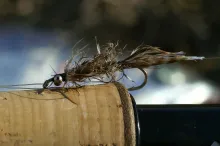
A wish for a generic bait imitation was what made Kasper Mühlbach develop a fly, which he originally dubbed the Epoxy Triumph; A small epoxied baitfish imitation along the lines of the American tradition.
This fly was since modified a bit, and is now the Epoxy Miracle.


We don't often see traditional epoxy baitfish imitations used for Baltic sea trout. That can be a surprise since the fish are known to feed heavily on sand eels and other slender baitfish.
Most sea trout fishing is done with streamers or Woolly Bugger like shrimp imitations - or one of a selection of a whole spectrum of flies. We just see very few baitfish imitations in people's fly boxes.
The epoxy flies we see come out of the US are often fairly big, meant for stripers, bluefish, albacore and other large predators, which chase bait in the surf. Flies with lengths up to 5-10 inches are not rare, and that might be one reason why the style never caught on here.
We need flies a lot smaller. First of all a lot of our natural bait is only about 2-3 inches in length - even smaller - and secondly we fish light rods, not rarely down to 5 weights. This severely limits the size and weight of flies suitable for sea trout fishing.


But the wish for a bait imitation was still there and that is why Kasper developed a fly, which he originally dubbed the Epoxy Triumph; A small epoxied baitfish imitation along the lines of the American tradition.
This small and light generic sand eely imitation did well for him on one of our annual Bornholm trips. He had tied it up in different variations, and after a bit of adjustments and tunings it slowly developed into what we today refer to as the Epoxy Miracle.
It's not that miraculous, but an excellent fly with very good imitative capabilities and a low weight, which makes it easy to cast. The fly is amazingly mobile in the water in spite of its synthetic materials. These materials in particular makes it shed its water easily when hauled out of the water for a new cast, enabling us to easily control it on a light rod.
The fly comes in a number of variations, but three have become stable patterns: olive, dark and light grey. All three are very close to the sand eels that we see by the thousands here sometimes, but still general enough to pass for almost any small baitfish or fry.


The fly has proven its worth on may trips and has produced some nice fish. As a paradox it might be mentioned that small fish in particular seem to like it. This is not a joke or a lame excuse for us catching too many small fish, but actually small fish sometimes seem dumber than the large ones, and spin fisher will testify to that small sea trout often go wild on their rather large plugs. So if you run into a school of smallish fish and start hooking up regularly, leave the area and spare these toddlers the agony of having to bite over something close to their own size - with a hook in it!
See the tying steps below

|
|
|
|
|
|
|
|
|
|
|
|
|
|
|
|
|
|


- Log in to post comments




I saw this pattern f
I saw this pattern from a friend who got it from this site. So I tied some on a size 12 hook to try on trout and it works great on brown and brook trout.
Thanks Kasper. I hop
Thanks Kasper. I hope I'll be back in Denmark as soon as possible.During our last trip I prefered shrimps to epoxy miracle. It is time to give more time to epoxy miracle.
Pike,
good to hea
Pike,
good to hear! Keep going.
Kasper
A couple of days bef
A couple of days before I caught one sea trout on this fly. I was not able to catch fish for whole day so I tied this fly (blue type one) on my tippet and in ten minutes the fish around 45 cm was on.
Yeasterday I tied on
Yeasterday I tied one epoxy miracle fly and it was not so difficult tying acording to the Kasper' s instructions.Polar fibre is very good material and I really like it.
John,
I'm sure th
John,
I'm sure this fly would do fine for pike. My only problem with this fly and pike would be that it takes a lot of work and that pike typically shred flies quite severely. Apart from that I'm sure it would work in sizes a bit larger than the ones shown here.
Martin
Dear Martin,i am exp
Dear Martin,i am experimenting with your fly and was wondering if anyone has used them for fresh water Nortern Pike in varied colors that may appeal to them.Any comments would be appreciated...
Thanks John
I have caught so man
I have caught so many sea trout on this pattern over the years especially in spring.
It's a pattern I am confident in using.
No matter the quarry, by adjusting the size, I am sure it would work on all species.
Rip
Just discovered this
Just discovered this site and all most fell of my chair when I came across this fly. I have been using a fly very similar to this that I developed from the Bunny Belly Anchovy for Bass fishing in the UK. The only difference is that for the underside of the fly I use Fox tail as I believe this does not foul as much as the Polar fibre. This fly has become my fly of choice for Bass and has been very successful taking many Bass together with Pollock and Mackerel. However despite the presence of Sea Trout (some very large) and Salmon I have yet to get a take from these fish (using any fly).
This pattern would b
This pattern would be better adapted to Great Lakes Steelhead fishing if the tyer used a nickel plated, brass barbell weight on top of the hook. Use a holographic eye on the end of the barbell (grind down the rounded profile if necessary) and tie the entire pattern, upside down.
The barbell will cause the fly to ride, hook point up similar to a Clouser minnow.
The trick is to use this technique (pausing for a sip of Glogg) and create a fly that rides with the hook in a position so that when their is a strike, the fly lodges firmly in the corner of the mouth of your prey.
Also, try holographic silver tinsel on the body for more flash and sparkle. It will make the fly seem more alive.
BTW, I really believe in using a Mustad, downturned eye on this pattern. Because if you tie it as I have described the downturned eye uses the weight of the barbell to cause the hook to ride hook side up and will use the down turn as the flat stationary position from which the hook can be leveraged (again think fulcrum and lever) using the barbell.
Thats my two pence worth.
I have had seatrout
I have had seatrout take short like this, but I have noticed that they hook better if the head of the the hook is bright red. And even better is a flying treble on the baitfish imitation and the shank of the treble also bright red.
Bass Fisher,
I se
Bass Fisher,
I see no reason why this fine little baitfish imitation should not be able to catch a bass. Give it a try and let ud know!
Martin
I fish heavily for b
I fish heavily for bass. Would you reccomend this fly on rivers?
Ole (and Hans),
I
Ole (and Hans),
I haven't caught hundreds of fish on this pattern, and neither has Kasper, the originator, but in spite of this I am quite certain about the fact that "nibbles" and missed strikes are not due to the length of the fly and the placement of the hook, but caused by the way that some fish don't strike the flies, but rather tests it or merely touches it.
This is of course a pure theory on my behalf because I only have some loosely formed ideas about how the fish actually behave when they follow a fly and open their mouths over it. From my fishing for trout and other species, my guess is that a fish, which really wants to swallow a food item, does not hesitate or nibble or taste - it swims forward at a fast pace, opens its mouth widely, sucking in the food, and often turns away after that. This I have seen on videos showing fish taking dry flies on the surface, saltwater fish taking streamers and bass and pike striking lures.
If the fish does this with any fly, long or short, it will hook itself.
Think of some of the flies used for other fish: sand eel imitations for striped bass, long streamers for pike not to mention the long, green string flies used for barracuda. These flies can be up to 20-30 centimeters long (almost a foot!) and still the fish manage to get hooked.
I have caught very small fish on the Epoxy Miracle and they were very well hooked indeed. Look at the picture in the article. This has happened to me several times. So I believe that larger fish will have no troubles at all swallowing this relatively small fly and getting hooked on the hook.
Martin
Dear Martin,
tied
Dear Martin,
tied also some of the epoxy flies as mentioned in this article. Two questions came up:
A) Due to the length of the hairwing/tail the hook is located in the first half to quarter of the fly. I think you fished this nice fly already a couple of times. Did you ever experienced due to the length of the tail/wing a higher rate of "ineffective" attacks?
B) Do you put on first the eyes or first the epoxy?
Happy new year,
Ole
I experienced many t
I experienced many times, that these sea trouts were just "nibbling" my ( SMALL ) flies ! Unable to hook them. I would think that you would get lots of mistakes in the long tails of these flies ! Do you recognise this ?