
Wooly buggers are one of the all time most effective fish catching flies. However, if you think you need heavy tackle and lots of lead to get them to work - think again. Peter Frailey tells about his "Baby Buggers", and how well they cast and fish.
Building a Better Baby Bugger
The Woolly Bugger is one of the most effective and versatile flies ever conceived. My wet-fly box always contains several size 6s in the original colors and materials. Each is tied with a black marabou tail, 8-12 wraps of lead wire under an olive chenille body, and a black rooster saddle feather. Tied on a 3xl hook, a size 6 is generally the largest size with which I chase trout and fresh water bass. Wonderfully simple, this recipe is likely to be one of the first attempted by new tiers, and it can be tied in an infinite number of color combinations.

But for me, this leech-looking fly is definitely not a joy to cast. Most of my freshwater fishing is with an 8 or 9 foot 5-weight rod, and chucking a weighted size 6 Woolly Bugger down and across a river is not exactly a relaxed or smooth operation, especially in wind-assisted conditions.
In contrast, I have found that a size 10 casts very nicely, and turns over smoothly on the end of a 4x tippet. If you buy your buggers you know that size 10 is usually the smallest size available. However, with a few modifications Woolly Buggers can be incredibly effectiveness in even smaller sizes. Hook sizes 12 - 16, in 2x or 3x lengths, make delectable "Baby Buggers", and the smallest of these turn over smoothly on a 5x or 6x tippet, and can be cast enjoyably on lighter rods.
Small buggers benefit from modified recipes. Starting with size 10, I tie buggers as small as size 16 using alternate materials. In his book "No Hatch To Match", Rich Osthoff offers the recipe for one of his favorite prospecting flies, a size 12 Soft Hackle Woolly Worm. Rich uses a clump of rabbit fur for a tail, a dubbed body, and two or more webby hen neck feathers for a soft but densely hackled appearance. Because the photo in his book shows a tail of about the length of the hook shank, I believe he has actually tied a Woolly Bugger, not a Woolly Worm. But, no matter what the name, he has created a very buggy and seductive fly.
The recipes below have proven themselves time and again. Although I have indicated a range of sizes, if I had to choose one size to be my favorite it would be size 14 3xl for trout, size 12 2xl for smallies and panfish, and size 10 3xl for largemouths. One final note is that the recipes call for hen neck feathers rather than the traditional rooster saddle feathers. This is because hen is typically softer than rooster. Either way, rooster or hen, I recommend stripping off one side of the fibers for a more subtle appearance.


Hook: Size 10 - 16, 2xl or 3xl
Thread: 3/0 Danville (6/0 Danville for size 16)
Weight: 8-12 wraps of thin lead wire and/or beadhead
Tail: Clump of rabbit or other fur. Zonker strips of rabbit fur are available in many colors.
Body: Fur dubbing
Hackles: One or more hen or rooster neck feathers, depending on the length of the feathers or the effect desired. On each of the samples shown here I stripped one side of the feather before wrapping for a softer appearance.


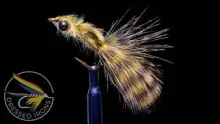
The "Hare and Herl Bugger" is my favorite bugger. I fish it upstream and downstream, and at all other points of the compass. Play around with swinging it, dead-drifting it, or stripping it. Tied on a size 14 3xl or size 12 2xl hook, this is the most versatile wet-fly I have ever used.
Hook: Size 12 - 16, 2xl or 3xl
Thread: 3/0 Danville (6/0 Danville for size 16)
Weight: 8-12 wraps of thin lead wire and/or beadhead
Tail: Clump of rabbit fur
Body: 3-4 peacock herl fibers and 2 black Krystal Flash strands, twisted together to make a durable chenille rope
Hackles: Dun colored hen neck feather with one side of the hackle stripped off


When wet, ostrich herl makes a slender yet motion-filled body. A bit more fragile than peacock herl, I like to use a wire rib to fortify this fly. Ostrich herl comes in many dyed colors, so there's plenty of room to experiment.
Hook: Size 12 - 16, 2xl or 3xl
Thread: 3/0 Danville (6/0 Danville for size 16)
Weight: 8-12 wraps of thin lead wire and/or beadhead
Tail: Bunch of ostrich herl fibers
Body: 4 strands of ostrich herl. Tie-in point is the front of the shank. Wrap rearward and then forward to form two layers.
Hackle: Hen neck feather with one side of the hackle stripped off
Rib: Fine gold wire, counterwrapped
- Log in to post comments



I have tied & used
I have tied & used these for the last couple of years. Using a 14-16 hook, but I also make my tail just a little bit longer. Even when I tie a #10, have found that making the tail just a little bit long and putting some flash in it that I have had exceptional luck.
I love the baby bugg
I love the baby bugger I find that the yellow and white baby bugger in size 16&20 work best in fall.
A valuable contribut
A valuable contribution for folks teaching beginners tying .
I like the idea of s
I like the idea of smaller Wolly Buggers,will get more hook set
Thanks Dennis Taylor
I've started tying t
I've started tying these "baby buggers" with rockchuck tail fur for the tails, makes for some interesting looking patterns, and the fish love them.
woodchucks are getti
woodchucks are getting scarce used to be able gather them as roadkill.
Fran Betters of the Wilmington area used to practically eliminate the woodchucks from the Adirondaks. He used Woodchuch in just about every fly he tied. You probably heard that Fran is no longer with us, he passed this spring, and is probably seeking
trout in heavan. If there are any there I am sure Fran will locate them. We will all wish him luck and miss him very much.
I've used Chris Helm
I've used Chris Helms predator as my starter fly in all our classes and at conclaves over the past 9 years but after this article and reading Woolly Wisdom the woolly is going to be the starter fly once again when in Jan we begin teaching our art to the 6th--8th grades in our charter school here in the Villages of Florida.
whats a good w-bugge
whats a good w-bugger for fall browns?maybe a zugg buggy looking one ??
Ken,
The pictures
Ken,
The pictures seem to work fine... can't you see any pictures or can't you click to see the larger versions?
Can you see these pictures below? They are taken directly from the links in the article...
Martin
I am unable to open
I am unable to open the pictures. Any suggestions? Thanks.
1st fly i ever tyed.
1st fly i ever tyed. brown in color. looked ugly, BUT i used this very fly in california, in the western foot hills and limited out in 30 minutes.(5 fish) Yes i am a believer.
Another good article
Another good article on a simple but good fly,wooly buggers can be changed up in so many differnt shapes,colors,sizes,and lengths,add rubber legs and you add a whole new fly for bass,and panfish,many times when all else fails in the fall I fish a all black unweighted version with a small trailer fly off the bend of the hook using the swing method of fishing with great luck.My friend and I coin the phrase "BUGGER BASHING" buggers work for all types of fish I've got a lot of large fish on small streams,using size #10-14 buggers black ,olive,and brown buggers use a loop knot to add a whole new twist to the action.
Whoopy Doo for the w
Whoopy Doo for the wooly buggers! This year we have been fishing high country lakes in Canterbury New Zealand for browns and rainbows with bead head buggers in green, black, yellow and hot orange. In cold water fish deep, in warm water fish top layers with a fast strip and in hot go down deeper still and slow. Results an average of 6 fish per person per trip, best brown 8 1/2 lb best rainbow 5 1/2 lb. They just love em!
Beautiful flies! The
Beautiful flies! These small wooly buggers (we call them leeches) also work very well for brown trout and grayling here in Finland, Europe. I always use marabou for the tail but having seen these patterns I think I should give a try to the fur tails... Being lazy, I sometimes tie them even without the hackle - with no impact on fishing.
Frome: E. Straitiff
Frome: E. Straitiff -straitiffedward@yahoo.com
I live on the White River and Norfolk river here in arkansas. The only thing I fish is the wooly bugger in small sizes on a 4 wt 8.5 rod Thay never let me down.
I really like the va
I really like the variations on materials and tying techniques used in this article.
Always liked the woo
Always liked the woolybugger but this article has sold me on making better use of it especially for bass and panfish.Wonderfull well written and illustrated.
Bravo! great pattern
Bravo! great patterns that catch fish,,.I feel naked without a box of buggers!
!!!Excellent!!!
!!!Excellent!!!
I've been tying my own
I've been tying my own buggers in the size 14-16 range for the past 35 years. when i first started fly fishing i noticed the absence of the smaller sizes in fly shops and the difficulty in casting the larger ones with a 4wt rig. i may start the day trying dries or other patterns, but the buggers are my "Go-To" flies. i've caught just about every fresh water fish possible in California and Colorado. in fact, late last night i caught my first walleye here in CO, on a green bugger with black hackle and tail. the smallmouths seemed to be fond of this pattern, along with a bead head bugger in brown. people passing by kind of trip out on me fly fishing at night, but it seems to be the best time for Smallies, walleyes and brown trout. the larger browns that don't come out during the day, just love the dark buggers at night. makes me wonder why i fish any other pattern.
muskrat is one of my
muskrat is one of my most important base mixing furs,mix it with purple haze lite brite in a dubbing loop tied as a wet fly. comb out with a stiff brush, add teal blue marker pen, fading front to back very litely. brush out, colors will explode with a rainbow of shades.the fly above needs to be finished with a thorough brush out, the barrel effect on the body should be almost equal to the tail in effect. under body base should be tied onto wet super glue, as should the head, my flies do not ,come apart.