
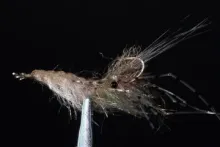
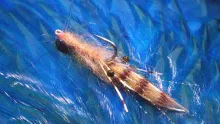
Shrimp patterns are always fun to tie. These salt water imitatoins are easy to do and fish well. Martin Joergensen has once again pursued the art of imitating these salt water arthopods - this time utilizing his family's hair brushes! Read the story and find the patterns here.

I used to tie a lot of shrimp patterns. I don't do that anymore. One of the reasons is that I like my shrimp patterns to have eyes, and when it comes to eyes, I always chose one of two alternatives: home made or store bought.
They both have their disadvantages.
Now I'm back on the track when it comes to shrimp patterns.
Store bought vs. home made
- Home made eyes
Pro: they are cheap, close to free, come in any size you want.
Contra: they are a chore to make. You need thick monofilament, a flame, varnish or a marker and time and patience. I used to make a bunch at the time, but my patience failed me. They also tend to vary more in size than you want. - Store bought eyes
Pro: they are uniform in shape and size, less work.
Contra: they are expensive - on the verge of the hilarious. Here in Denmark I can easily be ripped of up to USD 5.- or for a bag containing somewhere between a dozen and 30 eyes. That is too expensive for my taste.


Cheap brushes - cheap eyes. These were bought in a local supermarket at one dollar a piece.
Brush up your smile
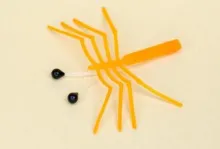
I don't remember when the thought came to me, but the solution to my problem was brushes. Ordinary hair brushes. The 'hairs' of these are generally made out of a stem with a small drop shaped ball at the tip. The shaft can be made from metal or plastic. Lucky for us, the least expensive ones are plastic. The plastic shafts are easier to work with and add less weight to the fly.
If you have a large bulk of hair or have a family member who has, you might already have a good supply of shrimp eyes in your bathroom closet.
If not, these brushes are usually available at a dollar or less a piece. And one brush contains from 50 to 100 or more eyes, bringing the price down to a very acceptable level.
They come in all sorts of sizes and colors, and if you shop around a bit, you can get a huge selection of all kinds of eyes.

The plucked (top) or cut (bottom) eyes together with the doom of the hairbrush. Notice how some brushes come with white tips. Others are colored, translucent or any variation in between. Always be on the lookout for cheap hairbrushes.

Bend the stalks of the eyes to suit your purpose. Some patterns require straight eyes others slant ones.
Cutting up
Creating eyes from a brush consists of nothing more than going berserk with a set of cutters. Heavy scissors or pliers do the job. In some cases you can just pluck the eyes off the brush, where they are inserted into a soft plastic membrane. In other cases the base of the stems are embedded in the handle, and mild violence is the only way to separate the two.
Collect the newly cut - or plucked - eyes in small Ziploc bags and you are ready to tie shrimp or damsel nymph patterns galore without the dreading task of burning mono or the even more dreading task of going to the bank to raise your credit.

- Log in to post comments



I'm thinking of a better way
I'm thinking of a better way to make the eyes for shrimp......
This is what is in the works...... mon. line.... take a very small bead[like salmon egg]
use the epoxy ...glue to line ....dip in black enamal paint...last coat.... clear coat
head cement?????????
whats wrong with using nylon
whats wrong with using 25lb nylon and just melt the end with match ...perfect and cheaper than a hair brush
Natural shrimp fly
hi there. wondering if you can help iam trying to get a pattern for the natural shrimp fly i fish for salmon in scotland as thy have banned the shrimp in scotland. many thanks frank
My wife will kill me
very nice, but my wife is going to kill me for cutting up her brush lol
You're a genius!
You're a genius! Hey, I've used orange hay twine for bodies of Salmonfly patterns before, so I appreciate a fellow improvisor.
AWESOME IDEA!
AWESOME IDEA!
I was looking for SOMETHING to use for eyes the other day and this would've been a perfect solution. I ended up using some old Mardis Gras beads instead.
Your brush eye's are a good idea
Your brush eye's are a good idea, I'll make some up to use on my crawdad pattern. Thanks for the tip. Walt