
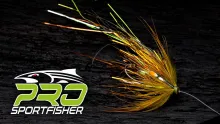
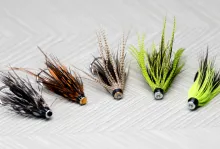
The Sunray Shadow is a true killer fly for salmon fishing. Tied on a tube with a wing and no body, simple as few flies, but still - or maybe rather because of that - extremely efficient. The fly uses few materials and is very easy to tie.
With the salmon season coming up in many parts of the world, I thought that a genuine salmon fly would be an appropriate thing to publish. And since there is a chance that I will be fishing for salmon this summer, I could whip out a few flies for that use at the same time.


Simplicity
I have always liked the Sunray Shadow. It's an extremely simple fly based on a very simple concept. It does what it's supposed to with a minimum of extras. The fly is basically a long, black wing on a tube, but with a stiff underwing to keep it from hooking itself and a visible top to add a little flash.
Ray Brooks' original was invented in Norway on the banks of the classic salmon river Laerdal. It became so popular and widespread and proved so efficient that the story tells that Brooks had it patented. I haven't been able to verify this, and I must say that the whole notion of patenting a fly pattern - and in particular one this generic - makes little sense to me. But that's another story.
No matter what, this fly was highly successful and has now spread all over the world and is tied in a wealth of variations.


The original
Originally Brooks tied the fly with three materials: white-tipped squirrel, monkey hair and peacock herl. The stiff squirrel would lift the long wing free of the hook, the monkey would create the very long and mobile wing and the herl would accent the fly. A US friend of mine often says: any fly with peacock herl catches fish, and this pattern has proved him right again.
The Sunray Shadow is essentially a souped up Collie Dog - perhaps the ultimately minimalistic salmon fly. It is just a bunch of black hair from a Border Collie's tail on a tube, devised in the UK sometime in the eighteenth century.
Brooks added one functional material to this (the stiff underwing) and some flash (the herl) and got from that the Sunray Shadow.


Speaking of dogs
One of the reasons that I found the Sunray Shadow a suitable pattern for my own tying, was my dog, Divus (Portrait of a fishing dog).
He might not be a Border Collie, but being a Shetland Sheepdog, he is pretty close. And while a Border Collie has suitable hair in the tail only, Divus has a whole body covered with Collie Dog and Sunray Shadow wings. Many a fly tyer has run his fingers through my dog's fur and gathered it into small bunches the size of a fly wing. But every time Divus has walked away with all his hair in place.
I, on the other hand, have the privilege of being allowed to actually take my scissors and cut a bunch! Not that I have asked the family for permission, but no one can see any difference as long as I don't start a wholesale production of flies.
Monkey, goat, dog
Brooks' original was utilizing hair from the black and white Colobus monkey, which is a fairly common and widespread African monkey with long, black and white, shiny hair. But monkey hair is both hard to find and politically very incorrect to use. And there is a large risk that is has been obtained illegally. Most monkeys are protected, and getting a hold of their skins mostly means sourcing it from monkeys in captivity. The black-and-white Colobus monkey is a protected species listed under Appendix II in CITES, and requires special permits to be traded.
For us fly tyers all this means: look for substitutes. If you don't have a black and white Sheltie at hand, goat seems to be the best bet for a monkey hair substitute. I do have a piece of black goat skin with hair, which is very similar to both the monkey and the dog, and I have tied flies with that too. It works just as well.


Tying it
The Sunray Shadow is not exactly a big tying challenge, and if you want an entry point to tube flies, it gets no easier than this.
Tie the fly on a 1½ inch plastic tube. Mount a tube fly holder in your vice. You can use a tool made for the purpose or use a large needle or a large blind salmon hook to hold the tube. More in Tube Fly Tying Tools and The tube fly needle.
Press the tube over the needle until it sits tight, and start the thread right behind the front collar of the tube and cover a small bit of the tube, no larger than the size of the head on the final fly. Some tubes come with no collar, and on these you can melt a small collar by holding the tube into a flame. Leave the rear end of the tube as it is.
Tie in a small bunch of squirrel or bucktail slightly longer than the tube. Top that with the goat hair, which should be about 4 inches long. Finish the fly with a couple of peacock herl over the wing.
Create a head that covers all the butts, whip finish, cut the thread and varnish a couple of times.

Weight
The plastic tube Sunray Shadow is quite light and in order to get it down in fast water you will need a sinking line or leader. Alternatively you can tie the fly on a heavier tube or you can add weight to the fly in the form of a conehead.
The best way of adding the conehead is to melt a collar on a thin inner tube and pass it through the main tube from behind. Slip the cone over the protruding inner tube in the front of the fly, add a drop of instant glue and press the cone until the glue binds. It only takes seconds. Then trim the tube a bit in front of the cone and melt a collar to secure it completely, The method is illustrated here.
Alternatively you can cut a ½ inch piece of thin inner tube. You need tube that fits snugly inside the cone as well as the main tube. Melt a collar in one end and slide the conhead facing forwards onto the tube. Add some instant glue to the outside of the tube, let it seep in under the conehead and slide the thin tube into the main tube, making sure that the conehead sits tightly against the front end of the fly and partially or fully covers the head of the fly. The latter depends on the size of the conehead and the size of the head on the fly. The glue binds in seconds and the conehead should be secured. The method is also illustrated here.
Another option is of course to tie the fly on a heavier tube like a bottle tube or a straight aluminum or copper tube as illustrated here. This will add a lot of weight to the fly itself. But many seasoned salmon anglers will prefer a lighter fly fished on a sinking line over a heavy fly on a floating line.


Fishing the fly
The most usual way of fishing this fly - and any salmon fly for that matter - is by casting it downstream and across, mending the line to let the fly sink and then just letting it swing across the current towards your own bank. The fly will work with the microcurrents in the water and thanks to the long and soft wing be very much alive. Some salmon anglers like to gently move the rod tip, inducing even more movement into the fly.
You can also mend the line upstream as the fly moves to decrease its speed and even make it sink a bit or mend downstream to speed it up, which will often elevate it a bit in the water column. No matter what you do the speed of the fly across the current will typically increase towards the end of the swing, and many salmon anglers experience that the fish will strike as the speed peaks and the drag in the rod is highest.
A less traditional way of fishing the Sunray is by casting it upstream and letting it sink. Since there is no drag from the line, the fly will sink faster this way, and you will be able to fish a lot deeper than on the downstream swing. Remember to keep contact with the fly when fishing upstream, enabling you to set the hook if a fish should strike the fly on the almost slack line.
- Log in to post comments



I had never used this fly
I had never used this fly but decided to give it a try on a very low Aberdeenshire Dee. I could see pleanty of fish in the pool, but they were not really interested in normal flies fished in a normal down and across method. Rules for the pool say no weighted flies, maximum hook size 10 and floating lines only. So, on went a 4" Sunray dressed on a 1" plastic tube and, unfortunately, a size 12 single as I could not find any size 10's.
What followed was my best days fishing. I hooked 10-12 fish, landed 3 salmon to 12 pounds and a sea trout but lost two very big fish due to the hook pulling after a few minutes. The fly was cast square and stripped back and I rose far more salmon than I hooked. Seeing a double figure Salmon chasing a fly is amazing and great fun!.
Next time I will make sure I have slightly bigger hooks!
Great fly indeed, and so simple to tie.
The best black hair
The best black hair legally available is fine shiney hair from a young Asian girl.
Just go to a salon and ask the beautician to save you some. I have used this hair
For years and caught sea runs, Atlantic salmon, and steelhead all over the world.
It is by far my #1 most productive fly in various sizes for these fish.
Hi out there!
Hi out there!
I am proud to have known Ray Brooks, back in good old days when the famous Laerdal River was still one of the best and famous rivers in Norway. He was a great salmonfisher and person.
The famed Grimersta River
The famed Grimersta river (In scotland) record was just broken last week, 20th September 2010 (previous record stood since 1900's). Fish of 32lb caught on this fly by a lady angler, and returned.
Enjoy your site
Martin:
Enjoy your site. I have a neighbor with two Shetland Sheepdogs - probably be looking at them a little differently now.
Cheers.
My six year old daughter
my six year old daughter looked at my fly boxes with a multitude of different flies inside, including a few sunrays, and said, 'dad, they will take anything' i think she might be right
A lot of hair types
Ask,
A lot of hair types are 15-25 centimeters. The original monkey hair, goat hair, certain types of bear hair. Even my dog's hair is up towards that length.
Martin
which hair
wich hair would he tie the 15-25cm fly with ??
Dog, Cat, horse
Martin, Dog, Cat, horse mane... When we brush our long haired cat, Princes, I save the fur, tie with it and call these "Princes Flies!" I've been wanting to get a couple of those "Long Haired" dog they show on the Dog Shows [one black, one white, one brown,.....]. Ever thought of going to the "Dog Groomers" and collecting the "Cuttings of the day." Yes, you would have to wash it, dry it, but what a good source of "dubbing" and tails. What do you think???
Keep your line wet, man.
In His Love,
Clyde
Neat and versatile
Hi Martin, what a neat and versatile pattern. I have tied tube flies before but always had a problem adapting them to single hooks (where I live we can only use single hooks). Your pattern has obviously solved this problem. This fly pattern could be made more versatile by adding various coloured underbodies to the hook shaft. I can hardly wait to try this pattern out.
Tight lines,
Herb
Thanks
Martin,
Thanks for the well thought out article, it has my mind whirling. I have made a connection between this bare tube fly and the simple tube and hook we use in the northeast to catch Snapper Bluefish. I'm wondering if there isn't a similarity between them. I know that the tube(in Snapper fishing) acts as a flashy 'bubbler'. Perhaps this open tube creates the same aggressive response. I'll try it on other trout streamers to see.
By the by...if you are a flea market hound, you will occasionally come across a short jacket from the 40's which is made of Monkey fur. I have passed them by before, but now will grab one if I see it.
Thanks again, tim
Useful dog
Martin, be happy with your useful dog. My own dog is styled in a light brown colour, handsome when tying saltwater and all kind of trout and salmonflies .
Big coincidence
Hi Martin, big coincidence. Some month ago, I published a tying article about of "Sunray Shadow". Look: www.riosysenderos.com/baul/sunrayshadow.htm (link is dead)
Excelent fly to Rio Grande, Tierra del Fuego.
Regards,
Carlos
The Sunray Shadow is a fantastic fly
The Sunray Shadow is a fantastic fly when fished on a floating line riffle hitched or made with a hole in the side to make it skate across the surface! The salmon of the Northern rivers of the Russian Kola Peninsula love it! that way.Very visual takes.Fish it with a downstream mend to speed it up as well.
Tønjum beat
Martin, we fished the Tønjum beat of Laerdal last summer and Mark Brooks (Ray Brooks son) showed us around and advised us about which flies to use and how to fish them. Needless to say Mark more or less only fishes the Sunray but slightly different to his fathers original (published?) pattern namely blue/black and not white/black. Also the Sunray's he uses on Laerdal are enormous - at a guess I would say 20-25cm long!! Mark ties them on plastic tubes and fishes them on a sink-tip line. Last season he took one 17.4Kg salmon in Tønjum and a monster of 19Kg higher up on the last day of the season - both on a ....
... blue Sunray.
Stuart