GFF logo


First published January 29th 2006 - More than 2 years ago

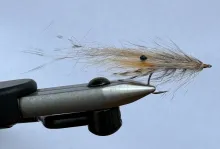
The Junior Mysis

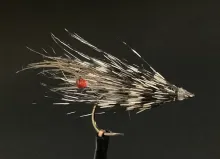
A mysis/shrimp imitation

By Kasper Mühlbach

I like patterns, which somehow imitate what sea trout prefer for dinner. Sculpins, sand eels, shrimp and mysis are often found during an autopsy.

Some years ago, Ken Bonde Larsen showed me a fly, which looked interesting. It was white and the dubbing extended in all directions, but in the water it looked amazingly different.
In a magazine an article showed a technique called "the aura technique" where the thread was dubbed and looped. A second and lighter dubbing material was added in the loop. That looked interesting too and when I read an article about mysis and studied some by myself I tied The Junior Mysis. The result was maybe more a shrimp than a mysis imitation.
So the inspiration to this pattern came from many places, and to claim that it was purely my idea might be overdoing it.


I do not remember what I first called it. On a trip to Bornholm, where it (I) took some good sea trouts, my friends called me "The Mite" which was transferred to "Junior Mite", because I am the youngest member of our Team Bornholm. From there the name went to Junior Mysis, which I think is a very appropriate name. It goes something like this:

Materials
HookTiemco 200R og Kamasan B220 size 6-8.
Thread8/0, olive.
WeightLead free
TailAngel Hair, holograpic gold.
Mouth partsMarabou, grizzle.
EyesMelted nylon or FlyEyes, medium, black.
Body, rearRabbit dubbing, olive tan.
BodySquirrel dubbing, olive and SLF dubbing, white.
HeadRabbit dubbing, olive tan.


Tying instructions
  1. Add weight 6-10 wraps. Secure it with some super glue
  2. Tie in 6-8 strands of angel hair as tail.
  3. On top of the tail, tie in a bunch of short marabou or use the fluffy part of a grizzle hackle - the part which is often being thrown out..
  4. Tie in a pair of eyes. Align them against each other.
  5. Dub the thread with rabbit dubbing and dub the eye base, forming a little ball.
  6. Now, wax the thread. Dub 10 cm with squirrel dubbing and make a dubbing loop. Put white SLF in the loop. Make sure to have the most at the top and less at the bottom.
  7. Spin!
  8. Turn the dubbing loop towards the eye. Stop 2-3 mm from the eye
  9. Form a nice little, but long head af rabbit dubbing.
  10. Whip finish


Want to comment this page? Fill out the form below.
Comment
Only comments
in English
are accepted!
Your name Your email

All comments will be screened by the GFF staff before publication.
No HTML, images or links, please - we do not publish such comments...
And only English language comments will be published.
Name and email is optional but recommended.
The email will be shown in a disguised form in the final comment to protect you against spam
You can see other public comments on this page

If you want to submit a private comment, not for publication, use this form

 
Did you find the above interesting?
People who looked at the above also looked at these pages:

Tie a muddler

Martin Joergensen: "One evening when I was tying flies with a co...

Blend your own dubbing

Almost everyone has the right stuff at their tying bench to make...

Applying dubbing

Dubbing must be said to be one of the most universal fly tying m...

Rasing chickens

From feathers to chickens - and back again You don't need to ra...

The new list of books

Our list of book reviews.
This other story related to "imitations" might also interest you:

Pete's EZ Hopper

Patterns: "...once they broke the surface film, the butts would tilt down and the head and shoulders would be the only part of the grasshopper above water. They neither rode high in the water, nor lay in a horizontal plane. My thought was to design a hopper that would duplicate that presentation." Read more about Peter Frailey's EZ Hopper. Go to the story

Click to see other stories with the keyword "imitations"

A few random articles for your entertainment

A Global Fly Fisher Publication
Copyright © 1994 - 2008, Joergensen/Petti/Schweitzer/Skehan
Portions of this site copyright © the contributors. All rights reserved.
This material is for personal use only. Do not distribute without prior written consent from each copyright holder.
Comments and suggestions are welcome