
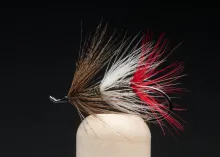
Pike fishing requires large flies, and they are not nice to cast! GFF partner Martin Joergensen has improvised over some well known salt water patterns and made them into a fly, which is light, large, easy to tie and still acceptable to cast on a 7 weight rod.
Simple to tie, easy to cast, perfect for a large pike to shred!
The Splayed-A-Live Pike Fly (sometimes just Splayed-Alive) is really a general idea more than a pattern - and not even a very original one. Basically this is a Stu Apte tarpon fly or a Seaducer that has gone pikey.
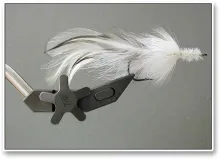
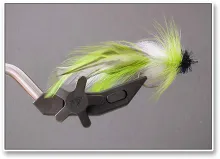
Pike flies are not a critical matter even though some might say so. I have caught pike on the most unlikely of creations. My guess is that pike prefer large and visible flies, fear almost nothing and are not exactly intimidated by some of the non-naturalistic critters we might cast at them.
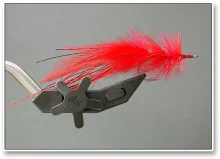
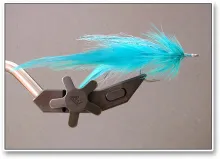
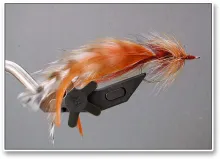
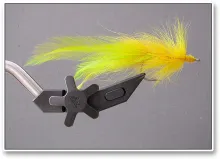
Stu Apte goes pikey
This particular fly was created in an effort to make something from natural materials that was not too cumbersome to tie, but still had some human appeal and aesthetics. If it wound up having some pike appeal too, well I would be the last to complain!
The fundamental parts of this fly are the splayed tail and the heavy hackle - a trait borrowed from the many tarpon flies, namely the ones originated by Stu Apte. This manner of tying gives volume, action and shape without having too much material. One problem with large flies and natural materials is weight. Because of this you want to limit the amount of material as much as possible.
Not a pattern but a template
The Splayed-A-Live Pike Fly is not exactly a precise pattern, but more a general manner of tying flies that will yield volume and light weight. The fly type is very functional, and basically consist of five materials:
- Support for the tail
- Tail
- Support for the hackle
- Hackle
- Head
Some flash might be added in the tail if desired. I usually add a few straws in a suitable color.
The hook
Selecting a hook for pike fishing might seem trivial, but can actually be quite troublesome. The hook needs to be large and light at the same time. The flies call for a lot of space and the large pike call for sturdy hooks with a large gape.
Selecting your average salt water hook will leave you with a lot of weight, and you do not need the strength. Pike are not tarpon after all - even though some of them seem to think so.
I personally prefer hooks such as the Partridge John Holden (S3) in the larger sizes and the Ad Swier Pike Hook (CS43) from the same company. The latter is only available in two sizes and might seem a bit strange in shape, but trust me: it works!
Other suitable hooks are various stinger hooks and I also have quite good experiences with some cheap, black enamelled "salt water" hooks labelled Aberdeen (not the new partridge ones!) that I once found at bargain price. I bought a whole bunch, but unfortunately I am running low in stock these days.
Select a fair size - 1/0 to 4/0 is usually suitable.
Materials
| Tail: | A small bunch of bucktail, deer or similar stiff hair. Four soft rooster saddle, strung hackle or similar feathers. Optional: a few straws of flash |
| Body: | Underwool from hair or coarse dubbing |
| Hackle: | Two feathers, as tail |
| Head: | Flash chenille or flash straws |
Select materials that match each other colourwise. I have a couple of good combinations that I love: white/grey and white/chartreuse, but many other colours will work. Many pike fishers prefer yellow, orange or red flies.
Tying the fly
- Prepare a small bunch of hair by removing the underwool and lightly hand stacking.
- Tie in the hair to support the tail and keep it from turning around the hook bend. Length is as hook shank or a bit longer.
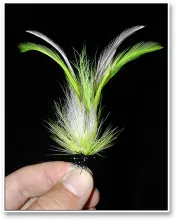
- Prepare four feathers in pairs. Remove plume to a suitable length, about twice the shank length or more
- The feathers can be varying sizes and colours as long as they are symmetrical two and two
- Pair two feathers and tie them in on the side of the hook shank, dull side out. Put the larger feather (if any) on the inside.
- Repeat with the two other feathers on the other side of the hook.
- Varnish or glue and cover the butts with thread
- Dub the rear half of the hook shank with a liberal amount of rough dubbing.
- Prepare two feathers for hackling.
- Tie them in by the butt, dull side facing towards the rear of the fly.
- Wind them simultaneously forwards in tight turns while stroking back the fibers. The should cover about half of what is left of the shank.
- Tie off and trim the surplus.
- Cover the remaining hook shank with dubbing, chenille or flash wound around the tying thread.
- Form a small head, whip finish and varnish or glue.
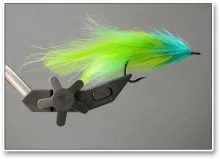
The bite tippet
I prefer to mount these flies with a bite tippet of thin piano wire or similar from home. Cut off a suitable piece of wire - about 30 centimetres or about a foot, Thread it through the hook eye and bend it. Now hold both ends of the wire with a set of pliers and twist the fly 4-5 times. Make sure the fly can move freely and trim the protruding wire butt.
By the water I bend the terminal end of the wire sharply a centimetre from the end and tie the leader onto this using an Albright knot. Tighten the knot using a set of pliers for it to be really tight. Trim the nylon and possibly the wire too.
Thanks to Danish percussion band Safri Duo for the inspiration to the name of the fly.
- Log in to post comments




Doug,
Thanks for
Doug,
Thanks for your comment, and I sure hope you none-fishing friends enjoy the site as much as you seem to! I'm glad you like the site and find it useful.
Martin
Mr. Jorgenson, this
Mr. Jorgenson, this is one fantastic site. I have taken up pike fishing, and the info you provide is outstanding. Also,your gearing up for "looks"is funny as can be. Your fly tying info is great as well. I tell everyone to go here; even people who don't fish! I live in western N.Y. State, USA, and we have plenty roughfish here. Flyfishing for pike is mostly overlooked. THANKS very much.
Randy,
Actually,
Randy,
Actually, I have yet to trash one of these flies because fish have shredded it. I have a few marred ones, but none that were completely trashed. And I have caught pike on it!
On the other hand, I have had a few of the very simple flash type flies (Valeur Pike Streamers and Tinsel Flies), which were literally flowing away in pieces after one pike.
So I don't think the rule is a simple natural materials versus synthetics.
Martin
Nice looking fly but
Nice looking fly but will probably last through about 3 fish. Synthetic materials will allow many more fish per fly. I have tied several patterns using synthetic body fur heads and angel hair tails that have landed more than 30 fish and are still usable.
Has anybody tried to
Has anybody tried to tie this fly on a tube? This could resolve the issue with hook selection and as well adding more volume to the fly.