
Ray Brook's classic the Sunray Shadow can hardly be outdone by any variation of this simple yet very efficient fly. But some people still like to add little details to killer patterns. This version of the Sunray has a body and eyes.

A row tied by Ken Bonde Larsen |
The Sunray Shadow has been a staple pattern in salmon fishing for decades. Its simplicity and efficiency is almost beyond description, and its catches talk for themselves.
It seems almost sacrilegious to try to "improve" such a fly, but in its own modest way the Staring Sunray Shadow can be considered slightly better than the original. Some people will argue strongly against this while others will only put a Sunray Shadow with body and eyes on their tippet. Because that's what the Staring Sunray Shadow is - a Sunray Shadow with eyes and a body.
Ray Brook's origonal Sunray Shadow is as simple as flies come. A wing and... nothing more, actually. The body is formed by the tube and there is no tail or any other fancy appendixes.
The staring version adds a body to give some more glare under the water and it also adds eyes under a small coating of epoxy. I have heard renowned Danish salmon angler and guide Henrik Mortensen say this fly can see where the fish are... That's hardly a fact, but it is a good fly.
As I also said, some people will consider it a desecration of Brook's pattern, but I always carry both the bare and the staring version in my boxes - or rather bags, because I usually keep my tube flies in ziploc plastic bags and the hooks in a small container.
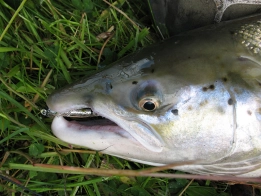
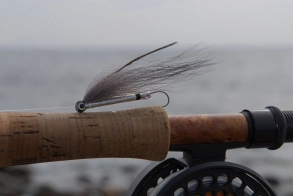
Well, 'nuff said. Here is the pattern and setp-by-step images of Ken Bonde Larsen tying the fly.
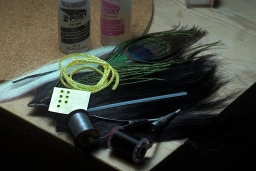

Step 1 - mylar tube |

Step 2 - start the thread |

Step 3 - trim |

Step 4 - ready for the varnish |

Step 5 - varnish |

Step 6 - underwing |

Step 7- trim |

Step 8- first black wing |

Step 9 - first wing on |

Step 10 - after the trim |

Step 11 - flash |

Step 12 - second black wing section |

Step 13 - wing in place |

Step 14 - peacock herl |

Step 15 - ready for eyes |

Step 16 - eyes |

Step 17 - epoxy |

Step 18 - remove |
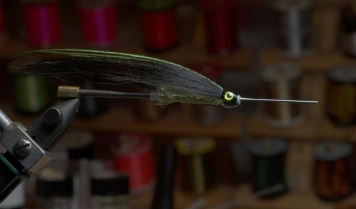
- Log in to post comments



What is the tool you are
What is the tool you are using to apply the eyes?
A knife
Jared,
It's a simple hobby knife. One of those that have a blade you slide out and break off one piece at the time to get a new and fresh tip. You can essentially use anything to place the eyes: tweezers, a needle, a knife like here. Whatever you have and what works for you.
Martin