
Read web site partner Martin Joergensen's report and see the fantastic pictures from his spring trip to Belize after bonefish, tarpon, barracuda, jacks, snappers, permit - and everything else that swims in these warm, turquoise waters.
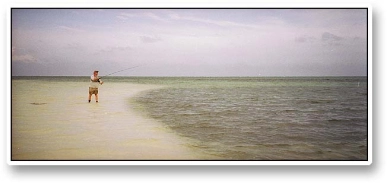
As I enter the water I am again surprised how extremely hot it is. Not only body temperature, but probably well beyond. The feeling is quite different, not least because I am wearing shoes, socks and long legged trousers. Strange but actually very comfortable.
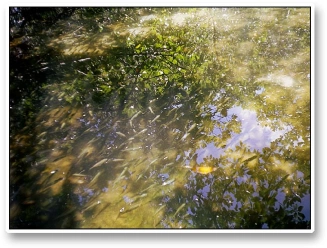
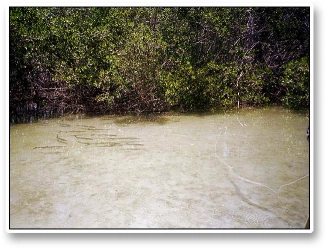
I have seen fish right in front of me -- a school of shadows moving over the light coral sand and mud. Definitely bonefish. The distance is probably less than 15 meters or about 45 feet, but still I have to be extremely cautious. These fish are spooky like nothing else.
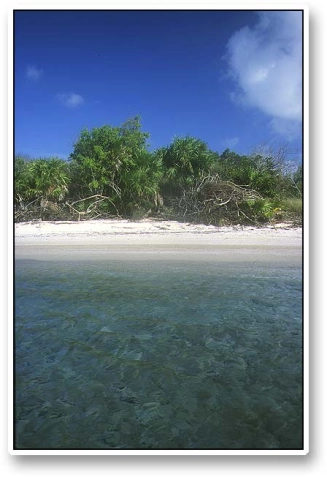
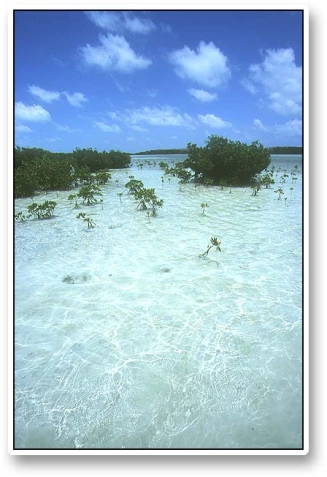
Good angle, bad distance
I prepare for a cast working out line in a couple quick blind casts, estimating the distance, shooting line and letting go. The fish are travelling from left to right and while my angle is great, my distance is not. The fly falls more than a meter or almost four feet short of the fishes' projected path. Surprisingly they are not spooked, but continue their travel towards deeper water. I carefully retrieve and make another cast.
This time I am right on! The fly is light and sinks slowly towards the bottom about 30 centimeters or 1 foot down. One fish turns. Then two. Then a last one. I strip carefully and they increase their pace, obviously competing for this snack that literally dropped from heaven in front of them.
I take three or four short, rapid strips and let the fly sink again. I cannot see the fly, but see the first fish stopping and feel the contact. I slowly raise my rod. Now the fish obviously feels it too. My line is on the water, but only for a few seconds. Once again the force and speed surprises and thrills me. All my casting line is gone in seconds. Not much later the rest of the fly line is gone, and I hear the knot clicking through the guides as the backing starts leaving the reel. The discrete sound of my Waldron reel is soothing to the ears. And the fish still keeps on...
Whoa!
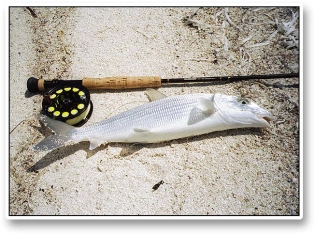
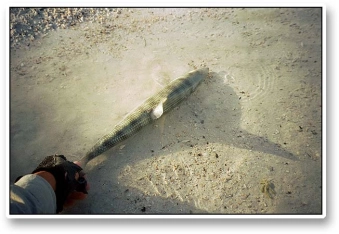
Turbo charged
Bonefish are turbo charged! They burst into speed and steadily accelerate into an amazing jolt of power and velocity. It is equally pleasing every time, and I keep on finding myself wishing for such fish in my home waters. Carp maybe, mullet perhaps, but bonefish definitely!
The fish stops about 40-50 meters away. That is close to 150 feet for the non-metric audience. And this is a small fish! I gain some line, get it on the fly line and into about half of that before it takes a typical second run for freedom. Not as long, but still frightfully strong and fast.
I gain line again. This time I get almost to the leader before the fish makes a few quick bucks, each time pulling off a bit of line. It is wearing itself out. Within a minute I have it in my hand.
Ghost of the flats it is, the bonefish.
A slender, silver, soft-mouthed creature of great beauty. I tuck the rod under my arm, unhook it and hold it for a few seconds before it slowly swims off to join its brethren in the deeper water beyond.
The only substantial evidence left is the slime on my stripping glove. No one was around to see or photograph me. I am alone in what seems to be a tropical paradise.
Ambergris Caye, Belize
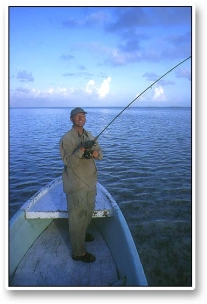
I have been here for about a week, and can look forward to one more week. The past days have been spent fishing from a boat for tarpon and bonefish, but today we have chartered a boat to bring us to a small peninsula close to the town San Pedro, and have been wadefishing all day. The temperature is steadily rising, and now - around 1 in the afternoon - it is as warm as it gets. If I look down, all I see is the shadow of my Global FlyFisher cap.
Opposite most of the area and the locations where we have fished bonefish the latest days, this place is wadable, which feels great after having been limited to the narrow space of a boat for days.
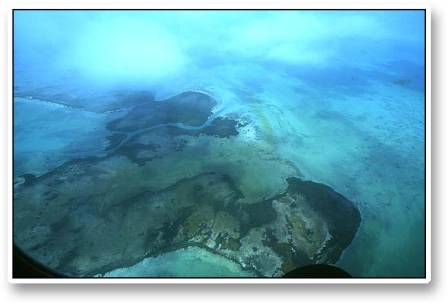
The peninsula is a part of Ambergris Caye and island behind the barrier reef in Central American Belize. Ambergris Caye is a paradise for those who want to enjoy diving and fishing, and even though the tourism has definitely marked the island and its only town, San Pedro, the ambience is still very Caribbean and laid back. We were there in May, which is off season regarding general tourism, but in the high season for fishing. The weather is agreeable, sunny but not extremely warm and usually fairly calm.
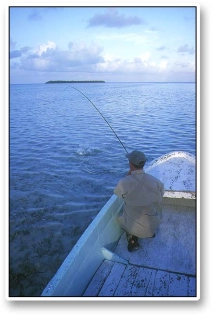
Nada, Nada! The tarpon win again...
The tarpon that (almost) weren't there
While the bonefish have seemed fairly accessible and cooperative the tarpon has not! We have fished for many days and seen an increasing number of fish during our day long trips. Even though tarpon guru Billy Pate says that the tarpon is such a good fish to flyfish for "Because it takes a fly readily", we have not had a single take in spite of countless well placed casts - not least from my friend, shop owner Kim Rasmussen of Salmon Fly in Copenhagen, who is a seasoned tarpon fisher. Even I managed to put a fly close to these evasive fish, but to no avail. They just turned away, totally ignoring the fly every time.
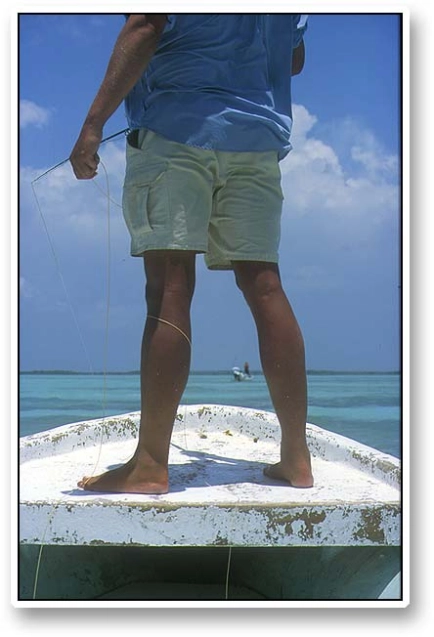
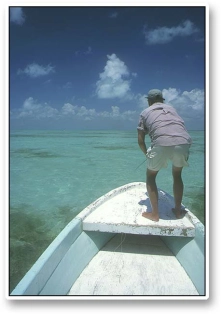
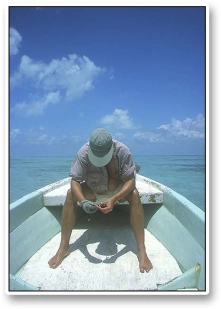
It is a far cry from the frenzy that I enjoyed on the Billy Pate videos that I devoured before leaving. Three or four of them showing fast paced action, stunning runs, spectacular jumps and an ever gum chewing Billy explaining in broad Texan how these fish are the perfect quarry for a fly fisher. "Because it takes a fly readily"… Yeah, right!
Tarpon fishing is not for the impatient. You get about an hour of activity during six to eight hours of fishing. Most of the time is spent standing in the stern of the boat, rod and fly ready, scouting for shadows or rolling fish.
Once spotted it is first up to the guide to maneuver the boat to a proper casting position and then your turn to place a fly within that critical square foot in front of a fish. Neither is easy and neither happens by the minute. Sometimes an hour can pass between casts, sometimes minutes.
We saw between dozens and hundreds of fish during our day long outings. We sometimes had more than one school to cast to, but only experienced a few takes, a couple of fish missing and none properly hooked.
Guides
Severo, Ramon & Manuel
More than excellent guides with their own boats. Not luxurious, but spacey and efficient outboard, wooden flats boats. They all do very good guiding, but specialize in each their field: Severo spots tarpon like no other guide on the island, Manuel is a very good bonefish guide and Ramon does reef fishing with anchovy chumming like no one else. They all follow your every wink, and - as you are paying - you should not hesitate to ask them to show you alternative locations or other targets for your flies if your luck is less than expected. The trips will usually last for eight hours, and you will be picked up and set off where it is convenient for you. I recommend starting early to get the better morning fishing and avoid the heat, which will try seriously to kill you after noon.
The price is US$ 200.- per day, which includes lunch, water and soft drinks.
Contact Severo Guerrero
Six steps
There are six steps to catching a tarpon:
1) Finding it
2) Maneuvering and casting to it
3) Getting it to take
4) Hooking it
5) Fighting it
6) Landing it
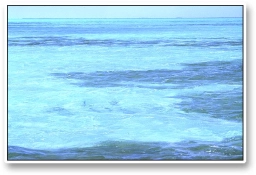
Each step has its narrow chances of succeeding, and we never really got beyond step 3. It seems to me that the closer you get to the final step, the less your chances of finishing that step gets.
Finding tarpon is not easy, but possible.
Getting the boat in position and casting can be difficult, but is doable depending on your skills and the guide.
Hooking it is highly unlikely and depends on casting precision, fly selection and quality, fish' mood and a lot of luck.
As you get towards the moment where you can get a picture taken of you with a tarpon in your hands, chances that luck will fail you, and the fish will swim off to freedom will increase drastically.
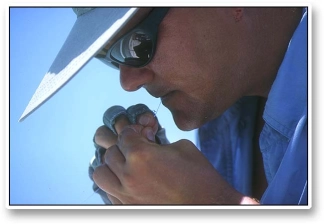
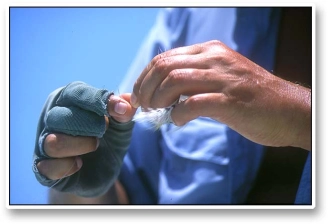
Ignore that fly!
The Ambergris tarpon seemed to have made a general agreement on ignoring flies! These fish were not spooked in the manner that the bonefish were. Sometimes they escaped, but always meticulously slow. Most times they just ignored the fly and turned off, disappearing back into a dark spot or swimming slowly on. The only thing really spooking them seemed to be the outboard motors of the boats, when they raced by or turned back to drift over the flat again.
Watching and chasing these fish is a fascinating game.
You learn to spot them on long distances, learn how they suddenly disappear, how clear you see them when they swim towards you or away, and how ghostly and almost invisible they become when they turn their side to you and reflect the bottom in their silvery scales.
The best time for spotting them is in the morning, where both sun and wind is in your back. In the low sun you can see the light reflected in fins and tails of rolling fish, and later on you can see the shadows as they cruise in small schools up to ten individuals.
A light wind and no clouds is the ideal weather. Just a small cloud blocking the sun will severely ruin your chances of following fish that you spotted while the sun was there.
We headed out at 5 AM in order to be ready at sunup. As soon as the sun approaches and passes zenith, the game tips even more to the advantage of the tarpon.
During our ten days of fishing we saw hundreds of fish, but only had a couple of takes.
Our guide, Severro's, theory was that the fish had been fished too much and were too used to boats, lines and flies. This seems probable. Not because there were many boats, but because of the deliberate way the fish turned down every fly we offered them.
Fish in more remote spots were more willing to take, and we heard stories of fish that were 'jumped' - that is hooked, but not landed - in other areas further south.
As Severro said every day after the tarpon quest: "Nada, Nada! The tarpon win again".
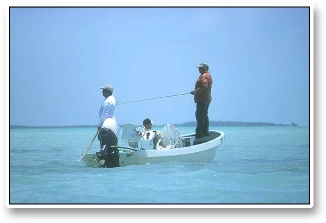
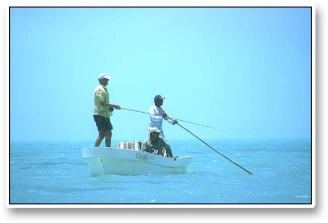
Severo, Ramon and Manuel
Fishing guides are readily available, and most dive and tour shops will arrange fishing too. We opted for three well reputed guides: Severo, Ramon and Manuel. Guides have large wood and fiber boats with powerful outboard motors. Do not expect luxury here either, but competent sailing and guiding.
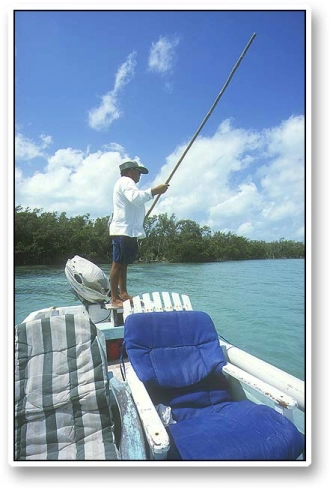
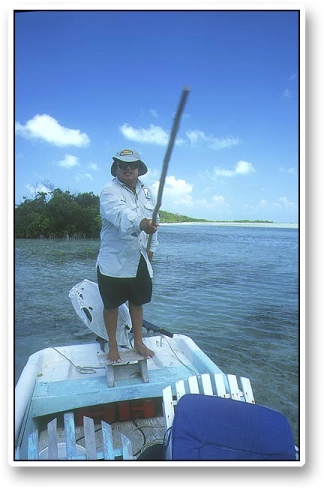
I fished with Severo, a man of few words, but a very skilful guide with a very keen eye for tarpon. He would stand all day on a small stool in the boat, poling it steadily and scouting for fish. Lunch and drinks is included in the hefty 200 US$ that a day will cost you. Again: do not expect luxury. DIY sandwiches with chicken, sausage or ham and sodas or water from the icebox.
The guides will do what you ask them to do, so take the liberty of bullying them around. If nothing happens in one location, ask for alternatives. Change between locations, go for tarpon, bonefish, permit, barracuda or one of the many other species available. Try fishing on the reef side as opposed to the mangrove or tarpon flats behind the island.
Have fun!
You paid.
You decide.
Gearing for tropical fishing
The right equipment
Being ready with regards to equipment and clothing is a very good idea. Be prepared for some spending on this front. The fishing is exotic and expensive, and so is some of the equipment. If you are like most people - and like me - this is probably going to be one of the only trips ever you will do to such a destination. It is stupid not to be well prepared. If you dislike the thought of buying expensive gear that you will only need once, refer to borrowing from friends or shops.
Apparel
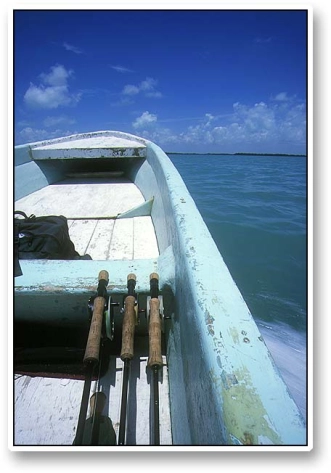
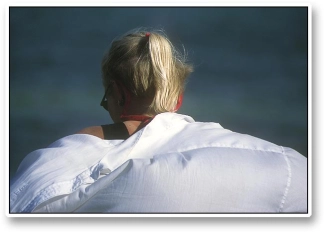
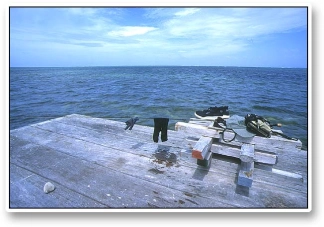
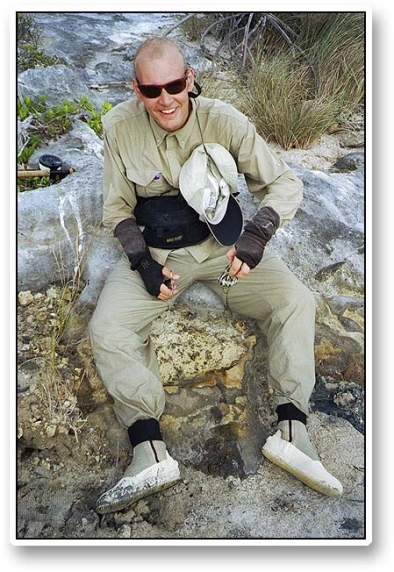
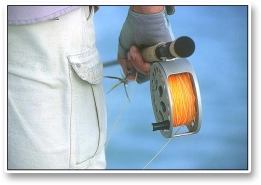
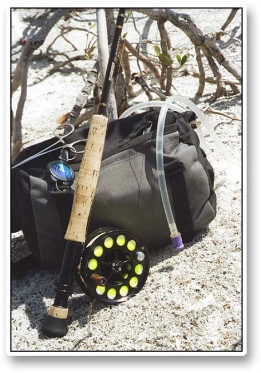
Be suitably dressed! And that means a lot more clothes than you imagine unless you are used to very intense sun.
Not even the best sunscreen can keep untrained skin from getting burned if it is exposed to this sun for hours on end.
Get lightweight, long sleeved shirts in a quality that dries fast. Get zipoff trousers of the type meant for warm weather use. Make sure it has a sunscreening effect. Bring shoes or socks to protect from sunburns on your feet and bring a cap with a large bill and preferably a 'skirt' on the back to cover ears and neck.
If you sunburn easily, make sure that you bring some gloves. Yes, gloves! The sun is merciless on the back of your hands, and stripping gloves will not only keep them protected, but also ensure that the salted fly line does not cut into your wet fingers.
Sunglasses
The glasses is one of the most important pieces of equipment you have for tropical fishing. Spotting fish under water is essential, and good glasses are utmost important.
Large glasses with good side coverage will exclude all stray light. The lenses should be polarizing and dark amber or brown in color.
Mount them on a cord around your neck for convenience and safety. Glasses flying over board during fast sailing are unlikely to be recovered.
Bonefish gear
Bonefish like they are found in Belize can be handled with rods between 7 and 9 weight. 9' is the length of choice. Longer rods will probably tire you in the wind.
The lines are floating WF's and make sure to get lines specialized for tropical salt. Lines for more temperate fishing will literally melt and become very limp and even sticky. I used Rio's Bonefish lines and was very pleased.
Most reels with a good brake will work. And you will need the brake! These fish take line like none I have caught before. A bad brake will lead to break offs and bird's nests.
Leaders are your average tapered, knotted or coated leaders, but be prepared to fish them long. We managed best on leaders about two rod lengths and even more.
Tippets should certainly be fluorocarbon, as this lightly sinking and very clear line will disturb the finicky fish as little as possible. 0.30 and 0.28 millimeters will suffice for most situations.
Tarpon gear
These potential giants require stuff close to the heaviest gear available. 11, 12 and 13 weights are come into play here, and many fishers prefer rods with an extra fight handle. You need lifting power, yet low weight and castability.
The reels are similarly critical. Large reels with plenty backing and a really good brake is a must. 2-300 yards of backing is common and the brake must be guaranteed not to burn down under numerous explosive runs.
Again the floating WF line must be suitable for tropical temperatures, and a second spool with an intermediate line might come in handy. Special tarpon tapers can be desirable for the heavy flies and leaders.
The leaders are a story all to itself. Constructing tarpon leaders is quite a task, and the job should fundamentally be left to someone with experience. As we are potentially talking 50+ kilos (100+ lbs.) and maybe once-in-a-lifetime chances the leader is critical, and its many parts and complex knots can be quite intimidating.
Reef gear
On the reef you chum for fish and all the typical reef fish will gather. Many can be caught on a fly including different jacks.
If you want barracuda or shark different methods have to be applied. Trolling for barracuda. Baiting for sharks.
The need for equipment will vary depending on your quarry, but the potential catches calls for something around and above a 9 wt. and the really big ones can easily give a 12 wt. a more than decent load.
Lines will follow the rod. Floaters will usually do, but sinking lines can be handy too. Make sure you have wire or very heavy mono to make bite tippets, especially for the barracuda. If you want to fish bait you might want to bring some bare hooks in suitable sizes. Stripped down flies can also double as bait hooks.
Bring snorkeling gear too. The chumming will gather a wealth of different fish and you will definitely want to take them in closer eyesight.
Beach gear
Do not cheat yourself of the pleasure of walking and wading along the beach and fish for whatever you see. Gear up for bonefish, which are probable everywhere, but be mentally prepared for everything from shad to barracuda. Use a long leader and light flies as most places are quite shallow.
Wear socks and a pair of old tennis shoes or real flats wading boots if you are so inclined. Do not be tempted to go barefoot or even in sandals. Shells, stones and coral sand will kill you. And if that is not the case the mud will creep in everywhere.
Flies
Needless to say that the water is salt, and the hooks need to be stainless.
For bonefish you will need small, mainly tan flies - weighted and not. Crazy Charlie, Gotcha and similar styles will do. A tan Woolly Bugger or a Hare's Ear Nymph will too. Tie the bonefish flies from size 10 to 2 - plenty in the small 6 and 8 range. Make sure to include some with weed guards. A fly snagging the turtle grass will stir the suspicion of most bonefish.
For tarpon you need a selection of standard tarpon flies. Sizes vary from size 2's for smaller fish to 3/0 and larger for the bigger ones. The patterns are numerous, but make sure you have a selection of both colorful ones and more subdued patterns in white, gray and tan. Use needle sharp hooks of the best quality! Do not compromise here.
For barracuda a selection of large, mainly green and blue or gray flies with plenty flash will work fine.
Remember to bring some thin wire for bite tippets and pliers to bend and cut it. The fish' teeth will cut almost any thickness of mono in an instant.
For the odd permit you need some crab patterns in varying sizes.
Other species like jacks, snappers, shad and pompano will take a variation of flies, and most of them are not that critical.
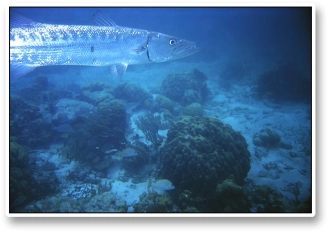
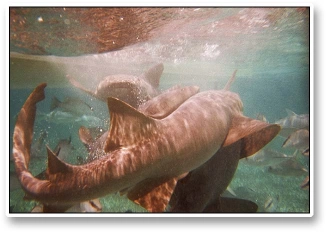
Snorkling gear
Do not miss the chance for a snorkeling trip under the piers in town and on or behind the reef. Bring a mask, snorkel and fins on your fishing outings too - especially if you go out on the reef side. You will surely see something that will make you want to look closer. A wet suit can be great if you want to dive or snorkel deeper, but most of us will be fine without.
Tools
Bring pliers and cutters for thick mono and cutting and bending wire. A set of artery clamps for unhooking fish - especially barracuda - will be practical too. If you are really serious about bigger fish - from jacks to tarpon - a Boca grip might also be neat to have.
On your own
Getting around in on Ambergris Caye
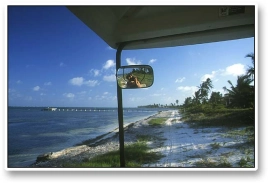
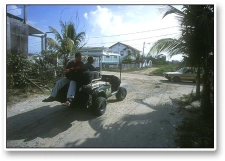
Most things in town are within walking distance - even the airport, Still I will recommend hiring a golf cart, which is one of the most common ways of getting around on the island for both locals and tourists. The cart makes travelling to a from town for dining and shopping a breeze, and also facilitates getting to more remote areas for some coastal fishing.
The prices do not vary much, and expect the prices to wind up in the vicinity of 200 US$ for a week for a cart that takes four persons. You can also get two and six seaters.
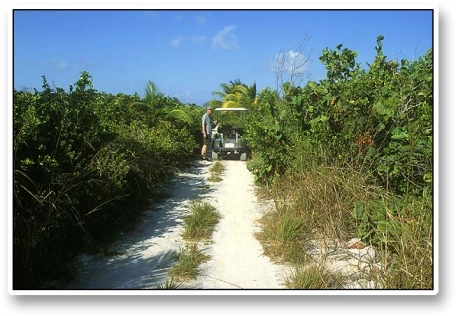
You return the cart for a recharge every day and pick up a new one. The system works quite well and the carts will basically take you as far as you can go on Ambergris Caye. At the car rental they said three hours of continuous running, but we had cars that did better - and some that did considerably worse! More than once a few of the party were stuck with a car that decided not to run any further.
On you own
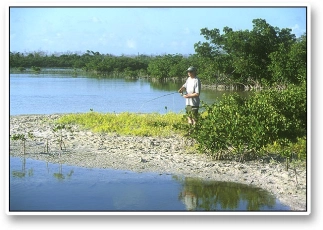
Do not cheat yourself of the pleasure of fishing on your own along the beaches and coasts. Walking along in knee deep water scouting for movement is great fun, and even though it is not as productive as boating over the muddy bonefish flats, it can be just as exiting.
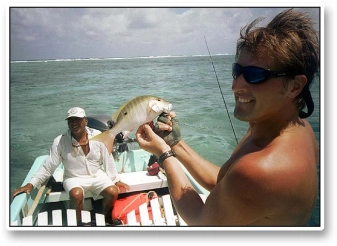
Spotting and hooking a fish on you own is a rewarding experience. On top of that the chances of picking up all kinds of species makes it even more fun. Expect jacks, snappers, shad, pompano and even an odd small permit apart from the bonefish that seem present in small numbers over most of the suitable spots.
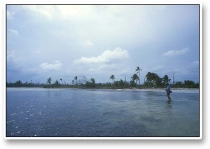
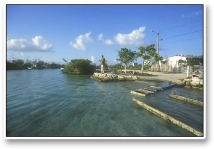
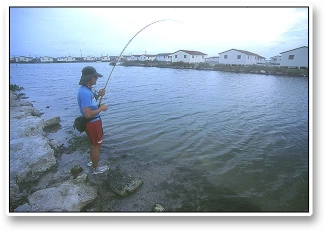
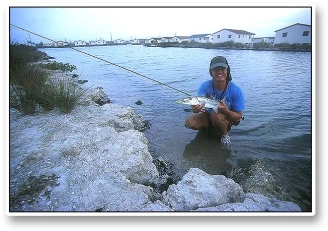
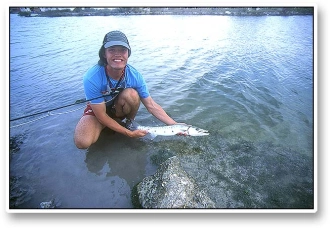
Do not fish anything over a 7 weight on these trips, and bring a variation of flies. Most need to be smallish and light. Sizes smaller that 6 is fine, and simple, lightweight flies seemed to work best. But do not forget a couple of larger ones with wire attached in case of barracuda appearing.
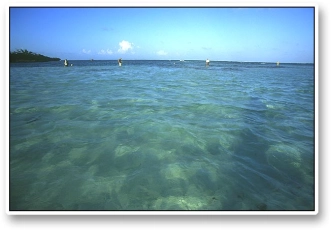
Look for shallow areas with coral sand, mud and turtle grass. Places with just 15 centimeters or 6 inches of water can hold bonefish, especially if there are deeper channels nearby. You need keen eyes and polarized glasses to see them if they do not break the surface. On the other hand you will often see nervous water as a result of the activity of almost any fish in the shallow water. This fishing is particularly attractive in the mornings and evenings when the sun is more merciful and the fish seem less anxious.
If you want to go to more remote parts of the island, you can arrange to be set off and picked up by a water taxi. This will cost you considerably less than a guided trip, but can be almost as rewarding. Strolling along undisturbed beaches is balsam for the soul. An occasional bent rod does not make the balsam less delightful.
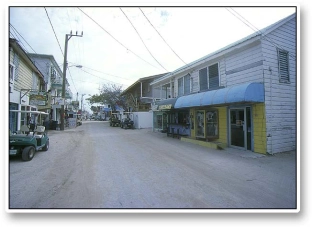
The backstreets of San Pedro
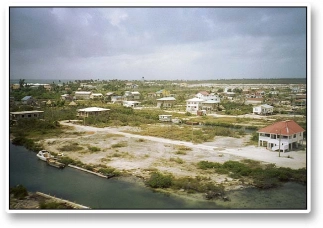
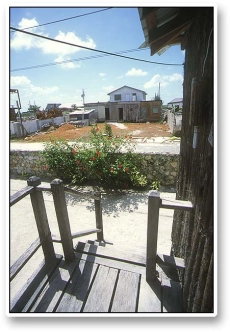
We made several ventures to less advertised parts of the island, scooting both up and down the east coast and probing the back channels and mangroves with our flies. This was an important and fun part of the trip, and brought many memorable moments.
The general conclusion is: where there is water, there are fish!
We fished semi-intensivley on the beach north and south of San Pedro. This is easily accessible water, much of it within walking distance, and we caught both snappers, shad, barracuda and bonefish here. Walk along and scout for movement. Cast to what you see and be prepated for pleasant surprises. Notice that fishing is prohibited from most of the piers - especially in the town itself. The Amigos del Mar pier in front of Lilly's Restaurant is particularly tempting. A snorkel trip will reveal a wealth of fish including large barracudas, hundreds of snappers and a huge school of about 50-100 bonefish in a size, which is found few other places on the island. These bonefish gross up to 4 kilos or 8 lbs. and swim around in a very limited area waiting for goodies to be thrown from the piers.
A cast from this pier is certain to bring more attention than you will like, and I strongly recommend not to try. Probe the many piers outside town in stead. You are allowed to fish from most of them, and even though the probability of running into fish like under Amigos del Mar is slim, the piers still seem to attract fish like few other structures along the beach.
The ferry
The ferry across the narrow channel between the sounthern part of the island and the northern part deserves a chapter all for itself. This is an amazing vessel that at first sight will seem doomed for a tough fate. It is basically a large steel box, floating what seems all too high on the water, flat on the top except for some rusty railing. It is open in both ends and ramps are lowly, hinged steel plates helped by some plywood waiting on the dock in each end of the journey.
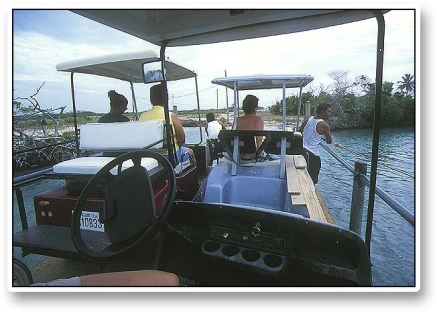
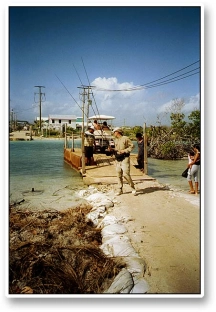
The trip is about 40-50 meters or 150 feet and is overcome by hand power. Yes, the ferry is simply pulled over with the aid of a rope hanging across the channel. There are no guiding wires or other means of steering. During tide and ebb the current will be strong and the ferry will swing around at the mercy of the elements and the muscles of a couple of deck hands.
It easily loads three golf carts and a large number of pedestrians and bikes. We did the trip several times, and nothing out of the ordinary occurred. The trip is an experience in itself, and you should definitely try it - not least to get to the northern part of the island and see that. The fee is 5.- BZ$ each way for a cart and free for pedestrians.
Ambergris Caye
A bit about the location
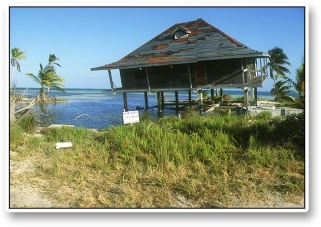
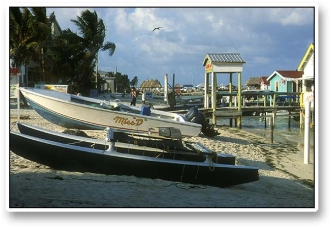
The Belizians are a strange and charming mix of Mayans, Caribbeans and assorted other groups of people and colors of skin. Their attitude towards strangers seems to be one of kindness and curiosity more than plans of exploiting the stupid and rich tourists.
The country does not seem poor as such, but of course you will see places that are more South American than American or Western European. Even so the standard of living seems acceptable, and beggars and thieves are far apart. We had no problems whatsoever during our stay, and quickly learned that we could leave our packs on the public beaches while swimming and our clothes on the piers while snorkeling. No one approached us with offers except a few kids selling bracelets and the wood carvers selling their craft on the beach and in the main street. All of them accepted a no thanks at first prompt, and never did we feel that we were pushed or pressured.
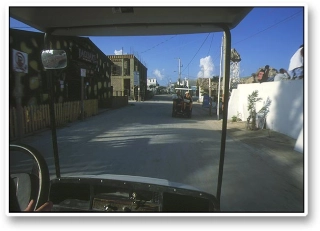
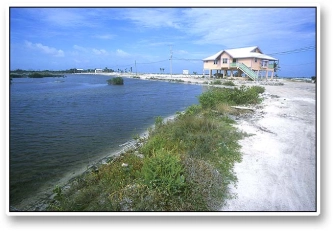
In the shops we were allowed to browse the goods with no one on our necks - all a very pleasant change compared to many other tourist destinations.
Most people speak English without problems, but both Spanish, Mayan, Creole and Jamaican English is heard. US dollars are accepted everywhere as is the Belizian counterpart, worth about half a US$ per BZ$. Credit cards are readily accepted in most businesses.
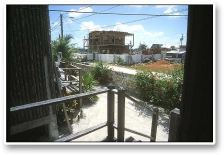
The price level is high - almost European levels - so do not expect a dirt cheap holiday.
A place to live
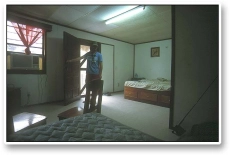
Accommodation is nowhere near luxurious. If you want the best, you might find it in some of the remote resorts, but in town the level seems somewhere between very low and acceptably high.
We had rented cabins in a place called Mayas Katut, which was a catastrophy! The owner had obviously sold the place between us reserving and arriving, and the place was now mostly inhabited by women of 'a doubtful reputation'. The location is way out of town away from the beach. Our room was cleaned once in two weeks, sheets and towels were not changed once and we had to buy our own toilet paper! All for 35 US$ per day per person! Not recommended!
Some decided to move to a place called Hideaway, which was the same price level, but orders of magnitudes better (Update: Hideaway seems to have closed since our stay). For the real cheapskate Ruby's on Barrier Reef Drive (front street) seems a good choice, and for the more picky both Banyan Bay and Ramon's Village seems good choices.
Eating
Rubie's (or Ruby's)
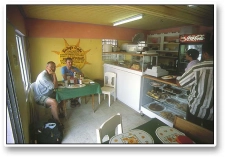
Fascinating place, good bakery, cheap lodging.
The Reef
Dirt cheap local restaurant. Located in the northern end of Pescador Drive (middle street) - the second street from the beach.
Mango's
Nice place with a large Caribbean selection. Located in the very south end of the first street facing the beach.
Fido's
Nice place to eat. Good quality and selection, which is reflected in the prices.
More places to eat...
Lodging
Rubie's
Mayas Katut
Do not use it!!!
More places to stay...
Golf carts
Cars'r'us
We used cars from American owned Cars'r'us and were satisfied with the service even though we had a couple of breakdowns. The prices seemed negotiable and fair. Located on Coconut Drive across from Ramon's Village close to the airport just outside town.
Mocho's
An other rental business is Mocho's. They have information online.
Map
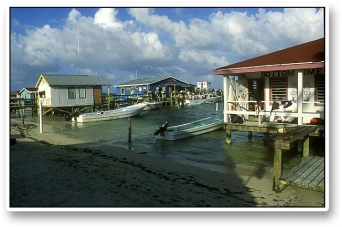
Most locations mentioned can be found on this small town map.
- Log in to post comments

