
Recently, GFF partners Bob Petti and Steve Schweitzer had the chance to visit Bob Venneri at his house and get a look-see into his workshop and how his seats are made, by hand, one at a time.
For the Love of Wood
There are many reasons for a person to build their own fly rod from a blank and a set of components. Like many hobbyists, I started because I could build tackle cheaper than I could buy it. I didn't have any illusions that I could build it better. However, as I learned more about the components of fly rods and what is available, I realized that I could build a better rod, and still build it more cheaply than I could buy it.
For some of us, rod building is more of an assembly process than a building process. Either we don't have the tools or the expertise to make our own components. While some of us will glue up and turn our own cork grips, that's as far as we might take it. We buy our components, choosing to spend our time learning and perfecting rod construction techniques.
As we build, we develop an eye for component quality. From defect free cork, to straight as an arrow blanks, to nicely machined reel seats. When it comes to reel seats for fly rods, I've always been drawn to those with beautiful wood spacers, especially those with swirling burls.
One day I got talking with Dave Lewis about his rods, and he mentioned that for his best rods and best customers, he got his seats from a builder named Bob Venneri. Those seats were spectacular - both the machining of the nickel silver parts and the beauty of the wood spacers. I could see how Bob's seats combined with Dave's exceptional thread and epoxy work resulted in rods that were far superior to mass produced factory rods.
I had no illusion that I could make rods as nice as Dave, but that didn't stop me from lusting after the beautiful woods in Bob's reel seats.
As time went on and I looked at more and more custom fly rods, I saw more of Bob's work. Almost without fail, builders would use his seats on their very best rods.
As a lover of wood - a Norm Abram wannabe - I am drawn to the woods that Bob uses and have always been curious about how the woods are selected and how the seat spacers are made.

Some of Bob Venneri's fine reel seats.

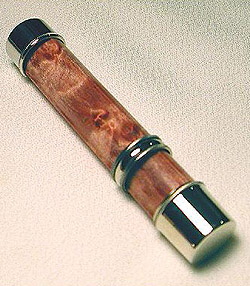
Spalted Cherry Burl in an Up/Down Slide Band seat. Of all the woods that Bob uses, this is my favorite. The swirling eyed burl and the dark veinations of the spalting are so beautiful.
Another Up/Down Slide seat with a birch burl spacer. Every piece of this seat is made by hand in Bob's shop - one at a time.
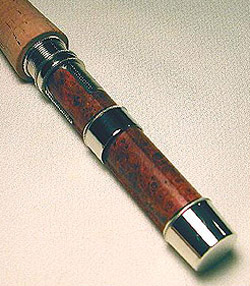
A downlocking seat with a cherry burl spacer.
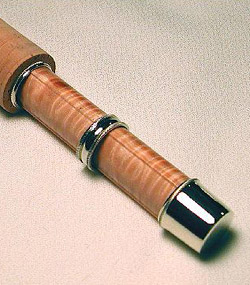
Beautiful Tiger Striped maple. The stabilization process and buffing really bring out the grain and depth to this wood.
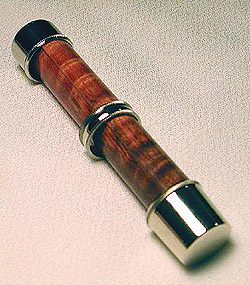
Tiger Striped dyed a beautiful reddish brown makes for a beautiful seat. The up-down slide band seat allows the angler to choose how his reel is mounted, to better balance the rod.
Kids in a Candy Store
This past October, Steve Schweitzer came out to the house for a weekend of fishing and fly tying. As luck would have it, we had a few inches of rain the days before Steve arrived and everything was high and chocolate brown. We tried for awhile to fish, but it just wasn't worth the bother. We had hoped to meet Bob Venneri for some fishing on the Esopus, but we decided to turn it into a tour of his shop instead.
Bob invited us into his house and commenced to tease us with bags and bags of his reel seats. Poor Steve walked away quite a bit lighter in his wallet, as he had a bunch of rod projects he was working on for friends and simply could not pass up the opportunity to hand select seats for them all.
It was then that Bob brought out his bamboo rods. Apparently him and his friends have been fooling around with making rods, in the hopes of one day selling rods or even making blanks available to rod builders.
As you would expect with Bob, the quality was unbelievable. I had the pleasure of casting one of his shorties in the yard - what a delightful little rod it was.

Bob Venneri (left) showing Bob Petti some of his fine reel seats and one of his bamboo rods.

A cornucopia of wonderful reel seats. You can see the little group of five seats that Steve has set aside for himself.
The Fish-n-Shack
When Bob offered to show us around his shop, Steve and I literally jumped at the chance. I know Steve is a woodworker, so I can only imagine how excited he was.
As Bob walked us through the shop, he told us about his days in a job shop, where a customer would come in and ask for something - anything - to be made. He wouldn't know from one day to the next what he'd be expected to make - or whether he'd have the tools to make it. It was a job of problem solving - how to get from a pile of raw materials to a finished product in the least amount of time and lowest cost possible.
It was only natural that Bob would build some parts for himself and his rod building friends. It's clear that he has a love for making things - something I can certainly appreciate. Since he had the tools and the know-how, it was just a matter of applying his experience in the job shops to create the tools and jigs to make his reel seats, from raw nickel silver and chunks of wood to finished product.

These are burls - pieces Bob gets from local wood cutters. The majority of the woods Bob works with are havested locally.

Bob uses his bandsaw to cut the burl blocks into 1x1x4 inch pieces, called blanks. He picks through the pile and selects those that will be sent for stabilization.
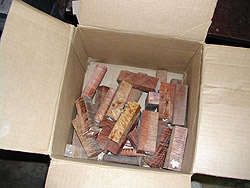
A box of stabilized blanks. The stabilization process brings out the natural grain in the wood, makes the burls easy to machine, and makes them impervious to water.
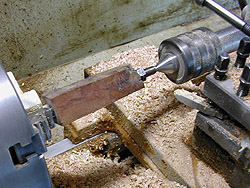
The stabilized blank are bored out and chucked into the lathe to be turned to final shape and size. Bob always leaves his seats a bit long, so the rod builder can cut them down to fit the rod and reel.
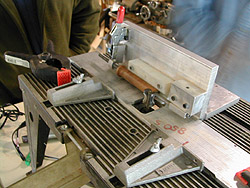
Bob designed this jig that fits on his router table and allows him to cut the mortise in reel seats, which helps hold the reel securely in place.

After the spacers have been turned, the mortise cut, and some final sanding completed, they are sprayed with an acrylic finish and set aside to dry.

The spacers are buffed to the final desired sheen on a couple buffing wheels.

Every shop has some rejects. These wood spacers did not pass Bob's stringent quality guidelines.
Metalwork
Most people have a vague idea how blocks of wood are turned on a lathe to a cylindrical shape. Working with metal on a lathe is something else entirely. Very few of us have seen a metal lathe, let alone seen someone operate one.
Watching Bob work on his metal lathe is truly watching someone comfortable in their environment. His motions are quick, smooth, and confident as he moves the cutting tools into place, applies sulphur smelling
machine oil to the turning stock, and swaps out one tool for another. As with any master craftsman, he makes the process look much easier than it really is. At one point I asked him if Nickel Silver was a soft metal because his tools cut through it like it was butter. He smiled and said "Nah", implying that what I took as easy was really the result of many years of experience.

The raw material for the metal parts of a reel seat is Nickel Silver turning stock and threaded rods.

Steve is checking out some of the nickel silver stock. These hollow metal threaded rods are the only parts not machined in Bob's shop.
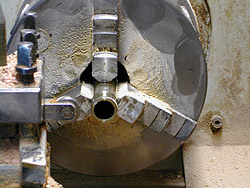
A length of silver chucked in the jaws of Bob's lathe, ready to be turned and have the knurls cut.

Bob at the lathe, holding a file on the stock as it is turned by the lathe.
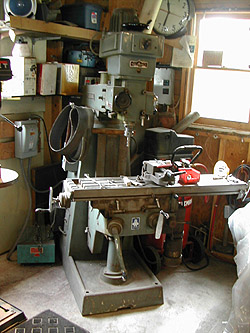
The big milling machine, where Bob cuts the slots in his threaded rods to fit alongside the mortise in the wood spacer.

Some finished nickel silver parts, ready for buffing and packaging.
One at a Time
Most folks might figure Bob uses a computer driven "CNC" machine to punch out gobs of reel seat parts one after another. Not so.
Every piece of Bob's seats are done one at a time, by hand. With the help of a friend or two, who handle various chores such as buffing, he turns out a couple hundred reel seats per year. Many go to a select few retailers, the rest being sold directly to rod builders.
While Bob does have a bunch of standard styles and sizes, it is possible for a rod builder to contract him to build something unique. Some professional rod builders have Bob make them seats that are unavailable
for retail sale - special seats for their special rods. Without his one-at-a-time hands-on techniques, such customization would at the very least be cost prohibitive, if not downright impossible.
Visit Bob's web site for more information on his reel seats, as well as a listing of rod builders who use them and retailers who offer them for sale.
Venerri's Custom Components
- Log in to post comments


Bob ,, Bob Jordan i
Bob ,, Bob Jordan i have been trying to contact you for a bit now and have been unable too do so ,,also have been trying to order from your site no go ,i do use paypal,I do hope your ok ,,so Bob please let me know if i can order some router bits from you please Bob Jordan ,,
I am a "lather" and
I am a "lather" and make pens, pencils, candle holders, wine and bottle stoppers, etc. I have received a request from a friend to make some reel seats. How do I find the "plans" (specs) for the sizes and procedures for the seats and various handles?
If there is a file, or book, that covers these procedures, I would appreciate it.
I have hundreds of p
I have hundreds of pounds of stabilized Buckeye Burl and wish to make and sell Reel Seats. I am interested in finding a source of the aluminum parts and tools, some instruction. 25 years experience on a wood lathe. Coop
I have used several
I have used several reel seats made by Bob and they are beautiful. I purchased them from Goldenwitch a few years ago and all my buyers love them.
Hi just turned my fi
Hi just turned my first reel seat down. Now I need to know whats the best paint or cover for it.
Thanks for your help!
PS: This is a wonderfull web site and big help for beginners to start with rod building.
Good Morning Bob;
Good Morning Bob;
I have a fly fishing workshop in Patagonia for many years and the amount of fly rods and I buy in USA.
Let me know if you can give me information because I want to make my rods and reels carriers need some direction where to buy bar nickel silver and wood inserts.
I have in my workshop tools to make it as a lathe.
Thanks for your time and I look forward to your prompt response,
Diego.
P.S. Searching the internet I found your address and I liked his work in the reel seat and a lover of natural wood'm also a fan of fishing with Bamboo.
Very interesting art
Very interesting article. Makes me want to onwn a fly rod too. Really a beatiful work of art and passion
I started collecting
I started collecting fly rods a few years ago and now find out I really know very little. To save me time and money are there any good references? I want to spend my money wisely. I have accumulated a rod winding machine and some other odds & ends. I really don't know what I need. From reading your article you are light years ahead of me. Can you help with some sources?
Hi Wonderful page, h
Hi Wonderful page, have tried to contact Bob - no success. I need a mortising bit to make my own reel seats can you help please. Admire your work.
Fabulous, inspiring,
Fabulous, inspiring, wonderful