
Classics in a classic way. These flies may look like something of today, but the concept of Wadington shanks is old as Methusalem. Danish fly tyer Niels Have has converted four classics to effective flies for early salmon and sea trout fishing. See the pictures and patterns.
 |
 |
|
 |
 |
 |
 |
 |
A selection of Niels' Wadington shanks: Willie Gunn, Green Highlander, Spey Ghillie, Tadpole
Danish fly tyer Niels Have - a good friend and fishing companion of mine - ties a lot of classical salmon and sea trout flies. And notice: these are flies for fishing, not for framing!
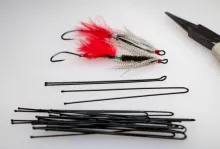
In preparation for his upcoming trip to Norway he has tied up a lot of flies. Among those I especially fell in love with these Wadingtons. Wadingtons is a traditional English way of dressing flies, where you utilize a special shank in stead of a hook. The shank is attached to a treble hook before the fly i tied, and part of the fly - typically tag and butt - will be tied on this treble. The connection between the shank and the hook is stiffened with a piece of monofilament to assure that the treble hook will not turn and ride sideways, when you fish the fly. See how to fit a treble on a Wadington shank.


Niels with a box of 50 feather winged salmon flies ready for this summer's fishing in Norway
When the treble is dressed it is connected to the shank and the rest of the fly is tied on the whole assembley.
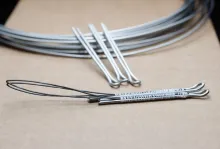
The shanks can be difficult to obtain outside Scandinavia and Britain, but if you want to you can easily fabricate them yourself from a suitable wire. We have done well with shanks made from welding wire. These shanks will be a little lighter than the ones commercially manufactured by Partridge.
The flies shown here are all classics tied up as Wadingtons. They are simplified in comparison to the original pattern and have straight hair wings made from bucktail. Niels mixes the wings of two or more colors for each pattern. The Tadpole is the only pattern with separated colors, while the rest are totally blended.
This is done by cutting an appropriate - small - bunch of each color, mixing them by hand and carefully stacking them in a hair stacker. The wings are then tied in in three bunches on three sides of the shank after the body is finished. This makes it much easier to control the distribution of hair around the shank.

| Materials Willie Gunn: | |
| Shank and hook | Partridge |
| Tag | Fine oval gold tinsel and yellow floss silk |
| Butt | Black ostrich herl |
| Connection | 0.60 millimeter nylon monofilament |
| Rib | Medium oval silver tinsel |
| Body | Black floss silk |
| Wing | Mixed yellow, red, and black - equal amounts |
| Head | Black tying thread |

| Materials Green Highlander: | |
| Shank and hook | Partridge |
| Tag | Fine oval gold tinsel and yellow floss silk |
| Butt | Black ostrich herl |
| Connection | 0.60 millimeter nylon monofilament |
| Rib | Medium oval silver tinsel |
| Body | Rear half yellow floss silk, front half green floss silk |
| Wing | Mixed yellow and green - equal amounts |
| Head | Black tying thread |

| Materials Spey Ghillie: | |
| Shank and hook | Partridge |
| Tag | Fine oval gold tinsel and yellow floss silk |
| Butt | Black ostrich herl |
| Connection | 0.60 millimeter nylon monofilament |
| Rib | Medium oval silver tinsel |
| Body | Rear half yellow floss silk, front half black floss silk |
| Wing | Mixed yellow and black - equal amounts |
| Head | Black tying thread |

| Materials Tadpole: | |
| Shank and hook | Partridge |
| Tag | Fine oval gold tinsel and yellow floss silk |
| Butt | Black ostrich herl |
| Connection | 0.60 millimeter nylon monofilament |
| Rear rib | Medium oval silver tinsel |
| Rear body | Yellow floss silk |
| Rear wing | Yellow bucktail |
| Front rib | Medium oval silver tinsel |
| Front body | Red floss silk |
| Front wing | Black bucktail |
| Head | Black tying thread |
- Log in to post comments




yeah i get it now, s
yeah i get it now, still prefer a bit of rubber tube myself. only found this site today ,really usefull stuff.keep it up
Mick, The mono ke
Mick,
The mono keeps the hook straight. It's not necessary, but nice that the hook doesn't dangle.
Martin
i don,t understand w
i don,t understand what is the mono for?