
The gold bead flies that are now so popular, actually originated in the central part of Europe - more than 100 years ago.

What it all led to: gold beads
History
The roots of the Gold Head or Pearl Head flies lie in the Northern Italian area. I think that already at the turn of the century the fishermen of Piemont, Bergamo, Brescia and Friulia fished in their alpine rivers with this type of nymph.
The nymph was build on a snelled hook (no eye). The silk gut was fixed already to the hook and the body of the nymph was mostly made from pure silk in different colors ribbed with an gold, silver or black metal wire. When the silk got wet it became translucent. Instead of the head there was a glass pearl slipped in place and fixed (laquered).
The fishermen at that time and also today use these flies - although the new flies are made of modern materials - on a special fishing rig called "Tiroler-Hölzel"; A "Tyrolean woodpiece".
Tiroler-Hölzel
At first these nymphs were used only with spinn-fishing equipment. At the end of the nylon casting line the "Hölzel" was attatched; a 10 cm (4") long slightly conically shaped piece of wood with a ring eye at the upper end and a lead inlay on the bottom. Then came the side arms of the rig consisting of 4-5 pearl nymphs with a 50 cm (20") distance attached directly to the line. This "wet fly system" with weight at the end was cast upstream as far as possible. The current pushed the "Hölzel" downstream so it rolled slowly over the gravel bottom towards the spinfisherman. The angler reeled the line in, in the same speed the nymphs were washed downstream. When the continuous move stopped the fisherman set the hook.
This system was and is still deadly mainly on graylings and is now prohibited in many rivers of The Alps. The method of fishing with the "Tyrolean Hölzel" is also called "Rieseln" meaning slowly rolling over the bottom. It was also very popular in Switzerland, Tessin, Graubünden, Montafon and the upper part of the Inn-river which is the main river of the Tyrol in Austria.
Back to the nymph
As I mentioned earlier the pearl on the head of the fly was mostly a golden or silver glass pearl from the Venicien glass industry (Murano). Later it was replaced with plastic pearls in different colors from the doll and toy industry. These nymphs were exclusively used by bait- and spinfishermen in the most silty (glacial) rivers of the Tyrol, Switzerland and northern Italy. It was never used for flyfishing.
The nymph was also - as I told you earlier - very successful in very tiny sizes imitating midge pupas (gas bubble thorax - my interpretion).
And the grayling really loved it.
Now I come into the game
In 1978 I got some of these pearl head flies from Tyrolean friends who told me that these nymphs were extremely successfull in the murky Inn-river. They thought that I could maybe make something out of these nymphs for flyfishing. They found them useless for themselves because they were to light in weight.
I tied some of these nymphs a tiny size 14 hook, making a medium to dark brown silk (Polycrylon - Kreppnylon) body with gold ribbing some brown hackle fibers pointing backward and a golden plastic pearl. To get the fly down I also added two layers of fine lead wire as underbody.
I used the fly first on my home river the Austrian Traun - at that time a world famous grayling river (today a world famous CORMORANT river). The success was tremendous and astonishing. In the clear water I could see how the graylings turned around and followed the nymph over many meters downstream to take it without any hesitation.
New technique
It was orgiastic at this time. I caught endless numbers of fish at any time of the day as well as any water depth. At that time my nymph technique (RM bottom downstream technique) was born as it's shown in the video "New ways with the caddises and new ways with mayflies". I used leaders of 5 meters length (15') and caught fish after fish with this system. At that time there was a rumor on the river saying that I had to use maggots and worms, otherwise my success could not be possible.
Further improvement
Anyway the next step in further developments at that time was to create a gold head nymph heavier then that with the glass or plastic head. The logical step was to use a brass ball or bead as additional weight. These I found in the Cabela's catalog offered as round spinner bodies in different sizes. The smallest type of these brass beads - which at that time had no conical tapered bore - I could slip over a Partridge Captain Hamilton L3A wide gap hook by pressing the barb close and opening the bend of the hook slightly to bring the bead around the hook bend.
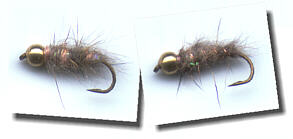
Two simple Goldkopff (Gold Head) nymphs with hare's wool and pink dubbing. The right one also has a copper ribbing.
A new fly was born, and I named it the "Gold Head". I had a saying at that time: "Clever heads fish Gold Heads". The original Gold Head nymph I tied only with some body dubbing which was a mixture of medium grey with a touch of pink and the brass bead.
But nobody understood me until I published the making of that Gold Head in the German magazine "Fliegenfischer" January/March issue 1985 page 58.
The article was titled: "New ways of fishing the caddis" - because I found out that especially right before and when sedge flies were hatching, the Gold Head was most successful fly probably because the bead resembled the air bubble thorax of the natural.
Years before in 1981 I also developed Gold Head micro jigs. A jig hook nymph from size 8-16. For the smaller sizes I used Japanese soft wire hooks in size 12 and 14 and bent the shank with a pair of pliers and superglued a split shot in place which I painted with gold varnish. Very successful for grayling in late fall and when midges were hatching - in larger sizes excellent for trout in deep pockets.
This type of hook is really perfect for deep fishing because the nymph is diving down actively where the fish are and can be jerked over the bottom without snagging.
About ten years ago I brought this fly to England when I was invited for a casting and tying demo at the Chatsworth Angling Fair. Afterwards it was successfully used by friends like Oliver Edwards, Charles Jardine, Greenhalgh, Alan Bramley and Taff Price. There were many articles written on the subject and the fly was spread out all over of the british area.
About 7 years ago Orvis bought and marketed my video in the US. The video was "New ways of fishing the caddis" where I show how to tie a Gold Head nymph. The pattern was then adapted by Tom Rosenbauer from the Orvis company and introduced into the US markot via their catalog. An article by him written for the Flyfisherman magazine appeared about 3 years ago. Now this very successful nymph is spread all over the world and fish from bonefish to salmon were caught with the Gold Head fly.
- Log in to post comments
