
These new fish shaped foils from Bob Popovics are really great for making baitfish imitations. They come in several shapes and many sizes, and stick on the side of your flies, ready to be covered with resin.

Bob Popovics has been breaking new ground in saltwater fly-tying for decades introducing new patterns, new tying methods and not least new materials - or at least new use of known materials.
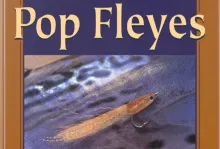
His book Pop Fleyes features a number of these patterns and techniques, but recently Bob introduced yet another material: Fleye Foils.
Ready-made
The Fleye Foils are small fish shaped foil profiles, which come in three shapes and many sizes.
The color and structure is the same for all foils. Very shiny and reflecting light in a multitude of colors. The foils have printed eyes and gills on them and in some cases mouths, meaning that the finished fly will become a pretty good imitation - at least where the foil is visible.
The foils come in sheets with a number of adhesive fish heads/bodies, ready to peel off and glue to your fly. After having attached the two foils to the side of your materials you take a few wraps over the tip of the foil, finish the thread and then cover the foil and materials with epoxy, light curing resin or another clear substance.
The result can be a very convincing baitfish imitation.
Many shapes and sizes
The foils come in three shapes and each shape comes in several sizes covering hook sizes from very large (size 4/0) down to fairly small (size 6), which covers a large span of baitfish sizes.
The shapes vary a bit, and are called Bay Anchovy, Silverside and Sand Eel. These differ in shape, predominantly in width (height) the Bay Anchovy being the tallest and roundest and the Sand Eel being the slimmest.
None of them are really fish shaped, but will make up the front part of the of the body and the head of the fish that your fly will imitate. You can make lots of variations to your flies by varying colors of the other materials used, using colored resin or resin with flakes or even using a marker to color the foil itself before covering it with epoxy or LCR.
In general the Surf Candy style of flies will be perfect as a base for the foils, in other words: slender and sparsely dressed flies.


Popovics demonstrating the Fleye Foils on video
Tying with the foils
When you tie with the foils they are usually the second last step, the last step being epoxy or some other resin.
In other words: you tie your fly, stick the foils on the outside of the materials and coat the foils and the materials with a layer of translucent material that holds everything together and creates a shape.
The foils are sticky on the backside, which aides the process and also have a small tip that you tie in under the final wraps of tying thread. This both secures the foil and curves the it a bit.
Once it's stuck on the fly and the thread has been cut, you apply the coating in one or several rounds to create a body shape and secure the materials.
Facts

The price is US$ 6.99 or Euros 5.60 for a pack with 24 foils of the same size, yielding 12 flies, so these are not the cheapest materials, but on the other hand they do give you a shortcut to some very nice baitfish imitations.
The foils are widely available in the US.
You can also find Fleye Foils on Facebook.
According to the distributor Bob Popovics has some new additional stuff in the pipeline. There will be more shapes and additional materials to make the Fleye Foils even more useful.


My first pattern
I have often tied flies to imitate sand eels, which are very common here and a top food item for the sea run trout that I fish for. Using Fleye Foils it's easy to get an imitation that looks pretty much like the real thing and certainly behaves very fishy in the water. I have tied it small. These fish often appear in large schools of individuals just and inch or two long, but can grow to 10 inches or more.
I have used very shiny and translucent Polar bear hair for the belly, but I realize that this isn't a common material. Use white bucktail or a synthetic in stead. Keep the fly very sparse and cover just the front part with resin.


Hand picked for this article

- Log in to post comments





Odd-Julian, If yo
Odd-Julian,
If you mean "trout fly" (I guess throut is a typo) then the reply is yes, Fleye Foils can be used for any fly that's supposed to look like a small fish. Lots of trout have been caught on flies tied with Fleye Foils.
Martin
Was on your web-side
Was on your web-side and find this "Fleye Foils" which can be tied in different type of fly( sand a.s.o. ).
My question is, can this Fleys Foils also be used for tying throut fly.