
I am as likely to sit down and tie six different flies as I am to tie six of the same pattern. Speed is not a concern, but I don't want to waste my time either. There are things I can do to make my life easier which may be different from a professional production tyer.

My tying desk. Chaos, but organized chaos!
AK Best once wrote that you don't really know how to tie a fly until you've tied a hundred dozen. That may not be an exact quote, but the message is pretty accurate, and I believe it is from his first book "Production Fly Tying". The point he was making is that after tying a whole mess of flies, you can pretty much put away the hackle gauge. You know what size hackle to use by looking at the feather, you can pinch off the perfect amount of dubbing so you're not going back for more or pulling off the excess, and you always grab the perfect width hen hackle for the wings. There is always just the right space behind the hook eye for your finishing wraps, and always the same number of hackle wraps. After that many flies, they all look the same and you've learned a thing or two about economy of motion - you can tie a whole bunch of flies more quickly than tying them "one at a time" so to speak. The goal is maximum output - raw "numbers of sellable flies per hour".
I do not tie like that, and chances are neither do you.
You don't really know how to tie a fly until you've tied a hundred dozen
Not a pro
I am not a professional "I feed my family by selling the flies I tie" fly tyer. I do not sell my flies at all, nor have I ever tied a hundred dozen of any specific fly. The closest I came to mass fly production is one of Byard Miller's whacky caddis fly swaps back in 1999 where we had to tie a hundred. I am as likely to sit down and tie six different streamers as I am to tie six of the same pattern. Probably more likely, since most of my tying is for fun these days.
Speed is not a concern, but I don't want to waste my time either. There are things I can do to make my life easier which may be different from the advice of someone like AK Best. True, there is plenty of overlap (like learning to tie with your scissors in your hands), but while I'm not likely to pluck a whole dry fly neck and store the feathers according to size, I will pluck as many as I need when I sit down to start tying instead of plucking hackles for each fly.
That being said, even though I am not a professional fly tyer, after twenty plus years of wrapping thread I have learned a thing or two that might be of interest, even if you're not a wet behind the ears beginner. We're never done learning new things. Just last month I was watching Ted Patlen tie a fly and he used a different technique to mount his streamer wings than I use - and it got me thinking. So I tried it. And I liked it.
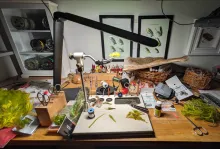
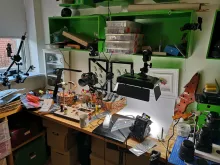
In the interest of sharing, I thought it might be fun to give you a little tour of my fly tying area and offer up a few thoughts along the way. Notice these are not pretty "smile and pose for the camera" type pictures that you often will see in magazines. This is a working fly tying desk, and I took the pictures after two days of tying featherwing streamers. The messes are real, which is what I believe would be most helpful to show. As Emeril would say "this is a cooking show."
So c'mon in.
Paper towelWhile I keep a trash basket handy next to my desk, the primary "how do I keep things clean" tool is a paper towel. I keep a roll on my desk and use half a sheet or a single one of those "select a size" sheets that I use to put all my waste bits. When I'm done, I just wad it up and toss it away. |
 |
Drying wheelOne of the better investments I've made in recent years is this drying wheel from Cabelas. Since I tie a lot of streamers and use a rather viscous cement for the heads, I need a way to spin the fly as they dry to avoid drips and sags. You can either rotate your vise and whistle dixie, or stick it on a drying wheel. This wheel is always to my left on the desk and usually covered in flies like it is here. |
 |
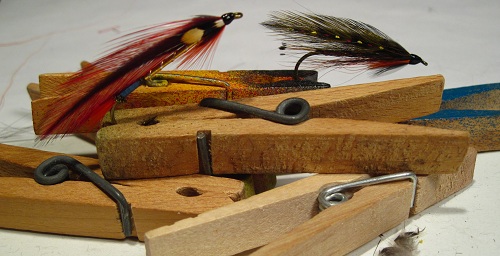
Clothes pinsClothes pins are another indispensable item on my desk. They hold flies as the head cement dries (wet flies and nymphs and such), they come in handy when you need a place to put a few stray strands of flash material, and they serve as an emergency aid if your thread breaks and you don't have a hackle pliers handy. You can probably steal a few from the house without anyone noticing. |
 |
BobbinsYou can't have too many bobbins, but they don't all have to be the very best quality. I have two good ceramic bobbins that hold my white and black thread (Danville 6/0 Flymaster), and random other bobbins for other stuff that I use a lot. I really hate changing threads on bobbins, so I always try to have the threads I use most often ready to go. The next time you order some materials, add an extra $10 investment in a couple cheap bobbins. You'll be glad you did. |
 |
Magnetic padsRemember when Tiemco sold hooks with those little magnetic pads in the package? I stuck one on the base of my vise for holding hooks. It's not foolproof, but it sure does come in handy. |
 |
Material springYou can either pay the $15 for a specific material spring made for your vise, or you can buy a 75 cent coil spring and build up the space with tape like I did here. That little rig is older than my daughter, who is now a freshman in High School, so it'll last. I hate paying money for silly things when a cheaper solution works just as well. |
 |
Save old thread spoolsEver need to tie a couple flies with a red hackle beard and feel guilty about tossing away the rest of the feather? Save your old thread spools and put those partially used feathers in the holes in the end. Next time you need a pinch of hackle, look there first before digging out your box of feathers. Danville spools are really good for this. |
 |
Multi-drawer organizersBy all means get one of those multi-drawer organizers at the hardware store meant for storing nuts and bolts and other small parts. Keep it right in front of you to sore all your spooled goods and label the front of the drawers with what's inside. How would I deal with all those things without this? No idea.In-freaking-dispensible. |
 |
Feathers readily availableI like to keep some feathers handy and readily available. Here you see some peacock pieces and a couple pheasant tails. I used to haunt a local craft store and pick over their peacock feathers when their flower arranging department had a sale. I'd get full sticks for fifty cents apiece, so I stocked up. I keep a couple on my desk and the rest out of the way. On the right is a waterfall of dry fly saddle hackle. I reach there first before diving into my bin of hackle, as chances are I'll find the hackle I need. When I'm done, I tape the hackle on the waterfall with a piece of masking tape so I can use the rest next time. Problem is my daughter has an eye on those feathers for her hair. Hands off, Sarah!! |
 |
Compartment boxesCraft stores sell cheap plastic compartment boxes that are great for fly storage. These were all in the neighborhood of a dollar. The same box from Myran or some other "name brand" would be eight bucks. You need somewhere to put flies before they go into your box, unless you are tying straight into your box. These work beautifully, and they are available in a bunch of different compartment arrangements. |
 |
Spool plastic binsThreads are usually sold by the dozen, and the plastic bins a dozen spools come in are very handy for spool overflow - things that don't fit in your organizer anymore. Just set them off to the side, you'll use it eventually. Fly tyers throw away nothing. |
 |
Snap lid plastic boxesWhen my kids were young, baby food came in jars (which were handy in their own right). Now Gerber sells food in these little snap lid plastic boxes! When my nephew had his first son and I saw these things - my eyes lit up! Had to have a couple. I use one for storing loose exotic feathers that I don't want to throw away and want to keep track of. An extra jungle cock eye, a blue jay feather, maybe a golden pheasant crest. If I've plucked it but haven't used it, in here it goes. |
 |
Plastic binsYou've probably all caught on to the plastic bin craze. These are a buck apiece and a true life saver. Not only do they keep your things organized, they help prevent bug infestations. I always have a couple empties on hand, for new aquisitions and the occasional overflow or reorganization. Mothballs inside these plastic boxes aren't as apt to stink up your room. (Well - not as bad at least). |
 |
Shoe boxesAnd shoe boxes are handy, too! I keep a bunch of duck and goose quills in one of these because they are big |
 |
- Log in to post comments


I love the tips
I love the tips. I also use many of the tips mentioned here such as the gerber food containers, the magnetic square on the base of my vise. A few more that I would like to share are:
1. Dryer sheets (such as bounce only cheap ones) work really well when tying with hair or if the environment is extremely dry as it is here in Northern California.
2. The drying wheel is critical. My father made one for my step Mom and one for me using a BBQ rotisserie motor. It works so incredibly well and the motors were actually scavenged from BBQs that had been thrown away.
3. Wine Corks... These little buggers are such a useful item. I use them to put flies on as they dry, I use them to protect my bodkin tip (and myself) and for dozens of other things. I also cut the corks in half and clue them to a picture frame so I have a way to display some of my flies. It actually looks very classy.
4. Hemostats, like a doctor uses, are very useful tools. I use them as tools to hold things, I use them for that extra flash that I only used part of. etc..
5. Tic Tac boxes work really well to house beads, cone heads and any other small parts. I have found some plastic bins at the dollar store that will hold the tic tac boxes so they too are organized.
I could go on and on as I love tying flies but I also love the challenge of seeing what is out there that can be used or reused that was never intended for fly tiers. I also agree that a fly tier never throws anything away. LOL I look forward to additional tips, tricks and quirks from anyone who is willing to share. :) Happy Tying to all!
Try looking on Ebay
Try looking on Ebay for your Jungle Cock cape; but instead of looking under fly tying materials try looking under feathers for making jewelry. I tried this on a whim and wound up getting a beautiful #1 cape for $100.00. Lesser capes in the fly tying materials section were going for at least what I paid and most had bids on them. I was the only one who bid on the one I got.
That was good information
That was good information ..appreciated the time you have gone to explaining those items. Always in trouble for feathers floating around on the floor :)) It is interesting how a simple tip when tying such as applying head cement to your thread prior to a whip finish makes things so much neater and easier than trying to seal the finished head.
These are great ideas
These are great ideas. Even as a commercial tyer I have never thought oft here kinds of ideas. I am a big streamer tyre as well and whenever I can get a chance I tie a few of the streamer and Spey style salmon fly patterns found on this website and on other resources. Please get back to me on any good flies to tie. Also, if you know of a good, cheaper place to get actual jungle cocks please inform me. They don't sell them for the cheap in fly shops in Colorado. I would love to start tying more different fly with artificial jungle cocks because I have easy access to them. Do you know of any patterns to start with. I would love to contact you with more useful hints and inventions I have used as a commercial tyer. I find that running a string on the ceiling to clip your materials to, with strings attached to the materials to pull them down. I am in need of a better fly dryer like your Cabelas one. Do you know of any other good commercial size ones.
These tips were so helpful
These tips were so helpful! I've only recently gotten into fly tying and these tips helped a ton!!!!! I have found that old cigar boxes with a hot-glued foam sheet in the bottom is a great way to store flies temporarily. Thank you!
Thank you so much
Thank you so much for your tips. I have been tying mostly buck tail jigs for about 6 years, on and off. Just untill recently I have gotten pretty serious about doing other Flies, the RIGHT way. Heck, I just took the time to find out what all the tools were called, and more importantly, what they are FOR. Never even knew what the Whip Finishing Tool was for. I just wanted to tell you that I love doing this and your tips were and are very helpful. If you'd like, please write back to share more about tying. I'm worse than a beginner when I see how there supposed to look. Thank you again. -Justin. From Volusia County Central Florida.
I have an old wine cabinet
I have an old wine cabinet that I put all my hackle and such in. Close the door and it doesn't look like I'm ready for a yard sale. But then you do have to get lucky and be there when someone put one out for the trash.
Well done Bob
Well done Bob. I believe we all have the same tying environment. I would add one more important thing to your list of tips...a tool organizer. Essential from my point of view.