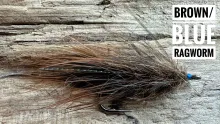
The Long Island Sausage Fly is perhaps an easier name for this German ragworm imitation. That might work better for some readers. The fish don't care, the fly is still a killer.

How this Ragworm Imitation Came About
For a start: sorry about the name! I know this is a hard one to swallow for non-German-speaking readers, but just accept the fact that the fly has this rather strange name.
For those insisting, the pronunciation is /ˈlaŋəˌlɛndɐ ˈpølsə ˈfluːə/
You could also try with LANG-uh-lend-er PURL-suh FLOO-uh. Put pressure on the capitalized parts.
You can also simply translate it to Long Island Sausage Fly. That’s basically what the name means - not that it has anything to do with Long Island. The island in the name is the Danish island Langeland, which translates into Long Land or Long Country. But Long Island is probably more natural and known to English speakers, so we can stick with that.
As a small aside Langeländer is actually a Danish brand of sausages, and pølse does mean sausage. The fly does look like a sausage, so there is logic behind the name.
In the spring of 2013, while staying at a vacation home on the island of Langeland, I had the idea to develop and tie an attractive ragworm imitation.
This fly was intended to catch sea trout reliably in very cold Baltic Sea water between 0 and 6 °C.
It also needed to move slowly and seductively through the water and present an appealing silhouette in shape, color, and size.
With the necessary tying materials and a little practice, you can tie the Langeländer Pølse Flue yourself.


1. Create the Foundation Wrap with Monofilament Thread
Make a foundation wrap with monofilament over the entire length of the hook shank and secure it with head cement.
2. Add Weight for Horizontal Balance
Next, cut two pieces of 0.35 mm lead wire, each approximately 3-4 mm long. The amount of weight can be adjusted as needed.
Tie them in side by side on the underside of the hook shank, centered roughly one-third of the way back from the front, and secure them. Then coat everything with head cement.
With the lead weight positioned in the front third of the hook shank, the Pølse Flue should maintain a horizontal position in the water while sinking on a tight line.
3. Add the Marabou Tail for Attractive Action
Tie in long XL marabou feather segments (brown) for the tail.
Then use additional wraps to angle the tail away from the hook bend to help prevent fouling while fishing.
The long marabou tail creates attractive underwater action when pausing the retrieve.
4. Prepare and Tie In the Latex Strips
Cut two tan latex strips (6 mm wide) to the appropriate length, using the hook shank as a guide.
Tie the latex strips in at the rear, just in front of the marabou tail, one above and one below the hook shank.
This can be a little tricky at first. Taper one end of each latex strip to a point. This makes that end much easier to tie in and secure.
5. Prepare the Ribbing for the Body Segments
Tie in a piece of monofilament (approx. 20 cm long, 0.22 mm diameter) at the hook bend and color it black with a permanent marker.
This line will later be used for ribbing to imitate the individual body segments.
Andreas Jendrichowski
6. Prepare the Rooster Hackle
Tie in a long black rooster hackle by the tip at the tail end as well.
Long rooster feathers with hackle fibers of relatively uniform length along the entire feather are preferable.
7. Build the Body with Synthetic Yarn and Dubbing
For the body foundation, I use synthetic yarn as filler. Depending on the thickness of the yarn, I wind it tightly and evenly forward around the hook shank in 1-2 layers and secure it about 8 mm behind the hook eye.
This saves a considerable amount of dubbing material when building the entire body.
Tightly wound synthetic yarn also absorbs less water. As a result, the Langeländer Pølse Flue can still be cast well on a 7- or 8-weight fly rod.
Next, dub the body with the brown synthetic dubbing evenly from back to front, stopping about 8 mm before the hook eye.
In the front, I leave enough space between the body and the hook eye for the chenille head.
Over time, I have tied the Langeländer in various brown and purple color combinations. All of these color variations catch fish.
8. Wrap the Rooster Hackle
Next, wrap the rooster hackle forward in even turns, starting at the rear and stopping about 8 mm before the hook eye. Tie it down and trim surplus.


9. Divide the Hackle Fibers for a Slow-Moving Profile
Now divide the black rooster-hackle fibers evenly to both sides, left and right.
To create a slow-sinking profile, all of the hackle fibers should ideally be positioned evenly along the right and left sides of the body.
10. Bring the Latex Back and Belly Forward to Create the Wing Effect
Under slight tension, bring the latex strips forward and tie them in - first the underside, then the top side.
Make sure the latex strips press the black hackle fibers evenly outward and flat to the left and right along the entire length of the body.
This makes all of the hackle fibers project sideways, allowing the fly to glide through the water as if it was riding on wings.
11. Form and Tie In the Body Segmentation
Carefully wind the black-colored monofilament between the individual hackle fibers to form the fly's body segments.
Make sure the individual body segments are spaced evenly along the latex strips.
12. Tie In the Black Head and Jaws
Form the ragworm's head with black Ultra Chenille to finish off the fly.
Species-specific features such as the black jaws at the head and the numerous legs along both sides of the body are intentionally tied larger to create strong contrast and their own movement in the water.
13. Finish with Head Cement
After the whip finishing knot, secure the thread with head cement.


The Secret of the Black Head
While wading near shore and fishing with a fly rod, I watched several ragworms moving slowly through the water in front of me.
I witnessed a sea trout unexpectedly approach from the side. Suddenly, it swam toward a ragworm and immediately gulped it down whole.
I observed this feeding behavior several more times at short intervals.
I could only think: Why does the sea trout inhale the worm so quickly?
After all, a ragworm is easy prey.
I interpret the sea trout's behavior this way: Ragworms have large, defensive jaws in their oftentimes black heads. When threatened or in danger, the worms extend these jaws and can inflict painful injuries on attackers.

Jaws = Danger!
That live observation on the water also explained the sea trout's rapid, hurried feeding behavior to me. The fish have adapted the way they feed to the danger.
By quickly inhaling the ragworm, a sea trout reduces the risk of being injured by the worm's jaws, for example on its sensitive gill arches. Ever since that key experience on the coast, I have tied all of my worm imitations with a small, visible head that is usually black.
A black head tied onto a worm fly continually signals to sea trout:
Danger = eat the ragworm quickly to avoid injury.
The small number of missed strikes I have had over a long period reinforces my decision to fish black-headed worm patterns along the coast.

Tactics and Presentation
The design and its effect:
With the hackle fibers projecting sideways, the Pølse Flue glides seductively through the water as if it was riding on wings. The goal is to present this ragworm fly slowly and attractively to fish in very cold water.
Why?
Because sea trout are usually sluggish at these cold water temperatures. That is why I fish the Pølse Flue with long, slow strips. Pauses of about 2-3 seconds on a tight line are ideal.
The tight line maintains direct contact with the fly, allowing you to respond quicly to a strike.
The hackle fibers projecting to the right and left help the Langeländer move slowly and naturally through the water column as it sinks.
This retrieve technique has several advantages.
- It allows me to fish productive spots very thoroughly and intensively.
- The ragworm fly remains visible and attractive in the strike zone longer.
- It increases the chance that sluggish sea trout will follow the worm fly and, ideally, be tempted to strike.

The strike often comes during the fly's sinking phase. This method requires patience and discipline. In the end, the long-awaited strike makes it worthwhile.
In my experience, despite its long marabou tail, the Pølse Flue produces few missed strikes. The Langeländer is often inhaled without hesitation, and the hook usually sets securely.
Under exactly these conditions, on a cold spring day along the west coast of the island of Langeland, I caught a large, bright silver sea trout on the Langeländer Pølse Flue. The strike came close to shore, right during the sinking phase. After an exciting fight, I safely landed a sea trout measuring 75 cm and weighing 4.5 kg.
The Langeländer Pølse Flue has tempted beautiful bright silver sea trout between 60 and 75 cm. Cod, rainbow trout, and sculpins have also been unable to resist this fly.
A good fishing friend has also fished the Langeländer Pølse Flue very successfully for many years with a Sbirolino rig.

How It Got Its Name and Its Permanent Place in My Fly Box
Under the conditions described above, the Pølse Flue has been my first choice along the coast for years.
That is why the Langeländer Pølse Flue has a permanent place in my fly box next to the Mika Fly and PG Reje (PG Shrimp).
I chose this name because, with a little imagination, its silhouette reminds me of the well-known Langeland sausage.
Simply the Langeländer Pølse Flue. You can see the box in the top for more info on the name.

This article was translated from the original German article found on Andreas' web site. AI was used for the basic translation, but the raw translation has been thoroughly edited and adapted by me and approved by Andreas.
- Log in to post comments