
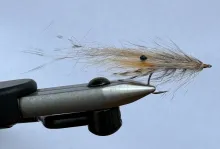
There are thousands of shrimp patterns in the world, made from the same template. This pattern is a time consumer, but it makes it more interesting tying shrimp flies. The eyes, proportions and legs gives this pattern some kind of magic.
|
|
|
|
|
|
|
|
|
|


Shrimp patterns are popular all over the world. Bonefish like them, bass like them and sea trout like them, just to give a few examples.
Some patterns are impressionistic and generic while others are realistic. But there are also some in between, which are generic and yet have this magic touch of the realistic ones. The Honey Shrimp is such a fly.
Short history
It was invented during 2001 by the Danish fly tier Henrik Agerskov. Because of the realistic look, it quickly became a favorite among many fly fishers.
I did not know of its existence until April 2003. I was fishing with some friends on our annual trip to Bornholm, and was taking a break in a local tackle shop. Here I saw a grey shrimp fly with orange legs on one of those foam boards where shops often keep their larger flies. It looked interesting and I bought one to study and reverse engineer.
Later I tied a few, but it never really made to the top in my fly box. Maybe because the legs did not stay in position and the fly often capsized.
Reborn at the GFF summit
Three years passed without noticing the honey until the GFF Summit 2006. During a break, Jesper Kamstrup and I discussed flies and casting techniques. He was very much into fly fishing and serious about his technical performance. When I looked into his fly box, I could hardly see any flies but Honey Shrimps in a dark version (Dark Honey, see below). They were large. Tied on a size 2 or 4 and 7 centimeters or almost 3 inches long.
Big flies!
"Well, the smaller trout go for them but do not get hooked, and the bigger ones seem to hit them with a rare resolution." Jesper said, as I was just about to go through a minor questioning.
"The average size has come up with 15 cm or 7 inches since I started using it. This dark version is now the only fly attached to my tippet."
Later that day, after a good meal, he tied Honey Shrimps for several of us. Martin started using it, and proved that it could take a fish or two.
Now, we have been asked by several anglers, if we would publish the pattern on GlobalFlyFisher.
Here it is
We wish you a good time at the vice, but first you have to prepare a few materials.
You need some epoxy eyes, rubber legs and dubbing.
The eyes takes time to make and they should also dry up, so let's start here.
Of course you can buy some, but isn't it more fun to make your own?
When you have made eyes enough, make 8 rubber legs for each fly.
Then make a dubbing blend of rough tan dubbing, SLF Saltwater, copper dubbing, and UV-dubbing. You can do that in the coffee mill, when no one sees it.


Tying Tips
If you want a more "bushy" version you can let the rip start after the second pair of legs and not after the first as shown in this article.
Controlling the antennas whether they are made of Ultra Hair or polar bear, might be easier if you tie them down, where you tie doen the ribbing instead of tying them down at the hook eye.
Even though we think this pattern looks like a shrimp, there is still long way to the perfect imitation. But as long as the fish also takes the fly for a shrimp, why bother?


Dark Honey
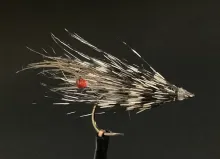
Jesper Kamstrups Dark Honey - a Honey Shrimp variant.
|
|
|


Jesper also ties a light version, where he uses very light colored dubbing as body and Unique fly hair, speckled grizzle as back - however, it is most often the dark one which takes the first place fishing trip after fishing trip.
- Log in to post comments


Thanks a lot for this
Thanks a lot for this great fly.
We were in Denmark in the middle of march 2013 with very bad condintions (water 0 deg.C and airtemp -2 deg,C). With 4 flyfishers we catch 5 seatrouts, from which I caught 4 with a pink honey shrimp. :-).
Now I'm thinking of to fill the fly-box only with different colours of honey-shrimp...
You can contact me
Robert,
You can contact me, and we can work on an addition for the article with your updates.
Martin
Update from Robert L
Update from Robert Logan on Shrimp Pattern - Gentlemen, I have come up with a partial solution to the head portion for the shrimp pattern I have been working and in an exciting new development....I have been experimenting with Enrico Puglasi fibers and have discovered that they become translucent and absorb water well to give a very much a "real shrimp flesh" look when submerged in water! I would like to post my fly tying sequence and photos for you all to see, tie, make commentary and more importantly catch some really large sea trout! How can I do this? I had a chance to tie this pattern at the 18th Annual Texas Fly Fishers Symposium earlier this month and I gave away several dozen of them.
instead of using plastic
Robert,
instead of using plastic, shell-back or the like for the shield, why not try using clear ultra hair or natural hair of some sort, coat it sparsly with epoxy, and you will have a structured back/head, strong, and coated.
You could also upload your tying steps in the forum and challenge all the GFF-visitors and see, who brings up the best idea.
Kasper
Thank you for recommending Soft-Tex
Thank you for recommending Soft-Tex...I have access to it but have not used it...yet....in my youth I used to fish with live shrimp and enjoyed catching and handling them...have you noticed how they seem to have "two-pieces"? The tail seems to make up 66% of their body (which I have technique that works good for this part), but the head part on real Gulf Coast shrimp is hard, like a molded shell or "helmet" that a Roman Gladiator would wear protecting their soft insides...I know I fill the inside with dubbing, rubber legs, glass beads, etc...but how can we make the this "shell"? My current idea is cut a piece of hard thin clear plastic and fold it around the hook shank over my "soft insides" to complete the head. I am currently experimenting with this concept. Has anyone ever done this before? If so, are there pictures?
Have you tried SoftEx?
Robert,
Thanks. Have you tried SoftEx?
Kasper
All fit together great
This pattern, the article and photos all fit together great! I am fascinated by shrimp patterns and have been working on a pattern that looks realistic wet for the shrimp we have here in the Gulf Coast in Texas. Does anyone have any ideas of what material to use for the head ...besides epoxy? I am looking for ideas and inspiration!
Dear Kasper,
Than
Dear Kasper,
Thanks for this very good pattern! I tried it this year on our annual fishing trip to Fyn (end of April). This shrimp was responsible for most of my takes. Best fishing trip to Denmark, so far.... :)
I tried the pink pig pattern as well, but couldn't get it to swim the right side up. I'll have to make some modifications to my pink pigs for next year. I also had a quick question: How true is it that one can only catch sea trout at high tide? I always see the local fisherman leave when the tide is getting lower. Am I casting my "flies" for nothing at low tide?
Thanks
Martijn
What great pattern
Kasper, what great patterns and account. I like both patterns. Thanks.
Butch, I too would like your '97 Honey Shrimp -- or publish the pattern here or e-mail me??? Thanks.
Shrimp patterns are time consuming to tie --but well worth it when you spend those precious few hours on the water! Some of our shrimp [in Mississippi, USA] are almost clear and small [hook14-20], some tan, others brown, some molted of 3-4 colors or light pink. I'll have to get busy at the vise.
Some times I like my shrimp heavily weighted, and at other times -- with just enough [5-10 rounds of non-lead wire] to allow it to sink slowly. Boy, what fun.
KEEP YOUR LINE WET!!!
In His Love,
Clyde
Thanks
Butch,
thanks, I am glad you found it interesting.
However, Jesper and I did not create it. Henrik Agerskov did.
We just tied it and published it on the Global FlyFisher.
Kasper
There was a guy soaking bai
There was a guy soaking bait, and catching skates, near my home in Brooklyn. He checked his line, and had a shrimp, that looked just like the honey shrimp, impaled on an 8/0 hook. He was fishing in about 50ft of water, in the shipping channel. I've gotta tie some of these, as all my shrimp patterns are pretty beat up. Fluke and Bluefish like these, too. Striper season opens Apr. 15th, so I'll need the honey shrimp by then. Tight Lines, Lars p.s. report from Upper N.Y. Bay
You guys have produced a great fly
Jesper & Kasper,
Man, you guys have produced a great fly. I really like the style of the fly and the legs are cool man. The Deep honey is smooth too.
Butch,
It would b
Butch,
It would be great to see your variant. I have sent you an email.
Kasper
I recall making my own version of the Honey Shrimp
Hello Kasper,
I recall making my own version of the Honey Shrimp in 1997 in kolding at the fly show. I would like to send you a picture of , but I am unable to do so becuase I do not have your email address. I tied a some what more realistic version using Wild Boar, Shellback, mixed dubbing cdc with rabbit. If you don't mind I would to send it to you per email.
Butch
Dont bother with my comment
Dont bother with my comment I just sent if I had spent more time on the page I would have seen the answer to my question.
Thanks Hamish
I live in the Orkney
I live in the Orkney Islands and I am keen to try some of these flies around our shores can you tell me how you fish them ie type of line and the retreave?
My setup consists of a floating shooting line
Serge,
my setup consists of a floating shooting line, a very slow intermediate shooting head and a normal nylon leader app. 5 yds.
I strip it in using longer strips, shorter, fast, slow - but (too) often I just strip it in using 1½ foot strips.
How do you work the fly at sea
I JESPER AND KASPER
how do you work the fly at sea ? you strip it fast or very slow ? do you use a floating or sinking tip line, what is the best setting.
thanks for comments
serge
You can use whatever you like
Hi Serge, you can use whatever you like to make the body of the fly, i just prefere to add some attraction to the fly, using the UV dub, it makes the fly "glow" in the water, however i've tied flies without it that works (almost) as well. For the back you can use EP fibers, i take two different shades of brown and brush them together in order to create a sort of spotted back.
Regards Jesper Kamstrup
You may use Ultra Hair or Kinky Fiber
Serge,
You may use Ultra Hair or Kinky Fiber instead of Ultra Hair. Be aware, that Ultra Hair is more fine and you may find even better substitutes.
UV-dubbing has other names like Flash-dub or Aura-dubbing. You can also use SLF Prism, tan, which is a new dubbing having this UV-look, but actually reflects light as in a prism.
I hope you find the materials you are looking for.
Kasper Mühlbach
Kasper
Superb fly and great pictures
thanks kasper, I was waiting for it, superb fly and great pictures. is there a substitute for the ( unique fly hair and the ice dub uv).
It may turn if the legs are too long
Igmar,
it may turn, if the legs are too long. The weight on the hook shank is added to prevent turning and keeping the right position. The ones I have tied lately works perfectly well.
Kasper
Kasper,
Thank you f
Kasper,
Thank you for this pattern. I heard some great stories of this fly. But does this pattern turn hook down? Or does the bunch of Antennas prevent this turning? That's one of mine main problems with a lot of shrimp patterns, they always turn back down and that is not so realitstic. Greetings from Holland and hope to see you along the Dannish coast. Igmar
I am glad
Paul,
thank you. I am glad you enjoyed reading it, and that you had such a great day!
Kasper
Thanks for the great article
Thanks for the great article Kasper, I also received a dark honey from Jesper at the GFF and was reluctant to use it (didnt want it lost), but on my last trip on the Danish coast I pulled it out of my fly box to give it a spin. As the first fish took my fly, I was not prepared, and my rod flew out of my hands from the very hard take, after a quick swim for my 900 $ outfit and landing that, plus 7 other fish that day I became a true fan of the honey shrimp. Now my fly box is full of them.
Paul