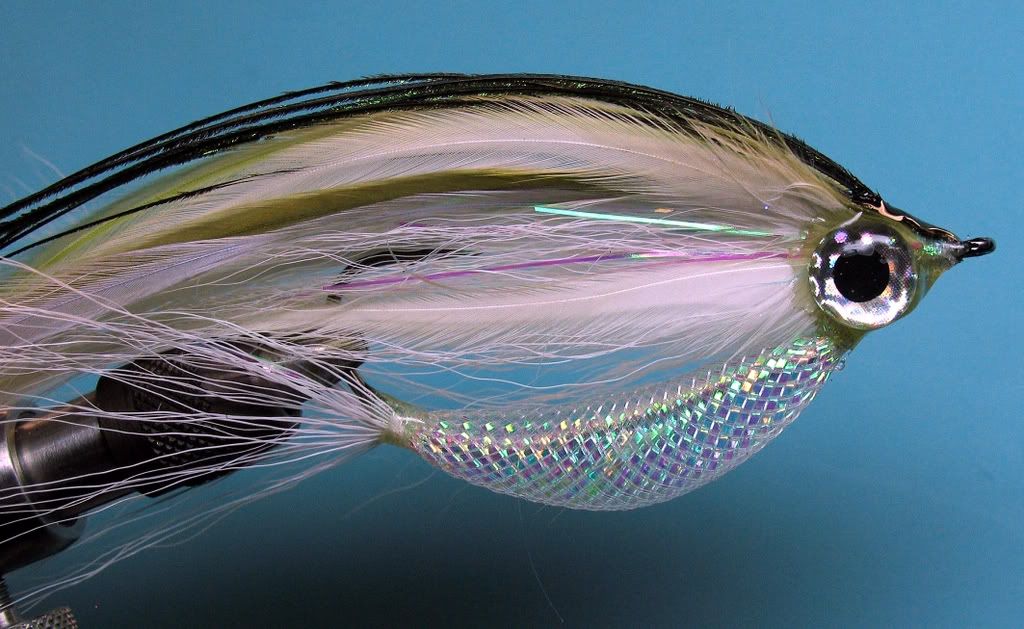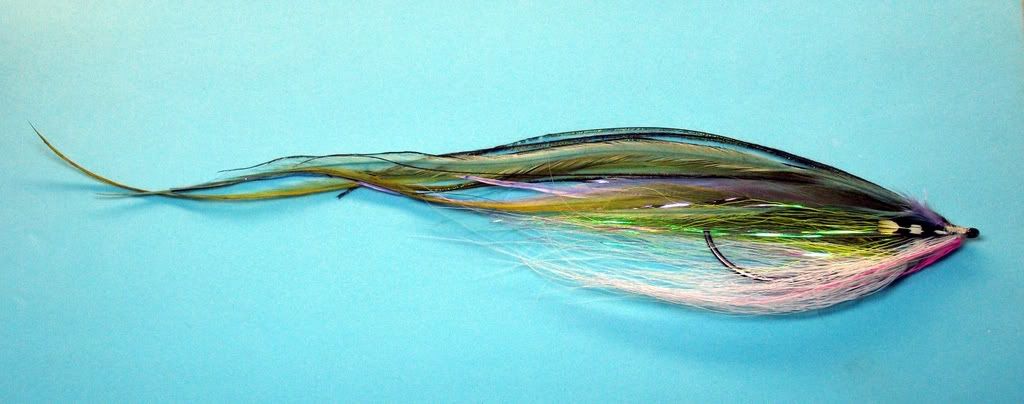
It was tied in tribute to an American TV actor - William Conrad I believe. I can look up the reference. Email me and I will look for you - bob_petti@yahoo.com. Thanks.
- Log in to post comments
It was tied in tribute to an American TV actor - William Conrad I believe. I can look up the reference. Email me and I will look for you - bob_petti@yahoo.com. Thanks.
Wiggy, Thanks for your reply. Yes, you are right, the line has clear intermediate tip. it is very interesting. A lot of Czechs go every year to Denmark and a majority of them use intermediate line and low weighted flies. We usually retrieve quite fast, so I would say that the fly is in upper level of the water. So in my opinion, the main reason for usinng floater is the sea weed. But I must also confess, that I fished some places where the floater seems to me better.
I am glad for any reply which can clarify this interesting issue. So thanks
Primarily three lines are often used for sea trout for a variety of reasons, so here goes:-
Floating line - Mainly used in areas where water is shallower or slow shelving (e.g. most of denmark from the shore), for floating flies, or at night when presenting a fly in the very upper layers of the water give a better silhouette and a better chance of a fish seeing the fly. Though a floating line has large control issues in windy weather and has poorer wind cutting properties due to it's diameter in comparison to weight.
Slow Intermediate (0.5ips) - A good line for allround fishing in shallower water and eliminates the wind effecting the line and thus having direct contact with the fly.
Fast Intermediate (1.25-1.75ips) - A good allround fly line for deeper water and fast shelving beaches (e.g. most of Norway). This is the line I use 95% of the time, plus it's clear thus be less visable, though this can be discussed. Due it's faster sink rate, you can present you fly at various deaths by just waiting a bit though may be too fast for shallower areas. A good caster due to it being relatively thin in comparison to it's weight.
Now I've no idea as to where you fish yourself, but your line sounds fine for most situations and even better if it's a ghost tip i.e. the tip is clear.
If you have any more specific question, fire away!
I used a Patagonia SST for 10 years - mostly the same kind of fishing as Martin (coastal fly fishing in Denmark and Sweden). My maintenance routine is a yearly spin in the washing machine with a special soap for breathable fabrics, and an impregnation substance - both from Nikwax. Bought a new Patagonia stretch last year (the one with concealed, top-entry frontpockets), but that particular model has now been redesigned. And I think i know why. My biggest problem is the depth of the front pockets - access is not very easy. I should have bought the SST again. My old SST is still working well - but 10 years of service has given it a "well-worn" look.
I would love to know the history of this fly, I am of the Conrad clan and I am a amature fly tier. I just found this fly on the web and am very excited to see a classic fly named after my family.
Am looking for the grain of the line to match the wt. for reference. A 6 wt. is about 160 grain. What is the grain of the other reference wt.'s.? What wt. is a 330 grain line?
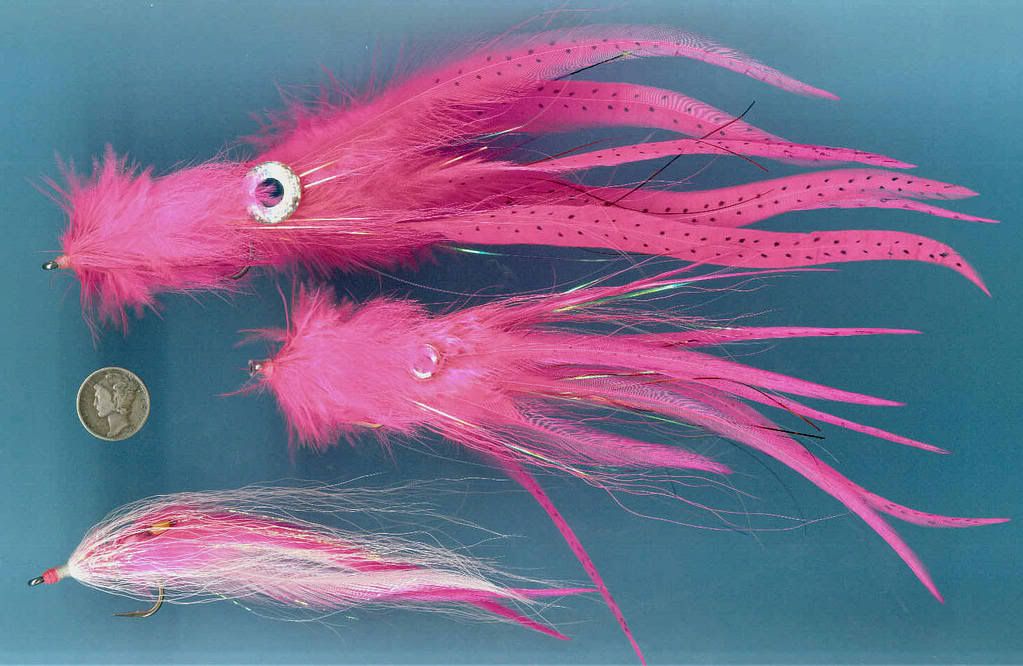
Variations on a theme...
http://i198.photobucket.com/albums/aa176/Phracas/5.jpg
I was in Aero this week and caught fishes 10-15m away from shore!!! it should not be different in Fynn. Have fun!
Tight lines,
Eddy
Hello martin,
Here are a few pointers for Florida: the great thing is that there are fishes pretty much anywhere to be caught.
For bonefish, the southern keys is the place to go with a fast 8 weight, floating line, boneflies and some barracuda flies, you should be able to hook something. Bones are spooky there but they can be big. Better bet for bones is to go to the bahamas, which is not far by plane/boat. Small trevallies cruise the flats as well...!
Tarpons can be caught in the keys as well, close to the bridges and all the way to fort meyers. Sure bet is to hire a guide with a boat for the big ones on a 10 or 12 weight. But there are many smaller ones in the canals, causeways, etc. which can be great fun on 8 weight. Snooks are there as well and can be fun.
Basically I would get a 8 and 10 weight fly rod, a 12 if you want to go for big poons, tropical floating lines, a good reel with lots of backing & good brake, good wading shoes, plenty of suncream, polarized glasses, plenty of different flies and cast whenever I could.
Renting kayaks is a terrific way to discover birdlife and go after fish as well. Depending on the season, hiring a guide should be done in advance, otherwise you might be left with a nondesirable one....wich is a waste of money.
Be careful of the sharks in muddy waters, plenty of bull sharks and big hammerheads can ruin a day...but they can be had on the fly as well and that's when the fun begins!!
Tight lines Martin! let me know how your trip went!!
Eddy
G'Day Andy...
The hook in the Dyna-King jaws is a Mustad Signature Series 4/0 Tarpon... (strong/heavy/durable)
The keel hook just prior to your inquiry is an Owner Cutting Point Rig'N Hook 5/0...(#5137-151) I fish it over estuary muscle beds and eel grass and congured up a snagless design.
Below is another more involved keel hook version on an Owner Cutting Point "Oversize Hook" 7/0 (#5110-171) Fished/drifted slowly on a floating line in low light during the Spring Herring estuary parade...
http://i198.photobucket.com/albums/aa176/Phracas/KeelHookInsinuation-1…
D.Roberts,
The lake is Tal-Y-Llyn as mentioned in the article from Wales, which you can find in the Reports section.
Martin
A suggestion on keeping the indicator in place is to pass the loop thru the O-ring and then twist the loop one time before placing it over the indicator. This has worked great for me. Love this site. Keep it oming...
good informashion for lads who live in wales picture of you sitting in boat lyn clywedog by any chance? many thanks d.roberts p.s tight lines
I can see it now...
Airport Customs/Agriculture Inspector:
"I'm sorry Sir...Please follow me into the 'QUARANTINE' area..."
"You cannot procede until we fumigate you and your baggage..."
"Worst case of Sea Lice infestation we've seen since we stopped a guy named Martin from Denmark!"
NICE TYEZ !!!
Awesome,, I never thought of slicing it very fine for wings
cheers ,, ,you've just given me another idea 😄
Andy
Looks great - and thanks for the crab pattern as well!
I'll have to try something similar with evafoam, which is similar but thicker.
There's also a product out there called "mayfly spent-wing material", produced by a top- notch gentleman in Ohio, Jerry Belfour. It looks like what would be used to wrap electronics, but is far more durable (in my personal experience) and somewhat more flexible as well. http://www.mayfly-material.com/ is the site (no affiliation shy of being a VERY pleased customer!) and I may be wrong, but he used to send a small sample upon request...
Anyhow, great tie and I look forward to many more!
Tight wraps,
Pete
Hi Pete
Its packaging foam I kept from a camera ... its similar to the closed cell foam you would buy for making gurglers, perhaps not so dense
I made a crab fly out of it too ..
http://img413.imageshack.us/img413/2163/imgp0720resizejx1.jpg
http://img262.imageshack.us/img262/5339/imgp0721resizeno1.jpg
http://img338.imageshack.us/img338/338/imgp0722resizene3.jpg
Andy
Awesome tie there! Just curious, what was used for the back/ carapace? An evafoam- like product, or perhaps a swiss straw? Just curious - whatever it is, it was used with great success!
Tight wraps,
Pete
'Wanted to display large, prominent eyez...
...with enhanced three dimensional characteristics.
Did not want to compress or restrict the body material nor rely on gobbs of goop to hold the BigEyez in place...
Simple, durable, adjustable, and suited to numerous applications.
An epoxy project that combines 3D eyes and mono...
http://i198.photobucket.com/albums/aa176/Phracas/3DBigEyez-1.jpg

… I have a small favor to ask.
Support the Global FlyFisher through several different channels, including PayPal.
The Global FlyFisher has been online since the mid-90's and has been free to access for everybody since day one – and will stay free for as long as I run it.
But that doesn't mean that it's free to run.
It costs money to drive a large site like this.
See more details about what you can do to help in this blog post.