
Imagine a fish that takes a fly as readily as a trout, whether it is nymph, a wet fly, or a dry fly. Czech nymph style, wet fly swing, North Country style or upstream dry fly. Now magine that, pound for pound, at least twice as strong as a trout

The author - Korrie Broos |

Releasing a smallmouth yellowfish |
Although Yellow Fever normally only occurs much further north, in the Tropics, is transmitted via a waterborne insect and has horrendous symptoms, South Africa has a type of "Yellow Fever", the symptoms of which are far more insidious: Victims of this disease, which is also caused by an aquatic organism, face a life long struggle against the symptoms.
Highly contagious
This highly contagious southern yellow fever has the following readily recognizable symptoms: anxiety attacks, flashback, nocturnal sweats, hallucinations, nervous anticipation and empty wallets. Victims suffer repeated withdrawal symptoms if not treated appropriately. (Although no long-term remedies have been discovered). The waterborne organism responsible for this highly infectious disease is the Labeobarbous group of fishes commonly known as "yellows" or yellowfish.
The name derives from their color, which varies, from a silver sheen with just the slightest touch of gold in their iridescent scales to the rich yellow-golden color of butter. A variety of species are found in river systems across the Southern Africa, seven of them in South Africa.
In European countries relatives of these fish are called barbel (Barbus barbus) and are not recognized as game fish most anglers. In South Africa they are increasingly recognized as a premier fly-fishing species.
Imagine a fish that takes a fly as readily as a trout, whether it is nymph, a wet fly, or a dry fly. You may want to fish the fly indicator nymph style, Czech nymph style, swing a wet fly across North Country style or upstream dry fly style a la Halford purists.
Their feeding behavior is between 80% and 100% characteristic of trout and grayling. Now, with all of that, imagine a fish that is, pound for pound, at least twice as strong as a trout (even three times as strong, some believe) and are commonly caught in the 6-10 pound range. Fly fishers contract "yellow fever" on the first hook up.

Clanwilliam yellow |

Keith Wallington |

Ready |

Winter on the Vaal River |
Incurable
Unlike the normal form of the disease, which can be treated if one has access to medical facilities, "yellow fever" is incurable, although short term relief can be gained by regular trips to the nearest suitable river (locally known as "therapy"). There are documented cases of fly fishers trying to shake the disease by going "cold turkey", who, on giving up in desperation have traveled up to three hours to the closest river to obtain temporary relief. In the most acute stages of the disease fly fishers who have been known to travel to their favorite river up to four times some times even more a week and more. Obviously work, family and other social factors suffer hugely when the disease reaches this terminal stage.
The Labeobarbus group is probably South Africa's premier fly-fishing quarry, rivalling the spectacular tigerfish, which unfortunately only occur in one of our river systems.
The 9 species of yellowfish occur in different drainage basins and some are listed on the IUCN red data list as Vulnerable to Highly Endangered. Their potential as excellent sport fish has led to the conservation plight of some species being high lighted by the fly fishing fraternity. In addition, although this is not the case for all recreational and subsistence fishers, it is estimated that at least 99% of all yellows caught on fly are returned unharmed.
There are seven species in South Africa, all highly sought after, but the two premier species targeted by the fly fishers are the Smallmouth and Largemouth, with the small mouth being by far the most common. As all yellowfish species are hard fighting fish the other reason these two specific species of fish have become so popular is the accessibility. They occur in the Vaal and Orange River drainage system with a total drainage area of over 682,000 square kilometres.
History
The history of fishing for the "yellows" can be traced back to 4000 years where the ancient San people hunted yellows in the upper reaches of the Orange River ("Senqu" River in Sesotho, the local dialect) in Lesotho. In 1820 there was a big influx of settlers from Britain as part of the huge colonial land grab in Africa. These settlers brought their fly rods from the UK and, while exploring the interior of Southern Africa, encountered the local yellowfish.
There is documented proof of the British officers fishing for yellows, at the Boer War Concentration camps, situated on the banks of the Vaal River in 1900.
Trout are not indigenous to Southern Africa and the first ova arrived via mail ship in 1898 in the Cape at Jonkershoek. After years of experimentation trout introductions became routinely successful and fly fishing for trout spread across the country and in many rivers trout manage to breed successfully and are actually a sustainable fishery without any further stocking. The oldest fly fishing club in South Africa is the Cape Piscatorial club (www.piscator.co.za), established in Cape Town in 1923, to look after the interests of trout fisherman and the trout.
The 1940s to 60s were the dark ages for yellowfish, as trout became the "fish to fish for with fly". The official policy of the nature conservation authorities to stock trout in the rivers also promoted the popularity of trout as a fly-fishing quarry. (Fortunately for all the indigenous fish this policy have changed and the nature conservation authority have gone back to original mandate of protecting and promoting nature that is indigenous to the areas). In the late 1980s some intrepid fly anglers rediscovered yellows on fly. They started developing more imitative patterns specifically for yellowfish and, more importantly perhaps, published articles on how and where to fish for yellows. This led to increasing interest and, since the early 1990s; there has been an explosion in yellowfishing on fly.

Double digit yellowfish |
Biology
Yellowfish start their lives very similarly to trout. They spawn in gravel beds under riffles. But unlike trout that swim to the headwaters, yellowfish choose the riffles with gravel beds within their home ranges.
Some species spawn up to three times a year, during spring, mid summer and late summer. This "series spawning" behaviour is an evolved behaviour that ensures good water flows are maximised and result in good recruitment to the population. This is important in South Africa where the climate is semi-arid and rains are not a guarantee.
The diet of the yellowfish consists mainly of larva and nymphs; during hatches they will, however, readily rise to dry flies.The smallmouth's behavior is very similar to Grayling and the Largemouth's more like that of the Marble trout.
The Smallmouth Yellowfish is a shoaling fish like the Grayling. They differ in that Grayling are fairly stationary in their holding areas, whereas yellowfish tend to forage over greater distances. They prefer the fastest sections of the river, which is typically in the rapids. Most fishermen will head for the faster water, although some of the real trophy fish may be found in pools or the slow runs.
If you have the opportunity to observe a yellowfish shoal feeding, it is worthwhile doing so for as long as one can, since this is how useful insights into their behavior can be gained, which in turn will help with more successful fishing in the future.
Smallmouth yellows occur in pods of up to 30 individuals and start feeding at the bottom of a rapid and move upstream. Since they often feed on larvae, nymphs and algae clinging to the rocks. The lips of the yellowfish have evolved along the lines of vacuum cleaners, with some specialists developing extra-large lips. Such individuals are commonly referred to as "rubber lips". While one observes them from above, they will be seen to push and nudge and turn over rocks with their noses to access larvae, nymphs, shrimp and crabs on the undersides. It is not uncommon to see scales get dislodged as they sometimes nudge and push and eventually manage to overturn rocks up to the size of half a football (remember these fish are capable of attaining over 20lbs in weight). The advantage for shoals of fish foraging in this manner, is that dislodged "escapees" are carried on to the next fish by the downstream conveyer belt. The observer may actually notice how fish rotate the duty to nudge the rocks while others lie immediately downstream to enjoy the free drift food coming past.
The normal outfits used for yellows are 5 to 7 weight 9-foot rods with matching floating lines. Recently longer rods, up to 11 foot, have become more popular because they offer better line control when indicator or Czech nymphing and the ability to reach that little run that would otherwise have been out of reach.
Fishing for yellows requires a stronger tippet, than the 7 x you would often use on leader shy trout. These are particularly strong fish so minimum breaking strength used by local fly fishers is a tippet of 6 pounds (4X), normally 8 pounds. Even with 8 pounds a smash take will break one off. Going heavier than 8 pounds, however, tends to put the fish off. Furthermore, thicker lines do not allow Czech nymphing rigs to sink fast enough to swim just above the bottom in the fast water; if used, heavier flies are required and they cause problems with drag. With tippets of 6 to 8 pounds one has the luxury of fighting the fish very hard, thereby reducing stress on the fish. Newcomers to fly fishing for yellowfish, not knowing the true limits of their tackle, tend to play the yellows far too gently and a 6-pound fish can tow them around for 30 min or more before they manage to land it. An average smallmouth yellow is between 2 and 6 pounds. A trophy fish is considered to be 8 pounds plus. Real lunkers are in excess of 10 pounds. Large mouth yellows, in particular, can grow in excess of 20 pounds. The South African angling records for both species is greater than 40lbs!
It is hard to describe the take and fight of a yellowfish on fly.
For the average trout fly fisher, visualize this:

Black fly larvae |

Small olive biot emerger |

Czech nymph |

Hydropsychidae larva |

Hydropsychidae pupa |

CDC Shrimp |
Flies
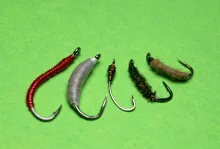
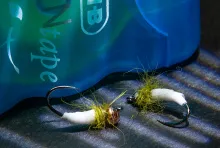
The flies mostly used for smallmouth yellowfish include caddis (sedges), mayflies, midges (buzzers), blackfly, shrimps, crabs, small fish in all their forms, including nymphs, emergers and dry flies.
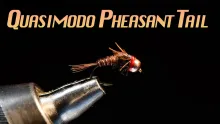
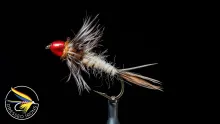
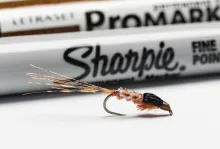
The most popular flies include caddis larvae, shrimps, brassies, GRHE, GRHE with brass beads; pheasant tail nymphs, wooly buggers, San Juan worms and Czech nymphs. At least one of the two flies usually deployed should be weighted heavily enough to allow the ‘control' fly to swim or bounce along the bottom. The other is either lightly weighted of unweighted.
The following dry flies have proved their worth: Elk hair caddis, Goddard's caddis, Griffith's gnat, RAB (a South African variation of the Variant style), flying ants, beetles and Klinkhamers.
The sizes that the most of the local fly fishers employ vary from size 12 to 18.
It pays to have a couple of patterns in each size as the fish can become very size-selective at certain times of the year.
Large mouth yellows tend to take large streamer and baitfish imitations, but they also enjoy drifted crabs and woolly buggers.
Imitative patterns are normally more successful than attractors. Keith Wallington, one of South Africa's most knowledgeable fly fishers and one of the most innovative fly tiers has developed some of the most realistic, patterns to match the hatch at various times of the year on the Vaal River (www.yellowsonfly.com). He is also closely involved in the monitoring of the Vaal River and sits on various committees and advisory boards for the management and conservation and rehabilitation of yellowfish and various rivers. Visiting his website for the latest reports on the Vaal river, fly tying patterns and matters aquatic, is a real pleasure.
Fishing Times
Summer, when the rivers are flowing strongly (but not too strongly), is the peak time for yellowfish on fly. During winter the fishing becomes more difficult, but the fishing is by no means bad. Since the Vaal and Orange River catchments receive summer rainfall, the water can be discoloured at times during spring and summer. During winter, however, the water is very clear and most fish hold in the larger slower moving pools, which offer greater depth, safety and more constant temperatures than the riffles. The most prolific mayfly hatches also occur during winter.
For the dry fly purist winter is the time to be on the water with long leaders. This is also one of the few times, in South Africa when you have to the opportunity to cast a full fly line to a rising fish; this will test your casting, line control and mending ability, which is essential to successfully compensate for the various current patterns you will need to cast across to reach a fish, cruising along as it sips flies from the surface of the large ‘slow moving' pools.

Dusk |

Secluded pool |

Winter on the Vaal river |

Zambezi yellowfish |
The summer rains discolor the water sometimes to visibility of 1cm. But even in water of that low visibility the fish will find your fly, if it is in the feeding zone!
This time of the year the rivers normally run much higher and the preferred method for fishing for the yellows is Czech nymphing. Although a fair number of fly fishers practice upstream indicator style nymphing with sometimes a second unweighted fly, tied onto the weighted nymph New Zealand style.
Yellows feed throughout the day although early morning and later in the afternoon do provide more fish. If you manage to locate a "honey hole" (that is where, for instance a small section of water flows much faster than in the rest of the river), it is not unknown to take up to 30 fish from a section of 15 foot square).
My favorite time to fish for these very special fish is in the summer, shortly after the sun has set but before night takes command of the day's reign. This is when the water in the large, "slow flowing" pools starts to look like a black mirror,. This is when the caddis hatches are most dense. They migrate to the shallows of the large pools, which are sometimes 100m wide with an average water depth of between knee and waist deep.
Some 1-3 meters or up to 10 feet from the bank in water about 30 centimeters or 10 inches deep the yellows lie in wait for the caddis pupae to emerge, they suck the emergers from the surface with hog-like slurping sounds. A very successful technique is to stand in the middle of the river and cast a # 12 elk hair caddis to the riverbank, with a slight upstream mend. Normally the cast is about 1m upstream of the last rise.
The adrenalin starts to flow as you watch/wait for the fly to slowly move into the fish's "window" as there is a sudden splash and the fly disappears in the swirl along with a loud slurp. Since their lips are soft, one rarely misses a take; but they are not so soft that the hook can be torn out. Yellows' lips are extremely tough and one can struggle to remove a barbed hook out of these rubbery lips (another good reason to fish barbless). Then the sport begins. Yellows simply take off and can strip 30 to 40 meters of line from the reel before they are turned.
At this time of day, one has limited time to catch a couple of fish, and then there is the struggle to carefully leave the river, and reach ones vehicle in virtually pitch-black conditions.
All that is left of a fantastic day's fishing is to drive home, tie some replacement flies, or maybe a new pattern that you found inspiration for on the river, and wait for the inevitable next bout of "yellow fever" and then to search for the next opportunity to find temporarily relief of the yellow fever.
Facts
Visit the following website for more info about fishing for yellowfish in Southern Africa.
www.yellowsonfly.com
www.fosaf.co.za
www.piscator.co.za
There is also an excellent book about fly-fishing in Southern Africa:
The Nedbank guide to flyfishing South Africa, which is edited by Louis Wolhuter and The Federation of South African Flyfishers (FOSAF) and sponsored by Nedbank.
The local South African fly-fishing magazines "FLYFISHING" and "The Complete Fly Fisherman" runs regular articles about yellowfish, flies and fly fishing techniques for yellowfish.
- Log in to post comments

I caught a 3.92kg yellowfish
I caught a 3.92kg yellowfish on the vaal river this weekend could you tell me what i the weightrecord for theyellowfish regards photo taken
Yellows on fly is fishing at its best
From Charl Bezuidenhout my email 0760847123@mtnloaded.co.za
great article.Great flys. Yellows on fly is fishing at its best.
There is a whole site
There is a whole site dedicated to Yellowfish on fly. www.yellowfish.co.za
From Lesotho, all the way down to the mouth of the Orange River
Johan,
The Yellowfish occur from Lesotho, all the way down to the mouth of the Orange River in the Atlantic. The stretch at Hopetown have plenty fish. Small Mouth and Large Mouth. I would suggest that you go fishing with someone that is a bit experienced and he will show you how to fish for Small Mouth Yellows. With a bit of guidance, you will have a super time.
Juust a brief report
Juust a brief report back. Recently, a group of 5 anglers visited us in the Northern Cape.In a three day spell on two of our very remote stretches of the Orange river, they landed in excess of eighty,yes eighty yellows, muddies and a few odd species. The heaviest yellow came in at 4.5kg. The average weight would be of the order of 2.5 to 3 kg. Bear in mind only one of the group could be regarded as of expert calibre. Virtually all the fish were taken in the rapids and all enjoyed a fabulous time on the water. I do not believe there is finer fishing for really wild yellows anywhere in south Africa. Self catering accommodation is available.
Smallmouth in Orange River
Is the smallmouth population in the Orange River at Hopetown worthy of a try. Someone told me they do not occur in that particular section of the river?
Maybe I am doing something wrong
Hi. Maybe I am doing something wrong or maybe people out there are confusing mudfish with yellows. Someone posted that he had caught over 30 yellows in one day. I have not even caught that many all together. Plenty of muddies (maybe I am confusing them and I have caught more yellows than I think). Maybe I am fishing the wrong spot (Silwerstroom and Yellofish Paradise) or maybe my technique is off but I would be really happy to catch more than two yellows in one day.
Yellow fever? I've got it!
Yellow fever? Ive got it! But why cant catch 1 in the VAAL?!? Ive tried several times.All the way from Newcastle to the vall is a long trip. What would b the ideal times, weather and bait?? And besides the fly fishing how else could i make a "yellow rig"?? Any information or help is apprecited. Thanx guys.
I am fortunate
I am fortunate to live in the far Northern Cape, near Prieska and the Orange river and enjoy catching Yellows on fly. If any one is passing this way maybe I can arrange a day or so on the river. Hereabouts it is virtually unfished for many, many kilometres and where I fish there are rapids, and long deep pools. Yellows run to over 3kg. I can also provide basic guest house accommodation. All much cheaper than anywhere else. At the moment the river is really pumping and fishing is difficult to say the least. However. it should clear by May/June.
Can the Yellows be caught in dams?
Can the Yellows be caught in dams? If so wat bait is used? were do you look for them, close to the edge/shaw or deep in middle of dam?
Wat is the best time to fish?
I stay in the Northwes province Hartbeespoort
This is an exelent site
this is an exelent site i love fly fishing going to the gariep dam november good luck to u all hope u get the big one
Yellows on fly
Yellows on fly what more do you want or need to get you hooked to fishing, it is and will if we look after the fish stay the best fresh water fishing ever..
I cant wait to go i have only fished in the vaal let us know of places to fish which is the best, and have good accommodation and is friendly to the wife's..
Salt water freak
hi guys....
iv been a salt water freek my whole life ,till i moved to johannesburg 2yr ago, a mate of mine told me about the yellows in the vaal in paris.ha ha .. well my o my i got the fever, amazing stuf!!!!!!!!
iv found very small flys and copper works well, the most yellows in on day is 36 and lost about 40 any way have fun all,
Probably the oldest angling club
Probably the oldest angling club in SA was the Rand Piscatorial Society which was formed in 1911.
Otherwise a very good article. I was fishing the fly for yellows ca 1970
GREAT article
Hi,
This is a GREAT article!! I broke my fly rod a few years ago and bought a new one about a month ago, went on about 6 fly fishing trips on the vaal between Silwerstrome and eendekuil. My problem is it seems that everyone around me picks up the yellows except me! I caught a few muddies and that's about it..... I have found the yellow as I can see them, checked the insects stuck to rocks in the river and immitate them with the flies I have, but still no luck.
Any help will be greatly appreciated!
Hotspots work
Hotspots works real good in the Vaalriver. Caught lots of yellowfish on the orange flies also.. Good luck guys.
cheers
Corrixa fished on 18' leader
Corrixa fished on 18 foot leader, below the cascades at Midmar. Absolute magic... The smash take and downstream run is way beyond anything a puny trout can ever achieve.It will leave the average English trout angler jaw-droppingly stunned. The only freshwater fish ever to take me into the backing. Sadly with the raising of the wall, the cascades has disappeared. Happy days!! I shall be in the Cape soon and looking for yellows. In the Orange maybe?
Many years ago
Many years ago, I used to bait fish for Yellow's in the Orkney area. I recently started fishing for Yellows on fly in the Vaal, but haven't been successful yet. During my "bait years" the most successful bait (amongst crickets, locusts, shrimp, whole corn etc) was thumbnail size crabs. Do you have a fly pattern for crab, and how successful is it as a fly, compared to other flies that have been identified so far, for Yellows. Having caught, trout, Tigerfish etc on fly, I look forward to the day I hook my first decent Yellow. Thanks for a stunning article.
Immegrated to Australia
Hi ,immegrated to Australia 7 months ago , reading this article made me even more homesick, never realised how much I missed chasing yellows in the vaal, treasure what you guys have , no place on earth like it. Definately will be coming home to catch yellows again
I'm coming to South Africa
I'm coming to South Africa to fish for Yellows in April. I found this article to be very informative in preparing for my journey.
Awesome website
Awesome website full of information and a good source of inspiration to go out and catch yellow fish.
I have won the battle
I have won the battle with Yellows in Sterkfontein Dam, but the yellows in the Vaal River are still eluding me. I have tried all these flies mentioned, but no luck in the Vaal!!!!
Very nice article
Very nice article, it's nice to know that you got over this deasese
I got fever Yellow fever
I got fever Yellow fever
Czech nymph ...
czech nymph, hydrorsychidae larv, shrimpbrassie pheasant tail nymphs? I will appreciate it if you could please give me info on purchasins the above mentioned flies
Thanks for the article
Thanks for the article.Am new in the fly-fishing fraternity (ex salt water rock angler) and have caught my fair share of yellows in the past 3 months.No let me state "I have Yellow Fever " and have gone fishing at every opportunity and have caught and released many.
Maybe an article on what type of "rigs " to use in the Vaal.(I use a 3 fly rig and this is very successful )
Great Article
Great Article. Sooner or later I'm going to come back home for some Yellows on the fly.
Well done Korrie
Well done Korrie...awesome read!! Nice pictures too, especially the flies...
Very good article !!
Very good article !!!
You make my night shifts so much shorter
Zero comments done very well.You make my night shifts so much shorter thank you.!!!
From Baghdad Iraq Al Daura Province
Thank you
Thank you for a very informative and entertaining read.
Also Another yellowfish info site and shop
Guys there is also another yellowfish info site and shop available that mostly targets yellowfish.
https://www.fishingforyellows.co.za/