
Streams, lakes even the ocean can appear almost non-existent in the way that the bottom is visible in your shot


We all love these shots of stunningly clear water. Streams, lakes even the ocean can appear almost non-existent in the way that the bottom is visible in your shot.
How do you best shoot these images, which let's the freshness of the water come out in the final picture?
Well, first of all you find clear water!
Duh!
Yes, I know it sounds obvious, but if the water is muddy or silty, it will probably never come out as clear. Some water has a tone to it - blueish, greenish or peaty, tea-colored, but is still clear. The color is mostly caused by different substances diluted in the water like calcium, ocher, humus from bogs or from particles like a green tint caused by algae or brownish caused by small particles. Such water can still appear clear, although it's not going to come out stunningly clear.
We usually perceive the "fresh" colors with clarity, so the blues and greens will work better than the browns. Many of my own clear water images have been shot in peaty waters - mostly because we have a lot of them in Northern Europe and Scandinavia.
But for the breathtaking clear look, you need clear water. Oceanic, spring fed or similar. Clear as gin.


So, when the water is found, you have two things to see to for bringing that clarity into the picture: light and reflections.
The light generally needs to be in you back. This will give the best light on the stuff in the water - typically the bottom consisting of sand, stones, tree trunks or whatever. If the sun is shining, just watch out for your own shadow.

Backdrop |

The color of water |

Wideangle |

Silty water and glare |

Sun in the back |

Tropical |

Unclear |
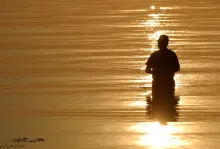
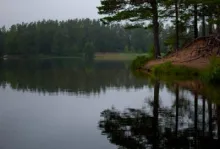
If the light is against you, you will increase the risk of reflections. The sun itself is of course a problem, but most elements will reflect in the water. Clouds can be a nightmare, and on overcast days, it will take some work to get the really clear look. You can do a lot by moving around. In mountains, valleys or in forests you can often find a dark backdrop to block out the reflections. The backdrop will still reflect, bu because it's dark, it will not block the surface.
You can also move up a bit - or simply lift the camera. When your angle of view is high, you can sometimes avoid the refections too. At least in part of your image. A camera with a wideangle lens stretched out above your head can give some amazing impressions of the clarity in the water, while at the same time retaining a great perspective with foreground and background in your image.
You can also use wizardry such as a polarizer. That is a filter, which has the purpose of removing reflections. By putting that in front of your lens and turning it to the right angle, you can filter out a lot of reflections.

Glare |

Polarizing filter |

No polarizer |

With polarizer |

Sun in the face |

With a polarizer |

Many new compact cameras allow you to take underwater shots, and once the camera submerges you will notice how dirty even the clearest water is. Underwater pictures work best in really, really clear water. Try to stay away from the flash.
The flash will illuminate stuff between the camera and your subject, and the camera will have a tendency to expose for the nearest elements, and not show the stuff further away, completely ruining the sense of perspective and translucency in the water.
So underwater images are best shot in really clear water with lots of light. And since you usually can't see what you are doing, you'd better take a lot of them, because most are usually useless.


When over the water, the flash can be the opposite: a great helper to penetrate the water and get to see what's down there. Flash images taken at dawn and dusk have a tendency to bring out a really great ambiance in clear water, and you can sometimes flash almost straight into the water and get some great results. But don't go all straight. That will only result in reflections of your flash. The same rule applies to angle as above. A higher angle gives a view into the water, a lower angle will let the water appear all dark.

- Log in to post comments
















mate you seem to hav
mate you seem to have some good fishing, luckey for me i have a river near by where we can catch pike , roach, chub ( a lot of big resident chub) on the fly, the biggest i had so far is a 5lb chub. Bro you take some amazing pictures, there not one picture here on your site that i dont like, they are truely amazing...keep up the good work....
wow! super photos.
wow! super photos. thanks for the tips.
Jeremy
Robert,
The fish
Robert,
The fish were spotted in the ocean south of Copenhagen, and the fly? Well I don't remember do a search for sea trout flies on this site, and you will finds dozens.
Martin
that is a really goo
that is a really good artikle where s the place with the big swarm of fish? and which fly did you use when you cought that seatrout
Great article, Marti
Great article, Martin!
Peter,
There was
Peter,
There was no particular post processing done. The original was slightly darker than this version, but the levels through the image are unchanged. I used a digital SLR with an external flash for the image, and they tend to control tricky flash exposures like this a bit better than compact cameras with their small built in flashes. It was shot at a fairly low shutter speed - a 45th of a second - to get the sky right, but apart from that keine Hexerei, nur Behändicheit...
Here is a shot of the same scene with no flash. No clear water.
Martin
Martin,
Your pict
Martin,
Your picture of Henning night fishing with illuminated sea weed in the foreground is just great! I don't recall having seen anything like this before. Any significant post-processing, like dividing the image and lightening the lower part?
/Stoltze
Peter,
As far as
Peter,
As far as I can deduct from the web IMBA is often used in Warcraft and means either imbalanced or immensely badass. We prefer the latter interpretation. Kasper's crashing wave is a great picture.
Martin
Some really good tip
Some really good tips and stunning pictures in this article.
wave picture is imba
wave picture is imba!