
The Hornberg can be cast out upstream and drifted as a dry fly. It can be pulled under the surface and stripped as a streamer. Is it a caddis? Stonely? A minnow? In early '01, a bunch of guys swapped their favorite Hornberg patterns.

Frank Hornberg was the creator of the Hornberg Special. While the fly is familiar to many, relatively little is written or known about the man. He was born February 27, 1882 in Wisconsin. In 1920 he became the first game warden assigned to Portage county Wisconsin and served there until his retirement in 1950. Frank Hornberg was a classic example of an old-time game warden and a colorful public figure. He died June 15, 1966 in Santa Rosa, California. It was during the 1920's he developed the fly that bears his name.
The standard Hornberg as typically described in current flyfishing literature and as sold commercially has a few salient features. It is tied on a 2 X long streamer hook. The shank is wound with silver tinsel. Yellow calf tail or small hackles are then tied in as an under wing. The wing consists of two gray mallard flank feathers tied parallel and vertically along the shank. Jungle cock eyes are attached so that the second eye shows. The front is then wound with grizzly dry fly hackle.
Hook sizes usually range from 10 to 6. Frank Hornberg initially designed the Hornberg Special as a dry fly. Several sources claim that he designed this pattern in the 1920's. Then in the 1940's the Weber Tackle Company helped him develop the fly for commercial production. The 1940's were the golden age for domestic fly production and Portage county was then the home to five tackle companies. Of these the largest was the Weber Tackle Company.
The Hornberg Special became one of the flies listed in their catalogue. It probably was this catalogue listing that contributed to the widespread distribution and usage of the Hornberg Special.
The Hornberg can be fished as a dry fly dead drift or fished as a streamer below the surface of the water. Alternately a combination approach can be employed. It can be cast out upstream and drifted until the fly swings below and dangles. Then the fly can be pulled under the surface and stripped in as a streamer. Fished as a dry fly the Hornberg is suggested to represent a caddis or stonefly. When stripped subsurface it is intended to represent a baitfish. While the above is probably the most common form of the Hornberg seen today, it really represents just the current stage in the evolution of this fly. This current version differs from the original Hornberg.
The old version differs from the current version by having wing tips that were lacquered and twisted or stroked to a point.
When tied in a small size and with the wings tented over the shank it may well represent a caddis. Frank Hornberg is said to have tied it as an imitation of lucastrine caddis, a caddis common to central Wisconsin.
While originally designed as a dry fly, the Hornberg special must have proven to be effective when fished subsurface. Now it is mainly regarded as a streamer pattern. Since its appearance in the midwest, it has gained popularity in the Northeast. There it became the Hornberg instead of the Hornberg Special and the wings tips were left unlacquered.
The standard Hornberg is constructed from the following materials as described by Bates (1950):
| Hook | Streamer, size 6 |
| Thread | Black |
| Body | Flat silver tinsel |
| Underwing | Narrow strips of two yellow neck hackles |
| Overwing | Two barred grey mallard breast feathers |
| Cheeks | Jungle cock, fairly long |
| Throat | 4-5 turns of grizzly dry fly collar |
It is not unusual to seen minor substitutions for some of the materials. The hooks range from 2x to 4x long. The underwing can be hackle, calf tail or bucktail. The hackle collar is grizzly or a mix of grizzly and brown. All of these slight substituions would produce a traditional Hornberg. For example Leiser's pattern description (Leiser, 1987) lists the following:
| Hook | Streamer, 6-10 Mustad 38941, 9671 |
| Thread | Black |
| Tail | None |
| Body | Flat silver tinsel |
| Underwing | Yellow calf tail, tied so as to tilt slightly upward |
| Overwing | Flanked by 2 mallard flank feathers, half a shank past bend |
| Cheeks | Jungle cock eyes, 2nd eye showing |
| Hackle | Grizzly and brown mixed - tied as a dry fly collar |
However as with all effective patterns variations were made to the original. Some of these alternative patterns may have been intended to develop certain aspects. Any of the following changes would make the result some variant of a Hornberg.
| Underwing Color | Orange, Red |
| Throat | Soft hackle tied similar to a salmon collar |
| Wing | Replacement of the Mallard by anything else is usually the starting point of controversy. Some regard Mallard as an essential component if the fly is to be called a Hornberg. Others are more forgiving and see no substantial objection to replacement of Mallard with other barred flanks feathers such as Woodduck or Teal. More radically substituitions involves use of other feathers such as Amherst, Silver, and Golden pheasant. There does not appear to be any consensus as to what the resulting fly should be called. |
Bibliography
Rogers, G. Stevens Point, Wisconsin: Fly Capital of the World.
Fly Tyer 2:30-32, 1996
Talleur, Richard. Assembly-line Hornbergs. American Angler 20:71-7
Talleur, Richard. Advanced Hornbergery. American Angler 24:71-77
The summer 1999 Fly fishing & Tying Journal has and excellent article on tying the Hornberg.
Downwing Red Hornberg
Lindsey Grandison

Black Hornberg
Lindsey Grandison
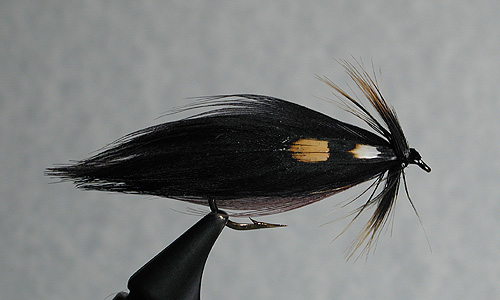
Dark Hornberg Wet
Bryant Freeman

Variant Hornberg
Glenn Seibert
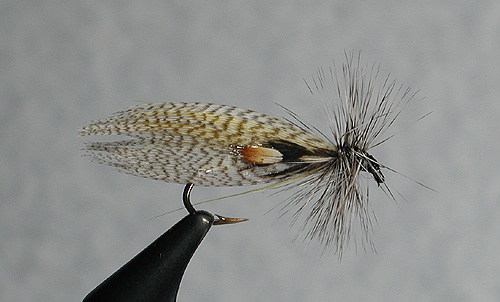
Silver and Red Hornberg
Bob Skehan
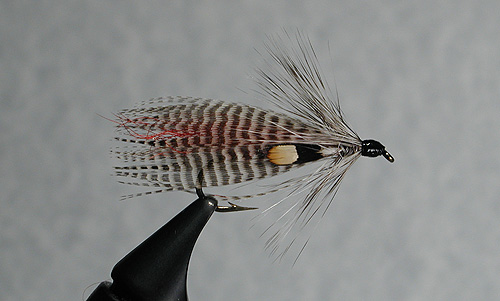
Olive Hornberg
Kelvin Hartley
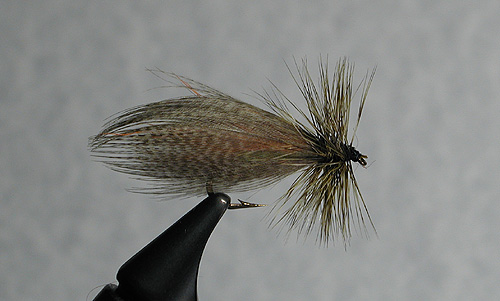
Hex Hornberg
Ron McKusick
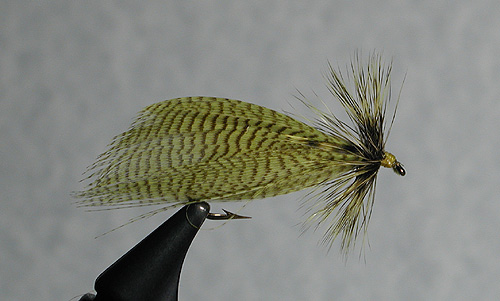
Hornberg Special Deviation
Clyde Watson

Traditional Hornberg
Bill Morrison
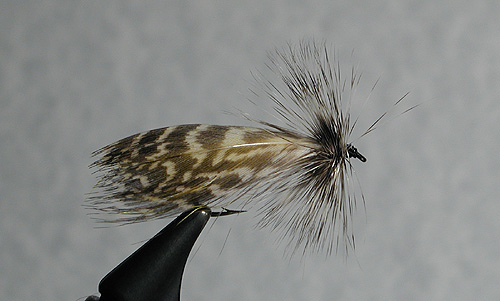
Woodduck Hornberg
Darren Bua

Dark Hornberg
Chris Del Plato
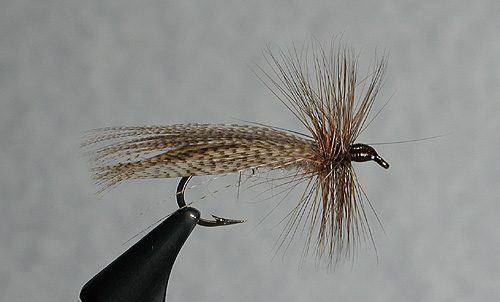
Traditional Hornberg
Gary Smith

Orange Marmalade
Steve Delaney

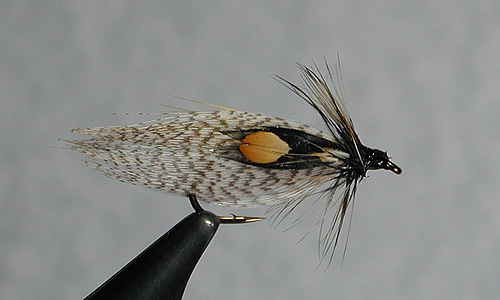
Traditional Hornberg
Jerome Molloy
- Log in to post comments
