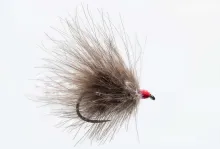
A high-visibility orange post and CDC makes this small dry perfect for your 7X tippet. Easy to tie, easy to follow on the water and a perfect choice when the fish are picky. Darryl Lampert from South Africa shows us one of his effective patterns.
The fish are rising all around you to midges. You open your flybox and search for your tiniest midge pattern. You finally manage to tie one onto the 7x tippet and cast it out. With so many rises, it’s very difficult to see when the fish has taken your fly, especially if like me your eye sight is not that great to begin with.
This is the problem I have faced for the last couple of years on the Cape streams, especially with Net-winged midge hatches on the Elandspad. While small midge imitations like the Griffiths Gnat are very effective, when tied on size 18 and smaller they are not the easiest flies to see.
A year or so ago, I started tying a midge pattern using a dubbing loop and a couple of CDC feathers. The pattern was very effective but when tied in black (which I have found to be the best colour) it was very difficult to see.
Darryl Lampert
One evening after tying up a couple of Parachute Adams, it suddenly hit me that if I added a parachute post to the pattern it would make it far more visible. I tied up a couple using a bright orange post and tried them out on my next outing. They could now be seen at a distance and took fish just as well as the non-parachute version. When tied in sizes 14 – 16, the pattern works well as a crippled mayfly imitation. You can also try skating the pattern to imitate emerging caddis.
HiVis Midge
Fly pattern, materials and tying steps
Darryl Lampert
Dry fly
rainbow trout (landlocked)
roach
Materials
Hook
Grip 11011BL Size 18 or Grip 14723BL Size 20 or equivalent
Thread
Gordon Griffiths Sheer Thread 14/0 - black or colour to match CDC
Post
Antron or Poly Yarn - fl orange or colour of choice
Body
CDC Feather - black or colour of choice
Start at the hook eye and run the thread about a third of the way down the shank.
Tie in your post at this point – no need to wrap up the post as you would for a normal parachute fly, although I find that a slight wrap up the post makes it easier to palmer the CDC without catching the post fibres.
Run the thread down to the end of the shank.
Take a CDC feather and stroke the fibres so that they are at a 90 degree angle to the stalk. Do the same with a second feather and then place them one on top of the other.
Clamp the one side of the two feathers using a bulldog clip, leaving about 5mm between the feather stalk and the edge of the clip.
Using a sharp pair of scissors, cut the barbs off the feather as close to the stalk as possible.
Spin the bobbin in an anti-clockwise direction until the thread starts to flatten. You can also pinch the thread between your thumb nail and index finger and run your nail over the thread a couple of times to help flatten it.
Split the thread in half using a dubbing needle (I use a large embroidery needle) and hold the dubbing loop open using your finger.
Place the end of the feather barbs into the dubbing loop and then pull down gently on the bobbin to lock the feathers in place.
Gently spin your bobbin in a clockwise direction until the CDC fibres are well trapped and splayed in all directions.
Now palmer the CDC forward and around the parachute post to the eye of the fly and tie off.
The finished fly should look very rough and buggy.
For faster/rougher water, use more CDC to create a bulkier fly, which will float better.
This is one of the simplest explanations of the Petitjean tool I have seen. As good as a video! Great description coupled with the great photos. Keep up the good work!
Glad your son got his first trout on the midge. Don't be scared to tie them larger and fish them during mayfly hatches. I recently caught some mullet using a white version of the pattern with the hivis post.
Thanks Darryl!
For years I have fished a #19-21 black parachute w. yellow wing a no tail for midges, but this is about 18537 times easier and quicker to tie!
Will keep you informed :-)
Hi Lars,
I have not had a problem with the fly landing on it's side. With this fly you can cut the post very short and it will still be highly visible on the water. Good luck and let me know how it goes.
The Global FlyFisher has been online since the mid-90's and has been free to access for everybody since day one – and will stay free for as long as I run it.
But that doesn't mean that it's free to run.
It costs money to drive a large site like this. See more details about what you can do to help in this blog post.





This is one of the s
This is one of the simplest explanations of the Petitjean tool I have seen. As good as a video! Great description coupled with the great photos. Keep up the good work!
The feather clip is
The feather clip is a Marc Petitjean Tool.
Most fly shops will have it or will be able to get it, You can also order it on the web.
Hi Darryl, thanks fo
Hi Darryl, thanks for the great pictures, now can you tell me where I can get a feather clip like that?
Hi Richard,
Glad
Hi Richard,
Glad your son got his first trout on the midge. Don't be scared to tie them larger and fish them during mayfly hatches. I recently caught some mullet using a white version of the pattern with the hivis post.
Regards,
Darryl
Hi Darryl,
This fl
Hi Darryl,
This fly helped my son land his first trout. Thank you so very much for the good memories and excitement this fly brings.
Richard B.
Thanks Darryl!
For
Thanks Darryl!
For years I have fished a #19-21 black parachute w. yellow wing a no tail for midges, but this is about 18537 times easier and quicker to tie!
Will keep you informed :-)
Lars
Hi Lars,
I have not
Hi Lars,
I have not had a problem with the fly landing on it's side. With this fly you can cut the post very short and it will still be highly visible on the water. Good luck and let me know how it goes.
Darryl
Hi Darryl!
This is
Hi Darryl!
This is a nice fly that I want to try for my local streams here in Denmark!
Does it always land with the orange wing upwards?
Lars