
Every year in March and April the rag worms emerge from the bottom to secure the next generation. They swim freely in the water, wiggling from one side to the other. Sea gulls feed on the from above and many fish species seem to focus on them from beneath.


A bit about worms
There are many different rag worms, clam worms, mussel worms, "brushworms", annelids, nereids - many names for the same group of worms and in many cases the same species.
One of the most important in Scandinavia is Nereis diversicolor, which can be found in many colors as the name indicates.
The nereids are long worms living most of their adult life in the bottom of the sea, unavailable as a food source for most fish. Each year in the early spring - sometimes as early as February, but mostly in March and April - they emerge and form big schools, where they secure the next generation. Many anglers will say that the first full moon in April will lure out the worms.
They are not only important to the trout as well to us when making rag "wormlings".
Current and storms may move the sand flats, where the worms are hidden and they will no longer be burried safely. The fish feast on them from beneath and the sea gulls from above - the gulls being a good indicator of the presence of freely swimming worms.
The nereids are a big mouthful and worth swimming for, so they are often found in the stomach of nice fish. The fish may even become selective or "blind" to other food items when the rag worms are present in endless numbers. The only thing that works then is a rag worm imitation.
The Real Boerstenworm
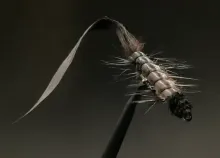
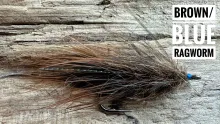
Several Scandinavian fly tiers have created rag worm imitations, but one of my favorites is The Real Rag Worm tied by Claus Eriksen in 1996.
|
|

After a tying course Claus went fishing with Davy Wotton. Claus tells the story:
"When we arrived, plenty of rag worms were wiggling and swimming around. Mr. Wotton smiled and asked if I had any flies looking like such a creature. So I opened my fly box and showed Davy the imitation - "Yeah, that looks like a real boerstenworm", he said. That is how it was named. And suitingly so since "boersteorm" translates directly into "brush worm" or "rag worm" in English.
It is the result after many ideas and variants. The current version is effective and not too complicated to tie. The bead and the soft connection between the two hooks make the fly go up and down in an irresistible, life-like manner.
Coloring with a waterproof pen makes the fly look camouflaged and reflecting the light in different colors and tones. This to some extend compensates for the synthetic and unnatural appearance of the cactus chenille.

When I asked Claus to send a picture of a trout taken on the worm, he send me the one to the right. That fish is huge by any standard, and a worthy proof of the worm's effectiveness:
"The fish took the fly one early morning in March. I was fishing a small reef of mussels. It suddenly exploded very close to where I was standing..."
Fishing at night
A smaller, black version is very effective when it is dark. The folded Magic Head makes it streak just below the surface. Claus has had so much success with this setup, that it has now replaced the old and famous Black Cigar.


The night version does not have a bead on the front hook.
Tying tips

The long and soft fly has a tendency to catch itself in the cast, but adding a weed guard to the front hook reduces this phenomenon up to ten times. The number of casts with a curled fly will go from one for every ten casts to one in a hundred.
The Angel Hair in the tail is not a must, but it gives a nice reflection in the soft marabou. Do not add too much, but only a few fibers.
|
|
|
|
|
|
|
|
|
|
|
|
|
|
|
|
|
|
|
|
|
|
|
|
|
|
|


I am sure that the movement and size of the fly will appeal to many fish: pike, perch, sea bass, stripers and many more, but you are the one to do the testing.
- Log in to post comments


I found your reference
Jakob- I found your reference to the study of worms free swimming during non-spawning times very interesting. I fish for stripers on the east coast of the USA and have had good luck with worm flies during the spawn, but this year I found worms free swimming in October around the new moon. The one fish that I kept was full of adult sandworms. After reading the article I may try worm flies more often than just the spawning periods. Ron
Not being a biologist
Hi! not being a biologist myself but a dedicated fisherman, I've many times seen multiple ragworm action at surface both in late winter nights, june summer nights and during more "traditional" early spring "swarmings".
Did a search on Nerieis Virens and found following publication: Migration of the Sandworm Nereis virens during winter nights (D. Dean, Marine Biology 45 165-173 1978)
Here the swarming behaviour is attributed to nightly migration during low tide ebb current and not spawning. This should be of interest to most seatrout fishermen!
My experience is that a black longtailed slim palmer-hackeled fly is very efficient during such nights and that a weighted fly is preferable to a "striping" fly as less fish ar missed at the strike.
Best regards
Jakob
Martin, regarding Ro
Martin, regarding Robert's post. I think he's confused about your statement regarding the first full moon in April bringing out the worms.
The joys of multi-national participation on a web site. ;-)
A ragworm swimming
Robert,
The fly is supposed to look like a ragworm swimming, so the stripping pattern is of course like a ragwork swimming - fairly slow and even, maybe with a few breaks. Ragworm swim with an undulating movement, that is difficult to imitate, but the plastic cup in front on the fly should induce some wiggling movement in the fly. You will have to try and see what speed works best for a compromise between speed and wiggling.
And regarding when you could fish this fly... I'm not sure I understand your question. You could fish with it on your birthday, Christmas morning and a day before or after midnight in April. You will have to explain what you mean to get a more meaningful reply.
Martin
Strip it in fast?
do you strip it in fast? and could you also fish with it a day before or after midnight on april
Fantastic
this fly is fantastic copy of the Australian squirt worm that comes to the surface in spring to breed, the species that i use it for is the sweet tasting whiting that grow to 47cm.
they are look like bone fish, and are more spooky than them, so i know this pattern will work. does it work with weights inside the head?
Another bead
use another bead on the end of the fireline , instead of the other hook. There's is no need for 2 hooks..( i think..)
Cornelis van Leeuwen,
The Netherlands.
for Kasper Mulhbach.
for Kasper Mulhbach.I have 3 left hands so no flytying for me. Can I order 10 day and 10 night Reel Rag
Worms or let me know where to order them.My next fishingtrip will be to Falkenberg in Sweden.
Thank you for all the info you send . A verry happy new year from Belgium
John
Sick of the hooks tangling
If you are sick of the hooks tangling just cut the bend of the front hook off and sand the burrs(Dremel tools rock). Us steelhead guys in the states use a similar fly called an articulated leach( and you rarely miss a fish with the back hook).
Thanks
Kasper, Thanks again for the "worm." The fly tangling on the cast seems to always be a problem with longer patterns. Even Decievers, Zonkers, and Double Bunnies have this same problem. That's why the standard lengths of 1/2 to 1 1/2 XX the hook length for the extention [past the hook bend] is recommended as a basic design for all patterns. I don't know of a basic "tying" solution [outside of installing a "weed guard" on the hooks]. However, if you do a simple "barrel roll" cast it will keep the fly straight and working properly. Problem: You can't cast it very far. Someday, Someday, some of you smart guys will find a solution and we will all smack ourselves in the head and say, "WHY DIDN'T I THINK OF THAT!"
KEEP YOUR LINE WET!
In His Love,
Clyde
Aart,
Interesting
Aart,
Interesting way of fishing this fly. Let us know how if the salmon found it stimulating.
Kasper
Weed guard
Lew,
I tie in a weed guard as shown here on the photo: Weed guard - The Real Rag Worm
Kasper
Nice fly, may be ver
Nice fly, may be very usefull in the dutch coastal system for seebass and other fish.. but I will give it a go in the Namsen river, Norway, next month. Any results for this fly more upstream, in the rivers with migrating salmon?
In B.C. lakes
In B.C. lakes, trout fishing, we must use single barbless hooks. How do you tie this worm now to keep it from catching weeds?
Stripping
So how fast do you strip it? I'm thinking it's slow but erratic.
Nice fly
Nice fly, though I've tried this type of patterns and they can be a pain to cast. Recently I've had fantastic results with a 15-20cm black zonker tied on a tube which is half the zonker length. During the day I fish it with an intermediate line and at night with a floating line.
Unfortunately have lost fish upto 10lb in the last weeks on this fly and have had many bites without the fish 'sitting'. A 'flying' treble at the back of the fly increased hooking dramatically but isn't the best for C+C.
In most cases
Florian,
in far most cases, the fish takes the rear hook.
Kasper
Double hook
Does it really need to be a double hook?? I know from a stability point of view it is nicer but what about releasing small fish?
Food for thought
Florian