
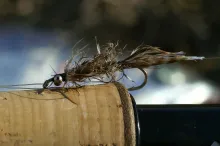
A classical pattern originated back in the sixties - here adapted for Scandinavian sea trout fishing, but probably also useful for bass and other species as well as the brownies it was originally tied for. The fly is fairly easy to tie and we have made it even simpler.
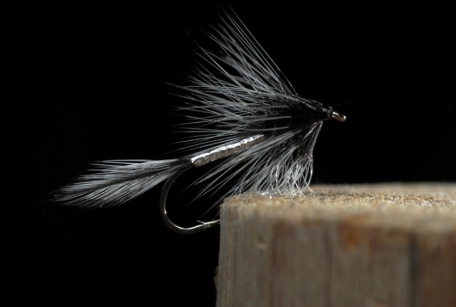
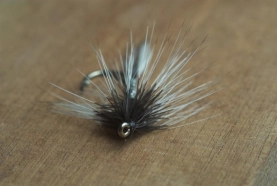
This fly has been a part of many Danish sea trout fly boxes for a long while. I personally bumped into it for the first time in a classic, Danish book about sea trout fishing by Jan Grünwald, which I'm sure has inspired many Danish coastal anglers. In this book Jan showed two versions of the pattern: a red and a badger. We will show you the latter here, but you can in principle tie the fly in any color(s) you please. Its hallmark is the tinsel back body and the hackled front – not the colors.
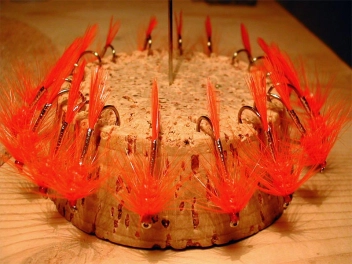
The fly is a favored winter fly - especially in red or orange, but also in black&white tied with badger hackle as shown here, which is quite close to the original. The fly is also seen in a pure black version as well as a light brown, sandy or tan color.
Ken Bonde Larsen who has tied the flies that you see here, doesn't tie the fly with any ribbing. The original had rib over the tinsel body and up over the front body to reinforce the tinsel and secure the hackle. Ken in stead varnishes under and over the tinsel, and hackles the fly so that the hackle stem lies in the groove in the thick chenille. This is equally durable.
Many of our flies have been inspired by the style of the Big Hole Demon. Look at flies like Joergen's Demon (and here) and Klympen.
The history of the fly reaches back a long time. It was originally created for Montana’s Big Hole River by Dan Bailey of Livingston, Montana. Back then it was called 1964’s “fly of the year.”, so it's an old boy, which has been appreciated from it's creation. Sometimes the fly is called the Black Hole Demon.



|
|
|
|
|
|
|
|
|
|
|
|
|
|
|
|
|
|
|
|
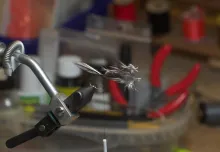
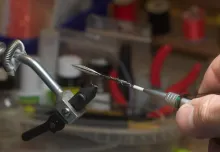
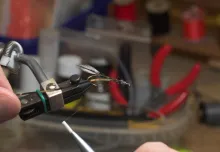
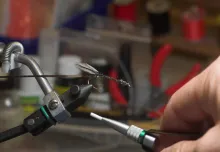
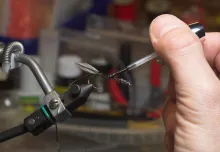
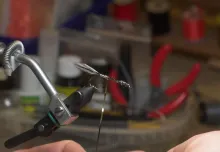
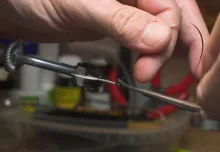
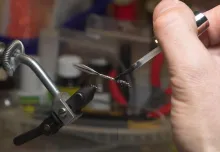

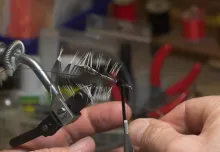
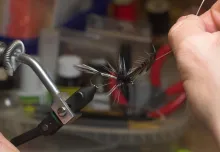
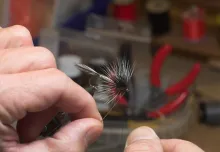
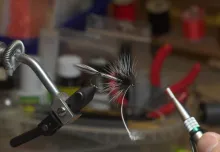
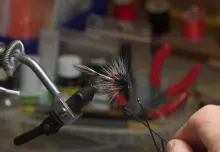



- Log in to post comments

Want to say thanks
Want to say thanks for the help, I got here. I use this fly for trout fishing long time ago, and that is why I was so interested in learning to tie it. When fishing for trout, size's of material become a major issue, I finally go the real material name and that is American Rooster Cape Bronze Badger. This is for smaller sizes, used with trout. This flies name came from up in Montana flat lands, middle of the state, and was named for some reason was different and it was called the Black Hole Demon. While there fishing, I caught a really nice 14" Rain Bow trout, in slow moving water.
Atlantic Salmon
Hi Martin,
Atlantic Salmon could also be added to the list of target species. Harry Darbee in his book Catskill Flytier,1977, writes that fishing the Margaree river in Nova Scotia, Canada, one year, no one had taken a salmon in seven days. He tried a Big Hole Demon and immediately hooked and eventually landed a salmon of 22lbs.His friend Mac Francis followed suite right after and got himself one of 13 1/2 lbs.
I think this is one of those flies that travels well.
Peter.
Most fly shops
Most fly shops and suppliers in the western US do not distinguish between silver and golden badger hackles.... and saddly even around Puget Sound some do not even know what badger hackle is... I suspect that Glen is from the western portion of North America and may be having trouble as a result. I suggest visiting the whitting web site under american hackle, the site has picture of silver and golden badger hackle. Basically the golden is golden/ginger coller with a black center, the silver is much lighter silver/white color with black center. There is also speckled basically golden or silver with black specks, and can be harder to find....
The cost of Whiting Badge necks may be high, but they have higher quality and more than double the number of feathers. I suggest using the Whitting American Badger.....
The full name...?
Glen,
The full name...? In what way? The cape is a classical badger cape - the feathers have a black center and white rims. It's quite common and available from many breeders. This one is most likely from Whiting Farms where Ken is on the Pro Team.
I have no idea what you mean with "explain the old one differently". Which old one?
Sorry about not being able to reply more precisely.
Martin
I don't understand
I don't understand a couple of things. One is the picture of the material, I need the full name of that hole cape, maybe this is full name, I don't know, I've never seen or known what that material is. Also could you explain the old one differently, maybe, I don''t quite get it and that is the way I want to tie one just to see how well it works, or show another of these doing that old pattern, please, any info is helpful.
Small trout streams
Usually fish small trout streams in Western Maryland,USA. Made this pattern a wet fly (small # 8) with hollographic tinsel and black ICE DUB instead of chinille. Worked well.
I did an update
I did an update to this fly and tied it as a dry fly several years ago. The original maker of the fly's son in law contacted me and told me about the streamer, I have one of those.
Mike Hogue, www.eflytyer.com
Tube version?
Did somebody tried a tube version of this fly? Some photos?
Pattern looks quite siutable for tube :)
Jeeez
Jeeez, Martin, you are totally right...
What embarrassing! I am sorry, I did not recognize it.
Thanks anyway.
Cheers,
Gabor
Next- and previous-links
Gabor,
I think the function you want has been in place for quite a while, actually. If you click on an image to see the large version, you can find next- and previous-links above the image to the right. This will take you through the images of the article one at a time - including the tying sequence.
Try it and see if this is what you wanted.
Martin
Just an idea, Martin
Just an idea, Martin.
As recently you have provided the articles on fly patterns with detailed enlargeable photos of the tying steps, it would be nice to have an additional button that enables readers on the page of the magnified image to directly navigate to the next tying step instead of first clicking back to the article. Folks with poor bandwidth would appreciate it, too. Anyway, I assure you I remain your reader even if no change is done. ;)
Badger
Dik,
The badger feather in the B/W fly can be replaced with any white, black or grizzly feather without disturbing the impression much. It will be a slightly different fly, but not drastically. You can also consider changing the color altogether as mentioned in the article. Most colors will do fine. Start out picking a hackle color that you have and like, and choose a body color to suit.
Martin
Substitute for badger
Do you have any opinion on what would be a good substitute for the badger? I love the fly!
Yup ...
Cornelis,
Yup.... we know about the background. Ken and I already discussed it. Use the large images, they are easier to see, but you are right. We want some ambiance in the pictures, but not that much! We will clean it up a bit the next time.
Martin
The background is a bit to much
nice fly ! ( hope the pictures of the tying are better next time , the background is a bit to much...)
Cornelis
The Netherlands
Been waiting
Niiiice, been waiting for this article. I haven't caught anything on this fly but I'm sure it's a good imitation of pretty much everything:). No pink Demon? Come on, every Dane has a pink version no? Hehe, :)
Have you guys tried this fly on Österlen Skåne? I'm going there tomorrow with a box of gammarus looking things and mysis.