
Crazy Charlie, Bonefish Bitters, Bonefish CDC&Elk and more. Some of these bonefish flies are well known, some are close to unknown, but they can all catch bonefish. Martin Joergensen has selected a few and tells the story.
The number of fly patterns for bonefish is almost as countless as the number of stars in the sky—or maybe just as the number of bonefish anglers. Here are a few well known and lesser-known samples for your inspiration.


Crazy Charlie
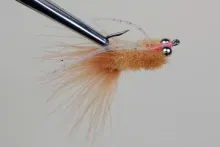
This is the father of a lot of modern bonefish patterns. No bonefish flybox should be without. Many of the patterns I like are tied Crazy Charlie style with the wing downward and the fly fishing hookpoint-up as a result.
The original Crazy Charlie is a bright and shiny fly, which has a lot of attraction—but also a lot of glare that might spook off some fish. See description and materials here
Gotcha
Another classic in the Crazy Charlie style where the wing covers the hook point and both are supposed to fish upwards. The Gotcha is a fairly dull and naturally coloured fly and can be a very efficient fly in smaller sizes like 6, 8 and 10. See description and materials here
Bonefish CDC&Elk
Many GFF visitors may know Hans Weilenmann's CDC&Elk dry fly quite well. Some may even know that a host of variations of this fly has seen the light of day (Diving CDC&Elk, CDC&Elk Streamer and many more), but few could probably imagine that this fly also exists as a bonefish fly. Welsh Paul Slaney is to blame for turning this modern, classic dry fly into something completely different.
I have tied up bunches of Bonefish CDC&Elks to use in my daily saltwater fishing for sea trout, and the work very well as a small shrimp imitation. I can see no reason why the fly would not entice bonefish in the same manner.
The fly is tied as a traditional bonefish fly in the Gotcha and Crazy Charlie manner with the wing under the hook. What happens when the fly is cast and hits the water is that it turns and fishes upside down. This makes it particularly well suited for fishing on the bottom, as is the case when fishing for bonefish.
Secondly the fly is a soft lander. Due to its fibrous CDC body and the fluffy deer hair wing, it will descend and land softly in spite of the fact that it has bead chain eyes to weigh it down. And I do not doubt that the CDC fibres will catch equal amounts of air and seem equally alive in saltwater as they do in freshwater. See description and materials here and the story of the original fly here.
Blackout Kluting
Another generic, neutral, shrimpy pattern incorporating deer hair. I tied the original Kluting for fishing for cod on the bottom, but a couple of years ago that pattern was converted into a sea trout pattern.


Its colors and material choice makes it a very generic small fish or shrimp imitation, and it's another example of a fly intended to fish hook point up.
You can read the story of the original Kluting here and the birth of the Blackout Kluting here. See description and materials here
Bonefish Bitters
I have personally caught more bonefish on Craig Matthew's Bitters than on any other fly. That is one good reason for me to recommend it.
It is also easy to tie and very durable—two more reasons.
The original is tied with epoxy—often on premade MOE-hooks (MOE: Mother Of Epoxy)—and are a bit more crab like than my hot melt glue version. I doubt the fish can tell the difference. You can get the Bitters directly from Blue Ribbon Flies, the fly shop of the originator, Craig Matthews
Read more about this neat fly in this GFF article.
The patterns

- Log in to post comments




Say Hey martin,
I
Say Hey martin,
I was just looking at some of your bonefish theme... wonderful work. Nice job. However, you have mentioned that Charlie Smith was the originator of the "Crazy Charlie." That's not quite correct... please let me share with you part of an interview I had with Bob Nauheim the person who created the fly...
Here's the story directly from Bob:
It took place on a bonefishing trip to the Bahamas. I believe it was around 1977. Keep in mind there really weren't many flyfisherman chasing bonefish at this time. I was working with a guide (and lodge owner) named Charlie Smith. We were watching the bones apparently key on "glass minnows." I asked Charlie if that was a common food for bonefish and he replied "Sure mon."
That night, back in the lodge, I tied some flies with a bit of flash, some clear Mason 15 lb. Mono, a couple of feathers, and a pair of bead eyes. The eyes were adopted from steelhead patterns I'd used with great success. It was the first time "bead eyes" were used on a bonefish pattern.
The next day we had a ball catching fish with the newly created pattern. Charlie said "dat fly is nasty mon" that's when I gave it the name "Nasty Charlie." I'd run into Lee Perkins, of Orvis fame, and he asked me about the fly design. He'd heard how effective it was on the flats. I sent him a sketch with tying instructions. Later that year it was presented in the Orvis Catalog as the "Crazy Charlie." It's had that name ever since. I'm delighted it's become such a widely accepted fly.
A sad note to this story is that Bob has just passed away. He will be missed by many in this industry. He was a mentor of mine and a close friend. Thanks for giving me a moment to share this story with you.
Cheers, Kenny
Very good!!!!
Very good!!!!
Hi Martin,
How go
Hi Martin,
How goes it mate?
Just read with interest your piece on bonefish patterns. Thought you might be interested to know of a "New, Old" pattern that is number 1 in my box at the moment.
Funnily enough it came about from a fly I "borrowed" from your sea trout box one day when you wern't looking ;-) I think you call it a Bjarke?
Anyway, I recieved a very nice bleached grizzle cape from Chevron Hackles a while back. The tannish colour tones immeadiatly made me think of bonefish.
Basically the fly looks like this.
Hook- size 6 or 8
Tail: A few strands of "root beer" crystal flash.
Body: Dubbed tan fur, nice and spikey.
Hackle: As mentioned above, palmered the whole length of the shank and clipped flat underneath.
Eyes: small, gold bead chain.
I fished the inside flats at Deadmans Cay, Long Island back in June. Was very lucky with the weather and the conditions made for some classic, ultra shallow water, wade bonefishing. The fish were spooky and ambush tactics were the order of the week. The pattern above outfished just about anything I had in my box by a mile.
Who said bonefish aint selective?
Cheers
Paul