
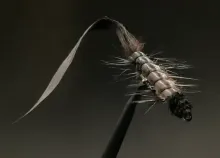
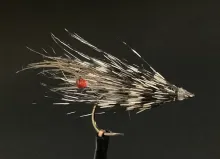
This fly is primitive close to being embarrassing. It's even ugly. It uses one material only and a crude and synthetic one at that. But... and there's a but... GFF partner Martin Joergensen has to admit that it's an efficient fly. It catches a lot of fish.

I honestly used to detest this fly! It's primitive close to being embarrassing. It's even ugly. It uses one material only and a crude and synthetic one at that. But... and there's a but... I have to admit that it's an efficient fly. It catches a lot of fish.
I have caught fish on it in the most terrible conditions. It takes a lot of mud and silt to hide this fly, and in its original version, utilizing pearl mylar tubing and a red base, it's a beacon in the water signaling left and right: here I am! Eat me! It's a far cry from anything natural, but who cares?
It works.
...but who cares? It works.
Variations
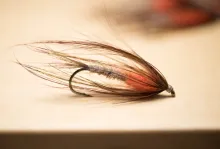
Most of my Christmas Threes break with the tradition and are tied with more "natural" colors, if natural is an appropriate word for peacock colored or black metallic mylar. But you have also been able to find orange, pink and yellow specimens in my boxes during particularly desperate periods in my fishing life.
The obvious variation is simply color. There are just two materials in this fly, and you can both vary it subtly by changing the color of the underbody or change the appearance more dramatically by choosing a different hue of mylar tube.
The tube is available in a large number of colors, and the possibilities are almost endless.
My favorites apart from the clear/red version are orange and pink, but peacock green and black have been known to work too. You can also add eyes to the fly, and one of my more successful variations even had a zonker wing.
This is another fly, which I like to weigh a bit, either with some ballast wraps or with bead chain or dumbbell eyes.
But again I urge you to keep the fly simple since it seems equally efficient in its least developed form.


A book
This is the first excerpt from an upcoming book by yours truly on Danish sea trout flies called "Favorite Flies for Baltic Sea Trout". It's a self published book featuring many of the flies that we use for our fishing, and will be out real soon now and available for online ordering.
The Christmas Tree is one of the flies in the book. This fly was originated by Danish angler and fly tyer Steen Ulnits and has been around for a very long time, probably more than 25 years.


Video instructions

Tying instructions
|
|
|
|
|
|
|
|
|
|
|
|
|
|
|
|
|
|
|
|
|
|
|
|


- Log in to post comments


The book
DW,
The book is still in the works, but I hope to finish it within a month or so. I keep on adding new patterns to it. Maybe I should just say stop and get on with it!
And yes, adding an intermediate or sinking leader to a floating head can make good sense. It can be a pain to cast, but sometimes the only way to get down to where the fish are, especially in running water.
Adding a sinking tip does add significant weight to the setup, and depending on the capabilities of you rod, it miht be a good idea to trim a bit off the shooting head itself. Personally I think I would make several heads, individually tuned for their tips, so that I knew that every single one would cast well. A completely flexible system might be difficult to create.
You can read about making really cheap shooting heads in my Fly Line Blues article.
Hope this helps
PS: thanks for the nice words about the site!
Martin
We have sea run browns
We have sea run browns coming back to a few streams late in the fall. So I hope your book is out before then. I enjoyed the audio of your Feb head shooting trip. I learned quite a bit. I will be making some heads soon for easing the casts to stripers. Your article on heads is super. What about sink tips looped to floating heads? Does that make any sense? Backing/running line/WF F head/ various 3 meter sink tips /leader? If so,do I shorten the rear of the head by 3 meters to compensate for the sink tips? ....Damn nice site by the way DW New Hampshire USA
I am the author
Jan,
Yes, I am the author... and the designer, publisher, photographer, proof reader and any other role you can think of.
The new book sits on my computer and is about 80-90% done. It's been quite a lot of work to get it ready, and I'm still adding patterns, although I'm running out of patterns that I actually use or have used, and that's the whole idea. The book will cover my own and my nearest fishing friend's favorite flies for sea trout.
My guess is that it will be another month or so before it's available on Blurb. I will annonce it here just like the other GFF books.
Martin
PS: It's now published: Favorite Flies for Baltic Seatrout
When and where
Hej Martin,
thanks for your description of this "old" one and your variations about it! You mentioned a new book "Favorite Flies for Baltic Sea Trout". When and where will it be published and are you the author?
Best regards
Jan