
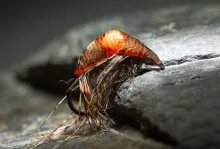
It's dubbing on a hook, but in spite of its simplicity, the Hare's Ear Bug is one efficient fly

When I ran through the step-by-step shots for this article I was a bit surprised that we actually managed to get as many as 12 different steps documented--me shooting pictures and my friend Ken Bonde Larsen tying. And I even had more pictures to choose from.
But then I thought
: why not? Some people have never tied a fly, and if this will be their first fly 12 steps is not too many. For the seasoned fly tyer I could just say: some teased out dubbing on a hook, but that wouldn't necessarily mean much to a beginner.
So I kept the large number of steps, but as you can see—even as a beginner—it is actually just some hair on a hook, and nothing more!
But in spite of its simplicity, this is one efficient fly, and will serve well as an imitation of a lot of small, gray/brown, elongated and nondescript animals such as scuds (gamaruses), water cresses and even caddis larvae.
Small gray/brown and elongated?
Hare's Ear Bug is it.
Where I live
we use it both in the salt and the fresh.
Fished actively over sea weed and its likely to be mistaken for a gammarus. Same thing in a lake.
Dead drifted or fished using a lift in a stream. Well it certainly looks like a tumbling scud or cress bug or even a hatching caddis to my eyes. What the fish think, I don't know, but it's a fact that they find it edible.
So get out
your hare's mask, your rabbit skin or any other soft, grayish brown fur you might have. Make sure it's not too coarse, and dub along as we tie one of the simplest flies in the world.
|
|
|
|
|
|
|
|
|
|
|
|
|
|
|
|


Some people might argue
that the fly would be better with a tail. You could rib it for durability. Add some hackle for legs. Use two colors to imitate a caddis. Add antennae.
Not on my shift!
The ease and simplicity of the fly is its strength, how weak it might ever be. And as I always say: it's way faster to tie two or three than to start fumbling with tinsel or copper for ribbing. And once it's teased out you have all the tails, legs and antennae you need.

- Log in to post comments



I Love the look
I Love the look for this pattern, I will definitely be trying it on UK Stillwater trout.
I tied one last night with an orange dubbed "egg spot". I look forward to seeing how it performs.
Thanks for a great pattern.
Guy
Great pattern for uk still water
This looks like a great pattern for uk still water fishing and stalking. I tied one up last night with an orange dubbed "eggspot" I will see how it performs. Very excited to try it thanks for putting it on the site!
Guy
Conratulations
conratulations for this page i like very much dante
Not trying to offend
John,
I'm not trying to offend anybody, but adding dubbing to a hook can hardly be called an invention can it? Nobody's trying to steal the thunder from Walt here (I never heard of him or his fly before now!), but I'd be surprised if somebody hadn't done this before Walt... like Frank Saywer. Try googling Saywer's Killer Bug and you will find something very similar to Walt's Worm and somewhat similar to this fly.
Flies as simple as this one is nobody's invention. They have been "invented" and tied by thousands of fly tyers all over the world for hundreds of years.
Martin
Its a Walt's Worm
Its a Walt's Worm invented by Walt Young.
A football
That's no trout -- it's a football!! Only bigger :)
Small flies for seatrout
Maybe now people start believing in the small flies we use for seatrout!
We've been using sizes 12, 14 for the last years with very simple dressing as well.
They have been picked up by a lot of big seatrout; they like to follow a big flies, but eat the small ones.
Instead of straightening a hook, I like to bend (forge) them on purpose. It will hook fish more easy, but that my believe
That's a killer fly!
That's a killer fly!! A similar one in dyed olive fur works well for me.
I know that this is
I know that this is a good fly for seatrout, but I ad some flash in the dubbing.