
A nice thing about this Bibio is that it's versatile. Play with it, use lighter of heavier hooks, fish it with or without floatant, wrap a thinner or denser hackle, and so on. But make sure you have some Bibios in your flybox spring suddenly is here.
|
|
|
|
|
|
|
|
|


A while ago I read Steve Schweitzer's article on a great fly of his, the PeeMew Midge. It uses thin, semi-translucent foam for a wing, and when wet the foam becomes even more realistic as a wing. This foam is the type of foam used as packaging material for stereo or computer equipment. It comes in sheets, is white, and about 1 mm thick. The result looks perfect. This fly uses the same type of foam as wing material, so: thank you Steve!
Bibios
Traditionally, the end of April is Bibio time. Bibios (Hawthorn fly, or Bibio marci) are black flies that can be as big as 15 mm, and their most striking feature is a pair of long, dangling legs. Bibios fly and hover around hawthorn bushes and other vegetation, and are listed as terrestrials. They hatch from underground. Apparently they are clumsy, and awkward fliers. They often fall from streamside bushes and trees, or are blown into the water by the wind. And trout like them.
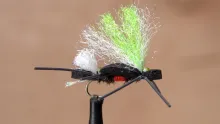
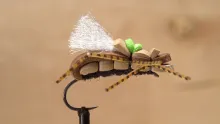
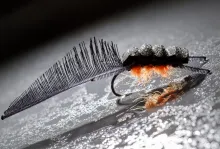
Lake Oostvoorne, a brackish, windswept lake on the Dutch coast, holds big rainbow trout. The lake is surrounded by bushes, and by the end of April the Bibio's are on the wing. Around that time it's a good idea to go to the upwind shore, and fish a Bibio. Until a few years ago, any black fly would work, but the last few years we noticed that on our lake a damp Bibio outfishes a high floating dry one. Mart's Bibio is the result of some experimenting with foam, hen hackle and black Angel Hair to produce a fly that does not quite float, but does not really sink, either. Here are the materials and the tying steps.


One of the nice things of this Bibio is that it's versatile. Play with it, use lighter of heavier hooks, fish it with or without floatant to the thorax or hackle, wrap a thinner or denser hackle (unlike popular belief, a dense, good quality hen hackle can float a fly), and so on. But make sure you have some Bibios in your flybox by the end of April.
Have fun!
Martin Westbeek
Oct. 2006
- Log in to post comments



lovely pattern
lovely pattern, although being scottish,i feel the "Bibio" should have a hint of red somewhere , although the pheasant tail will add a touch of side colour,so,,,,,,,i added a bit , a little flo red hot spot between foam and hackle, also did couple with one turn red hackle same spot , keeps me happy and works well here when there is a good ripple on water,had too try without red too.......worked just as well,so take the red or leave it,lol
have used this type
have used this type of fly for years and have learned a couple of tricks beginners can use.
use different colors of foam from the craft stores grip any sheet in your vice, needle nose pliers, any device that will hold foam and trim around with a razor you got a ready made body or wing. the way you tie this to the hook allowes you to make a fly with a conventional hackle or to wrap your hackle between the hook and the foam and you have a para application. something with a long taper; long may fly bodies.
Hi All,
I'v
Hi All,
I've been experimenting with lots of different kinds of foam lately, especially inexpensive hobby craft and free packing material types. I have trouble cutting the foam symetrically so, instead, I use wing burners, tweezers, clamps etc and singe the foam to shape with a Bic lighter.
Hi Martin
Excellent
Hi Martin
Excellent pattern! My vise is eagerly waiting.
Thanks again for the paraloop instruction.
Works great!
Pieter.
Compliments for the
Compliments for the nice pattern!
I will try it on lake OVM.
I will also try a mix of dark Cdc( meerhoentje of waterkip) and/or sealfur for the thorax!
GFF and Martin,
P
GFF and Martin,
Please do keep sending in patterns, background information and tips and tricks for this magnificent piece of water in The Netherlands. GFF is an excelent site, that more and more Dutch Flyfishers are visiting.
This article is an excelent example of how a not only a fly but also it's use is explained in dept.
Keep up the good work, I'll keep an eye on the site.