
Not one of Martin Joergensen's usual pike flies. For that it is way too complex and has too many tying steps and too many different materials. He doesn't like complex pike flies. "I spend dozens of minutes tying one, and a pike spends seconds shredding it!" he says.


This fly is not one of my typical pike flies. For that it is way too complex and has too many tying steps and too many different materials. I don't like complex pike flies. I spend dozens of minutes tying one, and a pike spends seconds shredding it!
But this one serves a purpose: It's a big, voluminous and flashy fly, which is still fairly easy to cast, and in spite of the amount of material it is not as prone to hooking itself as some of my other material-rich pike flies.
The pattern was sparked by a summer of excellent pike fishing. A couple of the guys that I fish with and I have been fishing a small lake during what is usually considered the worst time for lake pike: the peak of summer. The air has been scorching, water has been boiling and the algae have been blooming like it is often the case in nutrient-rich lakes in the summer. Usually that means no pike. The fish will tend to be passive, they will seek deeper water, and they won't be able to hunt with their sight. So pike anglers wait out the summer and put their efforts into the autumn, winter and spring months.


We started fishing for summer pike a couple of years ago, and there's no complaining about that. We've had a few skunked trips, but we have also had some fantastic trips. The weather has usually been very pleasant, and our worst problem has been wind - particularly in the late summer months where cloud cover and passing showers often lead to sudden wind shifts.
I think there are a few keys to our success:
- Fishing fairly deep, oftentimes connecting with the bottom
- Fishing large, visible and "noisy" flies
- Knowing the lake and having experience with which spots hold fish
The last point is of course obvious and a bit stupid to point out, but never the less very important. Searching and finding the pike has been a key to the success. After having found them we have subsequently fished the same spot many times, with good luck most times.
We have used Teeny and Rio 300 grain lines on 9wt. rods and I have even used a 750 grains line from Teeny. Not exactly a pleasure to cast, but it gets down!


OK, now, back to the fly. I have previously fished with large muddlers, and have had success with Monster Muddlers on this lake and others. But even though this fly may seem big, it shrinks when it's stuck in the jaws of a 16 lbs. Pike. The flies we have used this year have been bigger and have had more flash and action. I have used some tied with tonnes of artificial hair and flash, but they have an annoying tendency to catch themselves and develop into a large, tangled bunch of material. Not that I think the pike mind, but I do.


In stead of the artificial hair I have returned to the good old bucktail, which is very good for large streamers. It may seem stiff when dry, but it has lots of life once it's wet. Add to that generous amounts of flash and you get a very visible fly. My first experiments had a cone head and not much volume, but I wanted more water to move when the fly was dragged through the murky waters. As a die hard muddler man, I of course chose a deer hair head for that. The line will draw the fly down no matter how buoyant it may become, and actually, a floating fly on a sinking line is not a bad combination at all.
So bucktail, flash and deer hair it was, and the messy part could commence.
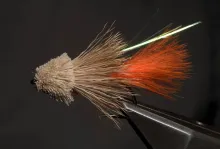
In order to keep the flash and hairs from swinging around the hook, I tie in the materials on top of the hook shank. First a bunch of bucktail midshank, then a bunch of flash. Then repeat the process, maybe with some other colors, just for the sake of variation. This part of the fly will fill maybe a third of the hook shank. In front of this you create a large and messy muddler head by tying on several bunches of deer hair and spinning them around the shank. Compress these first hairs a bit and tie in a second bunch. Keep on doing this until there is only room for a whip finish. You can see a more detailed description on tying muddlers in the article Muddler Mania. Don't worry too much about the appearance of the head at this stage. Whip finish, varnish generously and put the fly aside to dry.
Once it's dry it's ready to be trimmed. Don't trim it too close, but let the head be fairly messy and large. Trim it just a bit closer on the bottom of the head in order to clear the tip of the hook.
Arm the fly with a bite tippet made from wire, thick monofilament or whatever you fancy and you are ready to roll.

- Log in to post comments



Martin,
I just disc
Martin,
I just discovered your site. Very inspiring! I will visit it more often.
Hope my English is not to bad.
I am fishing for pike since i was 16 years young. Now I am 42, and for the last two years I am fishing with the fly on Pike. It's a addiction!!!
Here in the Netherlands is the season for fishing for Pike just closed.(Even though the Pike his / hers spawning is probably already done)
Time for tying some (of your patterns) streamers and fly-fishing for Ide!!
Tim
Martin, Now... That
Martin, Now... That's a Pike! Arms tired?
Martin, when did you say I was invited to share your boat, was it Nov. or Dec. '07???? Can't remember, [must be gettig old...****/##]
KEEP YOUR LINE WET!!!
In His Love,
Clyde
Hit the jackpot,whit
Hit the jackpot,white body with orange head and a bit of flash,got 13 in 2 hours on sunday morning!Im getting a lot of missed takes,do you think an offset hook would help?
cheers,keep up the g
cheers,keep up the good work.
Mike,
Pike hook s
Mike,
Pike hook sizes can cause some controversy, but my own attitude is that you should choose whatever size suits you and works for you. Swedish pike master Soren Essebo uses hooks as small as 4's and 6's for his pike flies and catches a lot of pike, while others prefer large hooks like the ones you use. Personally I'm inbetween. The hook should be lightweight and castable but still durable and able to contain materials for a large fly. Depending on the style of hook I have landed on something between 2 and 2/0 for most my flies.
Martin
Im a kiwi living in
Im a kiwi living in Ireland.I started fly fishing for pike last year and am hooked.I tie my own chook sized flies on a No 6-0 hook,is this a bit big?Ive caught a lot of pike on em,do you think a 2-0 is better?
Kirk,
The so-call
Kirk,
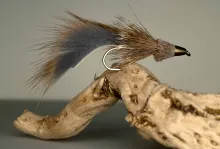
The so-called Orton-effect, which is used on all the images in this article, is merely a Photoshop-effect, which is freely accessible. See more details here.
Martin
Awesome article... G
Awesome article... Great looking pattern.. and the pictures are awesome.. how did you get that soft blur effect in the first few photos?
Jason,
We don't f
Jason,
We don't fish that deep. The depth of the lakes usually keep us from going under 6-8' or about 2-2½ meters. What I indicated by "fishing deep" was just that we want the flies to get down well below the surface and preferably just above the bottom. If you want to go deeper, try a denser line, like a Teeny 750. That will go to almost any depth!
We haven't fished much in weedy areas, but technically that should be feasable. And of course you can add a weed guard.
Martin
Martin, in your arti
Martin, in your article you mentioned that you go deep with these flies....how deep is deep? 20 ft? 30 ft? I'd like to get an idea of what type to conditions you were fishing? Have you had any success fishing these flies in shallow weeded areas....maybe with a weed guard? I'd like to try these flies for Tiger Muskie....I think they'll work great. Thanks.
Brian,
These flie
Brian,
These flies have been tied on 2/0 Aberdeen saltwater hooks from Partridge. That's what I had plenty of, and the hook is suitably large without being too large.
And yes, I'm sure large bass will love this fly too.
Martin
What hook do you lik
What hook do you like? Bet some nice big bass would like them too.