
Sometimes trout and grayling sip "nothing" from the surface. You have tried the smallest parachute in your fly box - size 18. What they are taking is much smaller. You look again into your fly box, and right - there is no "Nothing" there.
Have you also experienced the perfect evening by a lovely stream? The trout are rising, it is cooling down and the sun is painting the clouds and sky using a palette in gold, red and purple?

The box is filled with a new collection of hi-floaters, foam wasps, caddis flies, magic ball emergers etc. all tied in two or three favorite colors and variyng between size 18 and 10.
You are more than prepared. And yet, the trout refuse your flies time after time and they are clearly feeding on something hard to see.
Are they taking emergers? You tie one on, and they look at it but still refuse to take.
You need something small and maybe emerger-like. Something, which is almost not there. You need to attach Nothing to the tippet.
I have been in that situation in the Czech Republic, Colorado, Italy and last time on the banks of a Danish stream. Finally I concluded that I had to bring Noting with me, where ever I went - and I wish I done that a long time ago. When Les Austin gave me a bunch of hooks, I started tying.


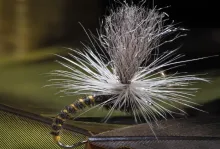
It is just a tiny emerger made with CDC to make it float well. You can make your own variant by varying the color, adding a short tail of antron, a parachute hackle, a rear body made of a quill or whatever you fancy... The small size and the loop wing is the key to the efficiency of this fly.
The point is that it is a good idea to bring a very small fly, just in case. Here is the step-by-step instruction:


- Log in to post comments




I will try this on t
I will try this on the Farmington River in Connecticut (U.S.A.) The olives are size 28 and the browns are very selective. This looks like a winner
Used some on picky t
Used some on picky trout pa stream. Worked very well.
I fished this fly in
I fished this fly in Russia last week and caught a mail order bride on my backcast. Should have used a lighter tippet and stronger vodka though.
While fly fishing a
While fly fishing a tail water, I noticed the trout were hitting my strike indicator more then my fly. So I decide to fix that problem and took a dry fly hook and used orange rabbit fur for the thorax and orange cdc for the loop wing. My next discovery was don't use a lite leader, they hit so hard it was amazing. This happened in spring 1994
Hello Ripley,maybe y
Hello Ripley,maybe you already tested this fly in Lithuania? :)
Regards,Sarunas_St
To dry a cdc fly, br
To dry a cdc fly, brush on a silica powder sold in the US as Frog's Fanny. Blow off the excess powder and keep fishing!
Ed,
thanks. Let u
Ed,
thanks. Let us know if you catch any.
Tight lines,
Kasper
HI KASPER.
good
HI KASPER.
good looking fly with c.d.c.,always looking for a new way in tying with c.d c..
will work up a few for a trip later this week to the junction in N.C. U.S A.
Kasper,
It didn't
Kasper,
It didn't take you long to fill those hooks! Have you tried them on the stream yet?
Thanks for your company over the week-end.
Regards,
Les
Rip,
I'll send yo
Rip,
I'll send you a bunch.
Kasper
Steps 9 and 10 pictu
Steps 9 and 10 pictures need to be switched around and there are a few misspelled words, not referring to the European "grey" either. (Martin writes: Fixed most of it) Nice fly though. I found a similar fly somewhere only tied with the opposite loop. I've caught fish on them when nothing else was working. They are a one fish fly for me though. Never found a way to perk them up other than putting on a new fly and drying them off.
Hey Kasper,
Dam nic
Hey Kasper,
Dam nice fly. I think that'll work big time. I'll try and throw it around in October in Lithuania.
Ripper's