
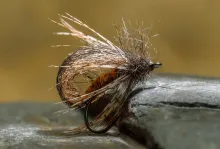
Realistic flies are not only for the display case. As Steve Thornton shows us, realism can also be applied to practical and effective fishing flies. Trout and grayling beware!
|
|
|
|
|
|
|
|
|
|
|
|
|
|
|
|
|
|


Flies and photos by Steve Thornton
Like most trout fishers, I've done my share of turning over rocks and catching bugs in my hat, for it is these bugs that offer us a clue to what a trout may be eating. While it is true that trout will eat things other than what is naturally available to them (the dreaded cheese ball
and canned corn hatch, eh), part of the fun of fly fishing for trout is trying to figure out what they eat and how they eat it. Once determined, the challenge is then to create and present flies that will fool the trout into thinking it is their natural food, and thereby hooking a few.
Steve Thornton, of Lincolnshire, England, is a professional advertising and editorial photographer by trade. He makes his living by creating images of products that will appeal to consumers. In a sense, that is exactly what he does with his fly tying - the consumers in this case being the trout and grayling in his favorite rivers and streams. He creates images of natural food items out of hooks and threads and bits of material, hoping he can convince a few fish that this is the dinner they had been waiting for.
His skill as a photographer directly applies to his fly tying. The task is not simply to replicate the details of the subject, but to accentuate those details that are most appealing to the consumer - the shine and gloss of a bright red apple, for instance, or the fluttering gills of a caddis larva.
Steve's flies are realistic - of that there is no doubt - but they remain fishing flies first and foremost. As he says "All of my flies are easy to tie. Anyone can tie them, as long as they follow the step-by-step procedures. And they are great fish catchers." So much so, in fact, that his Ammonite Nymph has circled the globe, from Russia to Japan, New Zealand, and across the United States, catching fish along the way. "When I am doing flytying demonstrations, it is amazing how many fly fishermen and women come up to me and say the Ammonite Nymph is their favourite pattern".
"I love to fish fast water. It's the first place I head for. The Ammonite is just great at searching for fish. I once pumped a trout in Mayfly time on a river called the Wye in Derbyshire. It had been working on the top and bottom and its stomach was full having eaten six or seven different species of food such as adult caddis and mayflies (Danica), hydropsyche larva, danica nymphs, shrimps, alders, and rhyacophila.
I put this selection in a specimen bottle along with an Ammonite Nymph and wow - the Ammonite just disappeared. The overall colours,
translucency, shape, silhouette, and segmentation made the Ammonite Nymph blend so well with these naturals that it finally convinced me why it was such a good searching pattern".
"My second favourite is the CAM Emerger. This, like the Ammonite, has all the triggers or trout food signals, but works on the surface. The CAM Emerger can raise a fish when nothing is breaking the surface. This pattern, like the Ammonite, I tie in large #8's for fast water down to #18's for slow glades and back eddies. It's a relaxing pattern to fish with, gazing at its high Mohican wing dancing with the stream can be quite dreamy until the eventful take awakens me".
When Steve started tying realistic fishing flies, he grew frustrated from the lack of suitable materials for such flies. So much so that he started designing and creating his own materials, eventually leading to the formation of his company, Virtual Nymph (http://www.virtual-nymph.com/). The intent of Virtual Nymph is not to sell all things fly tying to all fly tyers, but rather to target that niche of tyers who prefer to create patterns that closely mimic naturals. Obviously, his materials are tuned to his tying techniques, but clearly are limited only by the inventiveness of their users.
The first material he invented, and most likely his most popular product based on its worldwide sales, is Nymph Skin. "The problem with Nymph Skin was the minimum amount I had to order, one ton. Then I had to send it to Germany to be cut into the required width and thickness. Naturally, I needed shops to sell it for me, but like any new product the shops seemed to decline on stocking it when it was ready to launch. So, hence, Virtual Nymph." Since the introduction of Nymph Skin and the formation of Virtual Nymph, he has developed several unique fly tying products and continues to introduce new products as fly tying techniques are refined and developed. As a popular demonstration tyer at shows in Europe and the USA, and an instructor of fly tying course, Steve has become adept at teaching his tying techniques and showing fellow fly tyers how to tie his favorite patterns.
It wasn't long before he combined his skills as a photographer and his desire to teach by offering step-by-step instructions for his flies on his web site. The natural progression of such work was his CD-ROM "Masterclass Flytying" which was followed up by his recently completed book "Listen to the River".
I recently learned that Steve will be coming over to the US to fish some of my home waters in the Catskills. From what I've seen of his tying and heard about his fishing, I'm pretty sure he's got some fun days in store.
Ordering information
- Log in to post comments


I was at ty fest in
I was at ty fest in MD and No one stresses the art of fly tying. The art of fly tying is something that should be recognized. Fly tying is an art form that does not seen to have a place that is recognized. I can sit at my vice for hours and really relaxe and enjoy myself tying flys. It is the only time that a tyer can put to a vice something that does not exist. I know that not everyone wants to take the time that is needed to ty this type of fly, but I for one will never stop creating something on my vice that never existed before. Surely there must be other tyiers that have the same passion that I have. If so please respond.
Euan,I did post a co
Euan,I did post a comment to your posting but it did not show up. I use a Resentti travelar as doe my grandson. I highly recommend this vice.
Euan you are in the
Euan you are in the best stages of fly tying, do not get upset if you can't find the vice in the dvd. I use a Resenti traveler as does my grandson. A very nice vice which I highly recommend. The vice is a true rotory vice and there is nothing you can not do with it. If you have any further problems please feel free to contact me at hjackson@loyola.edu. Please enjoy what you have decided to get involed in, it is very rewarding.
Realistic flies are
Realistic flies are very rewarding in a personal way. Not all flies are for overboard. I do ty flys to fish with but I tend to gravitate towards the realistic flys. I have magnifying cubes that I stare at a real insect for hours. I do respect what all fly tyers do, but the art of fly tying to me is very rewarding. I would like to be able to ty one of my flys one day, put it on a flower and have a real bug try to mate with it. As said, it takes too long and you don't want to fish it. This is a sport in which you want to enjoy, thank you.
I enjoy it when I se
I enjoy it when I see an artist fly tier. I ty a lot of different flies but I tend to gravatate to the flies that represent a real bug. There is fly tying and there is the art of fly tying. You are diffinately an artist. Some day I hope to be able to ty a realistic praying mantis but as of yet it does escape me. I did ty a turtle which took me eight hours to complete. That fly will never get wet. Any advice on the mantis? I started my eight year old grandson on fly tying. He is really good at it for his age. Took him to see Bob Clouser at the Maryland ty fest.
I was wondering can
I was wondering can your flies be purchased
brillo flies hard to
brillo flies hard to beat caught a mag of a brown on your sedge
Hi Steve, I find you
Hi Steve, I find your books full of extremy useful information and fantastic photogrphs. I have one question what method is called fully-hacled flies, I have in my mind it is palmered but not sure, could you let me know, thanks. William.
Hi im jacob im 13 an
Hi im jacob im 13 and I tie realistic flies and I would like to know how you tie that killer caddis pupa.
if it cant be tied i
if it cant be tied in 20 minutes or less.And is very stiff,I find realistics realistically wrong for fishing.I don't want to spend an hour or two tying a fly that i may lose in the stream,a tree,etc,where i could have tied a perfectly acceptable impressionistic fly that would catch more fish,not fisherman,and not care to lose,cause i could wrap one in no time.All that said your flies r beautiful and r very artistic.They should be displayed in a shadow box and take the impressionistics to the stream.
my 2 cents
Hey Guys,
Thank y
Hey Guys,
Thank you for all your kind words. I hope to meet you all at the Symposium in November 08.
Keep the vices smokin... All the very best, Steve Thornton
Hey, Craig...
You
Hey, Craig...
You received the goods last year!
Hi
Steve ties good
Hi
Steve ties good flies, but he took my money last year and I am still waiting for my goods.
Doesnt return my emails or phone messages.
Be careful when dealing with him
Hi Steve will you be
Hi Steve will you be at the game fair In Nov at trent and gardens Stoke,
Hi Steve, i thought
Hi Steve, i thought my G P fly looks cool but your flies are magic. id love to be able to tie as good as that fantastic honest, ill be back to the drawing board later. People like you make us tiers try harder to improve are tying if you get the chance e mail back id love a chat
Mind blowing,,your t
Mind blowing,,your tying is great. Any off the New Zealand trout would eat any of you trout fodder. Great job.
hello all my colecti
hello all my colection and inspired of the modeles of steve which are fantastic and fishing and pattern is the fantastic artist
www.mouchesdepastors.com
I fished the Beaverk
I fished the Beaverkill with Steve two Mays ago at the Mayfly Club meeting on the river. I can attest that Steve, using his "Cam" fly outfished some rather well known personalities who were with us and who are excellent fishermen. I know he has pictures of a 23 and 21 incher he caught and released on this fly. He not only took the largest fish caught the two days I was there, but the most fish, by probably a 3 to 1 ratio.. Are his flies worth the time it takes to tie them?? You better believe they are! : Tom, just give them a try and I think you may want to rethink your comments...
Tom,
I think you wi
Tom,
I think you will find Steves flies do last a very long time. I have had 17 fish on one Ammonite nymph and at least 10 fish to the CAM. They do take slightly longer to make but after a couple of attempts they are really quick and simple. I spoke to Steve and followed his advice "just follow the step by step". No one knows if the extra effort is worth it after all only the fish can answer that one. But on results alone i can usually bag a few on the hardest of days using some or all of the above.
"dry flies and wet wellies" Dale
i really like the fl
i really like the flies you tied because they look so real and life like.However i honestly see no reason to spend that much time on a fly that good only to catch the same fish you could have caught on the same fly without soo much detail. I find it rather pointless.On the downside it probably takes a couple of fish before those "works of art " are destroyed. I really do though think that your flies are amazingly real looking and neat, but i see no use to fish with them.
Hi Everyone......I l
Hi Everyone......I love Realistic Flies which are tied by Steve Thornton. They are soo.....erm......realistic. I love tying the 'Ammonite Nymph'. I have only had missed takes on this fly and am hoping to catch some fish on it especially Chub and Barbel and other course fish in the future.
These flies are magn
These flies are magnificent!!!!!!!! Can they be purchased?
Euan, The vise is
Euan,
The vise is made by Lawrence Waldron. Find more information here.
Martin
Hi my name Euan and
Hi my name Euan and i am a beginner at fly tying but really enjoy tying a fly then going and catching a fish with it,the reason for this comment is that i bought a dvd by Oliver Edwards and in it he uses a certain type of tying vice i could not find out what type or make of vice he uses till now.After a long search i found that the vice he uses is the Law Vice the one advertised on the virtual-nymph web site but alas i cannot find any info on where to find or purchase the vice.I have written an e-mail to the company but as yet i have had no response.PLEASE E-MAIL ME WITH DETAILS OF THE VICE MY E-MAIL ADDRESS IS Ueshaw@aol.com. Yours Hopefully Euan.
hello steve, your fl
hello steve, your flies are absolutely amazing
To all who want
To all who want to buy Steve's flies, I can recommend a quick Google search for Steve Thornton. That will give you a link to Steve's site Virtual Nymph where you can find materials, books and much more from Steve and where you can contact him regarding flies.
We don't sell flies, we have no prices and we cannot help much when it comes to buying stuff that we mention on the Global FlyFisher. We provide links where we can, but when we don't, try searching through Google or your preferred search engine.
It's not that difficult...
Martin
hi do you know any w
hi do you know any were i can buy one of these or the price of one thnx
Aengus, Maybe fro
Aengus,
Maybe from Steve's own site. Try contacting him through there.
Martin
Hi, is it possible t
Hi, is it possible to buy this fly ?
regards aengus
hi steve, very inter
hi steve, very interested in your ammonite nymph. Only discovered its 'your fly'. Never actually seen one in reality, I have made poor attempts at dressing one. It looks a beautiful creation.
Can I purchase some, I live in Ireland And mainly fish the river suir. I,m trying my hand at czech nymphing.
Regards Seamus Barry, Co. Tipperary.
i would like the gol
i would like the golden stonefly on a number 8 hook
Exellent - you done
Exellent - you done a fine job, and it ought to catch fish