
Steve Schweitzer is at it again. He just can't stay away from those chick-a-bou feathers. Maybe it's because chick-a-bou is so versatile and incredibly buggy looking. After tying up four variations of a crawdad pattern, he finally found what worked best. See what he caught on his latest addition to the Tabou Series of flies and

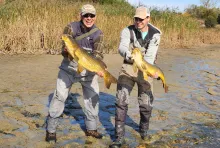
A nice early summer Colorado carp (aka Rocky Mountain Bonefish) was fooled by a Tabou Daddy. Tabou Daddies tied in orange, brown, rust, olive and white are especially effective colors for carp, trout, panfish and bass.
Soft Hackle & Chick-a-bou Crazy
I'm at it again. I just can't stay away from those chick-a-bou feathers. I look at them and wonder what I can come up with next. I can't quite explain it. I can't explain why I have a fascination for tying flies out of chick-a-bou. I imagine it's because a brahma hen soft hackle and chick-a-bou pelt is so versatile and the natural mottling is incredibly buggy looking. But every bird, male or female has a soft hackle with chick-a-bou pelt too. So I wondered what can I make with a rooster pelt? I dug out a Whiting Farms grizzly dyed brown rooster soft hackle with chick-a-bou pelt and messed with a few ways to tie a crayfish pattern. What I came up with, after 4 pattern variations, is a crayfish pattern that is easy to cast and has all the visual features of the real thing. And, consistent with the Tabou Series of flies, the materials are minimalistic and the tying steps are easy.
Sidebar on Designing Flies - Why Fly Features Matter
Most all fly tyers realize that flies work because of 4 primary factors: presentation, size, color, shape; ordered from most important to least. But, there's one additional element that I strongly believe is just as important as any: features. When I design flies, I concentrate on the features that would most closely mimic the real thing. Then I try to minimize the complicated steps or unnecessary/excess materials required. That's what you see in the Tabou series of flies: simple materials, easy steps and realistic looking flies.
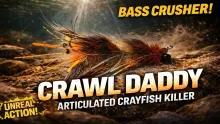
When designing a crayfish pattern, I see three important features that mimic the real thing: claws, legs and eyes. Of course body shape and color are important, but those are already covered in the traditional factors of fly design. Look at the picture below - a finished Tabou Daddy has the most prominent features of a crayfish while remaining easy and quick to tie.

A finished Tabou Daddy. A lightweight, easy to cast imitation of a small crayfish...a deadly pattern for most any species of freshwater gamefish.

Materials
The materials are quite simple, four to be exact, plus a hook:
- A grizzly dyed brown rooster soft hackle with chick-a-bou pelt
- Hareline Dubbin Rusty Brown Ice Dub
- Weighted wire
- 0.012" monofilament
- hook: a 3x streamer hook. A size 12 is used in this example.
- black model paint for the eyes is optional

Monofilament Eyes
Making monofilament eyes is quite simple. Cut a piece of mono to 3 inches. Burn both ends with a lighter until the mono balls up and turns brown. Be careful as mono has a tendancy to want to turn into a fireball and before you know it you'll have nothing but a ball of burnt mono. The trick I have found to be most effective is to practice a few times before settling in on making sets of eyes. Get accustomed to how the mono burns and balls up. Don't place the mono in the yellow part of the flame, place it in the blue part...the hottest part. Dab the mono in and out of the flame to prevent it turning into a raging fire ball. After a few practice tries, you'll get the hang of it. Be sure to leave an inch or more of mono between the eyes.
Once the burnt mono has cooled, dip the ends in black model paint and let dry overnight. I have found model paint to be quite durable and thick enough to form a perfect tear-drop shape around the burnt mono ends. Other paints may work well too...just ensure the paint isn't too runny as this will prevent a good tear-drop shape from forming. More on mono eyes here and here.
Preparing the Materials
LEGS: From the sides of the pelt, you'll find long hackles perfect for woolly buggers - these are soft hackle spade feathers. Pluck one to be used for the legs.
CLAWS: Just above the chick-a-bou section of the pelt (middle of the pelt), you'll find some chick-a-bou that isn't quite fluffy like chick-a-bou and isn't quite a spade feather. Pluck two of these to be used for claws. You can even use fluffy chick-a-bou feathers if you prefer. It really doesn't matter. The point is to select two feather that will simulate the claws nicely.
SPEED TYING TIPS: As in all my patterns on this site, I am a big advocate of preparing many materials in advance to speed the tying process. For this pattern, I tied the lead on a dozen hooks in advance, I made plenty of eyes the night before and plucked all the feathers I would need for the claws and legs.
| Step 1. |
Weighting the Fly Tie some lead wire the same diameter of the hook shank (or slightly larger) on the TOP of the hook. This acts as a "keel"and ensures the crayfish will align with the hook point upwards in the water as it is retreived. Alternatively, you can wrap the lead wire around the hook for more weight. |
 |
|
|
||
| Step 2. | Head of the Fly Using the Ice Dub, dub a fairly large sized ball of dubbing at the intersection of the straight shank and bend of the hook. This helps splay the claws and eyes outward. |
 |
|
|
||
| Step 3. | Claws Just behind the dubbing, tie in one of the claw feathers so that it splays slightly upward away from the hook point at about a 45-degree angle. If the feather has a curveature, ensure the curve is going outward. Tie in the other claw feather on the other side of the dubbing ball. When complete, the claws should look something like the pictures to the right. |
   |
|
|
||
| Step 4. | Eyes Just behind the dubbing, tie in both eyes so they point downward and extend just past the bend of the hook. Use the dubbing ball to help splay the eyes to the left and to the right. |
 |
|
|
||
| Step 5. | Leg Hackle Just behind the dubbing, tie in the spade feather by the butt. |
 |
|
|
||
| Step 6. | Body Dub the entire length of the hook shank with the Ice Dub. Create a tapered body by dubbing from thickest to thinnest as you dub to the hook eye. I prefer making a dubbing loop as shown in the picture to the right. I feel dubbing loops are more durable. |
  
|
|
|
||
| Step 7. | Creating the Legs Palmer the spade hackle to the hook eye and tie off. Try to palmer the entire feather on the hook shank. |
 |
|
|
||
| Step 8. | Trimming To Shape, part 1 Trim all the hackle from the hook point side of the hook. This is the top of the fly, so we won't need leggy hackle there. |
 |
|
|
||
| Step 9. | Trimming To Shape, part 2 Now, trim the hackle completely from the back half of the fly, leaving 2 - 3 palmers of hackle remaining to create the legs. |
 |
|
|
||
| Finished Product | Notice how the claws and eyes along with the tapered shape of the body make these crayfish look realistic. The palmered hackle when trimmed, also gives a nice segmentation look that a real crayfish has. | 
|
- Log in to post comments



Scott, Let me rep
Scott,
Let me reply for Steve here.
Chick-a-bou is widely available in shops as well as online. Whiting Farms who produces the feathers has a page about the material as well as a list with dealers. You can find chick-a-bou in a very large variation of natural and dyed colors, but the basic material is the same, and the same types of feathers are found on all these skins.
A very versatile material indeed! I personally have a lot of them, and use them heavily for my coastal flies.
Martin
Steve, This looks li
Steve, This looks like a fantastic pattern! I am very interested in it. I have tied several other crayfish patterns, but this one has peaked my interest. I am not well versed in hackle, especially chick-a-bou. Would you be so kind as to provide me with some resources for finding the chick-a-bou that you use for the Tabou Daddy - product name preferably. It seems different from the product that you use on emerger that you tie with chick-a-bou. Thanks in advance for your help and time!
Hi folks: Let me
Hi folks:
Let me answer a few questions at once here...
Chenille Body: of course you can use chenille...nothing wrong with that. I prefer some sparkle to attract the fish's attention, hence why I use dubbing, but sparkly chenille would do the trick as well...good thinking.
Alligator clip holders: Search for "note clip holder" and plenty of links come up. An idea: contact one of the corporate promotional vendors and ask for any excess or mistake printed items.
Thanks for the questions!
steve.
i like the fly and w
i like the fly and will tie some.
i would like to know where you got the aligater clip holders. i saw someone else using them at a fly show. are they from a store and where
thanks
This looks awesome.
This looks awesome. Is it possible to use Chenille instead of dubbing for the body or would that weight it down too much? I'm still kinda new to this and just trying to learn what's good to do and what's not.
Thanks.
look like easy made.
look like easy made. but not simple for do hehehe. nice tying.
Looks like a great p
Looks like a great pattern. Very impressionistic which I like in a fly. This one might catch more fish than fishermen.
Willi
Ron: Great commen
Ron:
Great comments! I have used zonker strip crawdaddys as well; successfully for smallmouth and bass for sure. However, I have found that the carp I go after are quite sensitive to a fly landing on the water; hence the light unobtrusive nature of this pattern. Zonker strips tend to help the fly land hard on the surface, despite a gentle cast. That may be just enough to scare shallow-feeding carp away. I've also noticed that tail material on crayfish tend to make the fly spin while casting, in essence furling the leader unintentionally. All this is well and good...Maybe I am just a bad caster :)
Regardless, I am glad other folks tie and use similar patterns to this...this pattern is just one idea to help you get started in thinking how to design your own for your needs. Tie on!
I have tied a simila
I have tied a similar pattern that is even more realistic and just as easy. The only differences are that I use zonked squirrel for the claws, and I put a tail made from deer hair that points downward. The reason for the fan tail is that it will create the signature signature cloud of a crawdad in retreat.
Awesome pattern Stev
Awesome pattern Steve! Thanks for publishing this. My personal patterns have always been more complicated than this, and took a lot longer to tie. This fly looks great, and I look forward to fishing it in '09.
belting pattern
belting pattern