
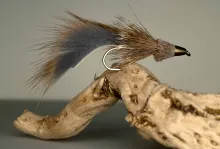
This is the lazy man's muddler, the sloppy tier's muddler, the beginner's muddler. It's actually quite close in style to some of the first Muddler Minnows tied by Don Gapen back in the 30's.


This is the lazy man's muddler, the sloppy tier's muddler, the beginner's muddler.
It's actually quite close in style to some of the first Muddler Minnows tied by Don Gapen back in the 30's. The original Gapen muddlers were not neatly stacked, spun and trimmed deer hair constructions, but more like a bunch of deer hair tied on the hook to finish the fly, hardly trimmed and not at all neat and tight at many of today's muddlers - including most of my own, by the way.
The Nightfly
Some years ago I was going on a night trip with my good friend Henning, and decided to whip out some quick flies for the purpose. Night flies for sea trout are generally large and bulky. A little flash doesn't harm and the color seems to matter very little, although dark colors are traditionally preferred by most anglers. I personally tie my night flies in any color, and rather prefer bright and visible colors, which make the fly much easier to see in the dark. In all my years of fishing I haven't seen that influence the success of my night flies.
Night flies should also fish in the surface, which calls for light and floating materials such as deer hair and foam, and a bit of bulkiness doesn't hurt either, because the fish seem to go for the fly using their sideline senses as much as their sight. So the more "noise" and the bigger the wake, the better.


Deer hair
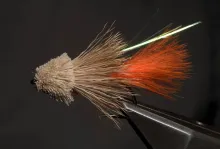
Since I love deer hair flies, the recipe was easily laid out: flashy tail and body, messy and voluminous hackle and head.
I tied up a bunch if similar flies in three different colors: white, rusty brown and natural tan.
The tail and body is pure flash: flash straws and mylar tubing. The messy front is a body hackle and a large deer hair head. Unlike my usual muddlers, this head is neither stacked or trimmed. I cut the deer hair to a suitable length - about 1/2 an inch or about 1-1.5 centimeters. This will result in a large and bulky head.
The head doesn't need to be compact, so usually one bunch of hair will do, but depending on you mood you can add a second bunch for a little more fill.
|
|
|
|
|
|
|
|
|
|
|
|
|
|
|
|
|
|
|
|
|
|
|
|


Fishing the fly
I always fish a floating line at night. I may sometimes use a neutral shooting, which sinks very slowly, but the fly still fishes in the surface or just under. I like to see the wake that the fly creates, and seeing a fish break the dark surface to take it is very exciting.
This exact night had the best conditions you can imagine for night fishing: a light sky that give some character to the water, a good current that pushes fresh water and food over the reef and a light wind in the back that helps propelling out a large and heavy fly.
I positioned myself almost on the tip of the reef, cast "upstream", mended the line and very lightly worked the fly as it drifted across the reef.
And we were in luck: a bunch of nice rainbows had decided to feast on whatever the current brought along, including our flies.


- Log in to post comments


Kevin,
I have nev
Kevin,
I have never been a great proponent of the view that long shanked hooks are a problem. The leverage issue comes up now and then, and there might be some truth to it for really long hook - like NE streamer hooks, but in my experience a hook as the one used here holds just as well as a short shank one. I typically use a Kamasan B800, which is a favorite hook of mine, and although it is quite long, I don't remember having lost fish where I could blame the hook.
Martin
Martin: Great site.
Martin: Great site. So much of your information is applicable to the sea run cutthroat fishing on the west coast of the US and Canada. Thank you.
Let me ask if you don't find that the long shank streamer hook on this Muddler gives the fish an extra advantage and leverage in throwing the hook? One of the reasons we like the tube fly out here is that it harbors a short shank hook (often an SC 15 Gamakatsu) and makes it easier to bring the fish to hand and effect a quick release.
Pike,
I never rin
Pike,
I never rinse my reels in freshwater... or rarely at least. If they can't take my abuse, they're not for me. The EDP has never been rinsed or lubricated and still works. That's good enough for me.
Martin
Martin, thanks a lot
Martin, thanks a lot. I usually use Scierra EDP and it seems to be ok too. But I always rinse the reel in the fresh water after fishing.