
Roger Duckworth shows an innovative and extremely easy technique to make durable extended bodies for mayflies, caddis, and stoneflies, and he shows a way of hackling the dry flies so that the hackle is under the body but above the hook so that it supports the fly more like the natural.

I have developed an innovative and extremely easy technique to make extended body flies, mayfly, caddis, and stonefly. I can make a dozen near perfect extended bodies in the time it takes most tyers to make one--and mine is more durable.
I also have developed a way of hackling the dry flies so that the hackle is under the body but ABOVE the hook so that the hackle supports the fly like the natural.
Here's a description of the processes
Instructions for making the extended body
Tool set-up
1. Place the needle in the drill and tighten the chuck.
2. Lay the drill down conveniently in front of you so that you can depress the drill trigger with one hand while holding the dubbing with the other.
Steps for making the extended body
1. Color the mandrel to the correct body length.

Silicone coated mandrel |

Tail added |

First wisp of dubbing |

More dubbing |

Coated and shaped |
2. Rotate the needle while coating it with silicone. Place a light coat of silicone on the needle starting from the mandrel tip to just a little over the length of the full insect body. Rotate the needle with the drill to get a complete application that fully covers the needle.
3. Lay the tailing fibers on the needle so that they are caught by the silicone and protrude the correct length past the needle tip. For caddis and other insects without tails, skip this step.
4. Grasp a small wisp of dubbing and rotate the needle while barely touching the dubbing to the silicone on the needle. The silicone will "grab" the dubbing and start winding it on the needle.
5. Continue rotating the needle while adding wisps of dubbing to fully cover the mandrel and to build the correct length, diameter, and color of the mayfly body. This step is where you can build the abdomen with one color (or blended colors) and overlap and build the thorax with another color.
6. Coat the body lightly with silicon or with water based head cement if desired, and rotate the mandrel to do final shaping and smoothing with your fingers. This will aid durability.
7. Using your nails, slide the completed body off of the needle. Be careful to not crush the wet body. Lay the completed body to the side for drying. Carefully put a slight curve in the abdomen if you desire. Variety of completed extended bodies shown.

Instructions for tying Duck's Natural Extended Body Fly

Thread covered hook |

Hackle tied in |

Extended body tied in |

Wing tied in and hackle started |
1. Place the de-barbed hook in the vice and wrap two layers of thread from the eye back to just above the hook point and half-hitch midway.
2. Tie in the hackle at this point, half-hitch, and add drop of cement.
3. Position the completed extended body so that the abdomen curves away to the rear of the hook and the thorax extends to just behind the eye and bind with 2 loose wraps of thread and then wrap three wraps under the body but above the hook around the tie-in point and half hitch.
4. Place the Z-lon wing material in the correct wing size on top of the extended body and bind with 2 wraps of thread. Too little wing material is better than too much. Fold the Z-lon into a single cord and form a wing by wrapping the thread around the base of the wing. I rotate my vice so that the wing points toward me as I wrap a few turns around the base. TIP: Dab the base of the wing with UV and zap with blue light while holding the wing in position - nails it!
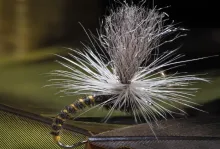
5. Take 2 to 4 turns of hackle placing the hackle forward between the thorax and hook and back between the abdomen and the hook so that the hackle is wound, semi-parachute fashion, around the junction of thread attaching the extended body to the hook.This places the hackle under the thorax and abdomen but above the hook for a VERY natural look.

6. Tie off the hackle with half-hitches and whip finish under the head. Place a drop of head cement at this point and at the base of the hackle. Trim the wing to correct length. Trim the thorax to correct length. Trim any errant hackle fibers so that the fly will lie flat on the water.
7. If the natural has a distinctly colored head, use a magic marker to color the very front of the thorax. Variety of completed flies shown.

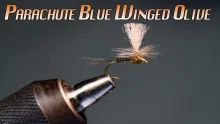
Video showing how to tie the fly with the body and a low hackle
- Log in to post comments




Sure you can
Jack,
Sure you can use this for a size 10 hook, and the silicone is available in hardware stores and builder's markets and is usually used for sealing in kitchens and bathrooms.
Martin
On a Size 10?
Can you use this technique on a Size 10. And what is the typical store to buy GE Silicone? Thank-you it is a very informative video.
Fishing with friends
Fishing with friends, each with 50 yrs + fly fishing experience, we had an opportunity to fish this inovative fly on the Green River, Utah. I can tell you that the strike ratio to similar flys was 8 to 1 in favor of Duck's extended body fly. It would be great if these flys were available commercially for those of us who love to fish but have limited time for fly tying or the ability to do so. Thank you Mr. Duckworth for a great fishing experience.
Yes, I have the link
Yes, I have the link and I will send it to you - the policy here is not to post links to other sites - I respect that! Still, the guy who posted that technique there (a very prolific and thorough romanian flytyier), didn't suggest that he was the originator - so I cannot give you the original. Anyway the front body, that complete the extended-body-mayfly, was made with cdc - which I'm a fan!
So, I'll mail you the link and anyone who wants it, just e-mail me.
Staff note: The link is here. We only disallow links to avoid spam. Add it without http:// and I will transform it to an active link.
Martin, GFF
Thanks for the comment
Stan, Thanks for the comment. I do not doubt that someone else thought of the idea to make the bodies. I got the idea from a post where a fellow was spinning a mandrel with his fingers. Do you still have a link to that site? The true INNOVATION I claim, which may have existed, was to wrap the hackle between the hook and under the body so that the hackle, like legs, keep the abdomen off of the water. This presents a more natural look. This is key. I tried the extended bodies last year with the hackle around the wings (parachute) and they were not especially effective. I went to the NATURAL style last Fall and immediately saw great results. Try them, they catch fish!
With all due respect
With all due respect, you said you developed an innovative technique for extended bodies but I learned about this exact technique from a romanian flyfishing site about 5 years ago.
Nice presentation anyway!
Wing--keep it sparse and short
Further info. Wing--keep it sparse and short so that when the wing gets wet, it will not topple the fly. The wings in the pic of the 4 flies are thick for the pic but I fish wings that are less than half as thick. Hackle, I take two turns of quality Metz saddle hackle and it floats them well. More turns tends to push the abdomen too far up. Fished the BWO yesterday on a slow day on the South Holstein. Fished many flies but ALL surface takes were on the Duck's Natural Style though I also threw standard dries and a purchased extended body that had the hackle traditional parachute style above the body. These flies work! I cannot wait to try them on the Green River in Utah at the end of the month!
I spun up some bodies
I spun up some bodies this morning after collecting a drill, needle, dubbing and a tube of GE silicone. Much easier than I expected. I can't wait 'till they dry so I can tie them on hooks and see how they float. Great idea, thanks!
Many thanks
Hi Roger Duckworth.
many thanks for your showcasing a new way to make flies on, I have even started to make these flies. I have made a fly daddy long legs, this fly was more realistic than others that I have made.
sincerely,
kenneth. www.westlin.dk
I use a small tube
I use a small tube of GE 100% silicon. Any quality 100% silicon will suffice. It dries in 3 to 6 hours. Make the wing VERY sparse. Open the gap on the hook as you flatten the barb for better hooking. I would add more but I am in the Bahamas bonefishing for research on my next article! Work, work, work..........
There is a difference
There is a difference of silicone for wet rooms, there are some ther are contains vinegar, but I do not know what is best. It could be that there is someone better than anothers, I would like to hear what is the best silicone to tie flies with ???
Works beautifully!
It's works beautifully! Floats high on the water and very realistic looking. The bodies are super easy to make. Thank you for sharing.
Silicone sealant
Kenneth,
As far as I know all the silicone sealant you buy for use in wet rooms such as bathrooms will do fine. Several types are available in stores that supply building materials and materials for plumbing.
Viscosity as well as drying times may vary, like the size of the tubes you can buy. Most sealant come in large containers meant to be used in a "gun" - a so called chaulk gun - but some brands are sold in smaller tubes with screw lids, better suited for fly tying where you use small amounts at a time.
I hope this helps you.
Martin
What is the best silicone?
what is the best silicone, I know that it must be waterproof,but there are a variety of silicon.
What I missed since 2013!
I only recently discovered this article. How could I have missed this demonstration? Thank you.
So many gems
Serge,
That's the "problem" with GFF!
There's so much hidden gold in these ores, and discovering everything is impossible.
Even I find things that I forgot was there!
Martin