
Let's look at a hook, and try to put the right terms on the right parts. This picture shows a hook (note that it actually is a rare vertical eye hook, great for this purpose).
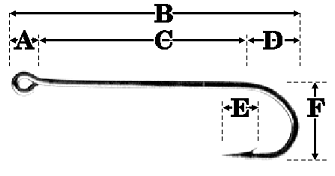
Let's look at a hook, and try to put the right terms on the right parts. This picture shows a hook (note that it actually is a rare vertical eye hook, great for this purpose).
The letters represent:
- Eye width - a good measure to use when indicating small distances in the pattern, especially in the front
- Overall length. The hooks 'outer' horizontal dimension
- Shank length. The length of the part we normally tie the fly on
- Bend - it can be difficult to determine where the shank ends and the bend begins, especially on curved hooks.
- Barb length - sometimes use to measure out tag/butt placement on salmon flies
- Gap (or sometimes gape) - almost the same as the hooks' overall height
Read more about salmon fly dimensions
I have selected a straight shank, straight eye hook for this example, but hooks can be very different from this scheme as you see here:

Two Partridge Bartleet hooks: heavy and fine. This is a very beautiful, classical hook, and it's my favourite for tying salmon flies.

The Tiemco 80x series is a series of short, thick straight eye salt water hooks. Very durable and practical, but not exactly beautiful. They are a bit on the heavy side, but good for certain purposes like The Gift Fly.
The Partridge John Holden hook is very similar to these, but made of thinner wire.

A grub hook with its extreme bend, is used in the salt as the sedge hook for small imitations. It's a very robust hook with good hooking ability thanks to a good angle between line/eye and point.

A typical sedge hook which is used by many Danish fly tyers for small crustacean imitations - and for sedge larvae of course.

The classic limerick bend is still one of the most beautiful for wet flies. These hooks are not widely available any more, but both Partridge and Mustad has some like this one.
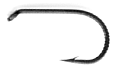
Special hooks for bead heads feature a large hook gap and a smooth round bend. The bead slips over the point and barb with no problems and can rest against the eye of the hook.

Same hook different eyes. This is the same Kamasan dry fly hook. The only difference is the up/down eye. It makes quite a remarkable difference on the overall look of the hook and the look and character of the fly.
- Log in to post comments
