Anybody can see that the Crazy Dane is really a Crazy Charlie - a very common salt water fly from the U.S. This type of fly is rarely seen in our part of the world, and I know no other fishers that use it.
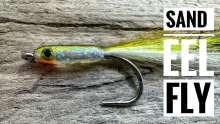
 Anybody can see that the Crazy Dane is really a Crazy Charlie - a very common salt water fly from the U.S. This type of fly is rarely seen in our part of the world, and I know no other fishers that use it. I started out with larger Crazy Charlies used from float tube to imitate small pelagic fish. This is contrary to the American way of using it. The Crazy Charlie is normally a shallow water bottom pattern for flats types of fish. My current version is much smaller and very lightly dressed. When retrieved in small jerks it's the spitting image of a small clear baitfish.
It fishes hook point up which is not really important, as I mostly fish the fly in the free water masses over deeper water.
| Hook | Size 4 John Holden |
| Thread | White or Dynachord/Bennichi |
| Body | Body Glass or Larva Lace over silver tinsel |
| False hackle | Crystal flash straws over red golden phesant feather |
| Eyes | bead chain eyes |
| Head | Color of thread |
- Tie in the Body Glass or Larva Lace in front of the hook
- Tie it down to form a smooth foundation on the hook shank
- Wind the thread back to the hook eye
- Tie in a length of silver tinsel (see Tinsel bodies)
- Wind tinsel to the hook bend and back to form a smooth silver body
- Wind Body Glass or Larva Lace in close turns over the tinsel and tie down
- Tie in a pair of bead chain eyes on top of the hook shank just behind the hook eye
- Turn the hook upside down
- Prepare a red golden phesant body feather by removing short and webby barbs and stroking the rest parallel with moist fingers
- Tie in the feather opposite the eyes
- Pull the feather to form a false hackle the length of the body
- Tie in a small bunch of crystal flash long enough to reach over the hook point
- Log in to post comments