
Awhile back, I received a shipment of hen necks and saddles from Whiting Farms. The saddles struck me with their intense colors and solid web, then necks with their stem length and shortish barbs. These feathers were perfect for the wet flies I was working on.
Awhile back, I received a shipment of hen "parts" from Whiting Farms - saddles and necks. The saddles struck me with their intense colors and solid web - the perfect substitute for schlappen, which is a bit overkill for smaller trout flies. The saddles are pretty cheap and readily available, so give 'em a try.
|
|
|
|
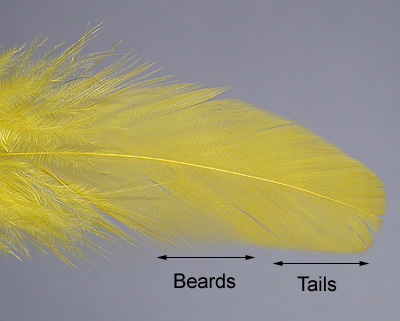
The typical hen saddle hackle is a dense webby feather with a rounded tip and fairly long barbs in relation to the length of the stem. The most useful portion of the feather is the top two thirds. The uppermost section is solid web right out to the very tips. As such, it is best used in places where normally a solid feather section would be used, such as on the tail of a classic wet fly where one would normally use a slip of quill. What is nice about the Whiting saddles is the length of these barbs is good in relation to the typical hook size, so the tag end of the feather can be wrapped the length of the hook allowing for a smooth and uniform underbody. |
 |
|
|
|
| The middle section of the saddle has longer barbs, but the fact that the barbs are not married out to the tips make these more appropriate for the "hackle" portion of a wet fly, what would normally be termed the "false beard". Where in the tail you want to give the illusion of a solid section of feather, in the hackle you want each barb to be distinct, as if you wrapped a conventional hackle feather (Chinese cock, for example) | 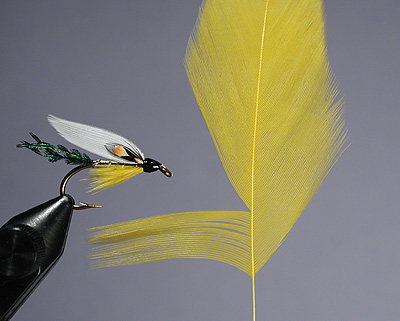 |
|
|
|
| This section of the feather also lends itself well to "mixed" hackles, as you can stack sections and work them with your fingers until the two (or more) colors are well blended. | 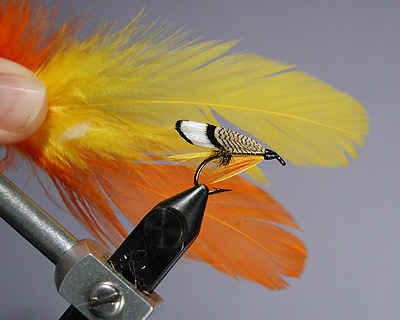 |
|
|
|
| Not the area of the feather where the web extends to the tips used for tailing. Notice that the barbs are plenty long enough so that the "waste" ends can be completely wrapped under the body to eliminate any lumps or bumps. | 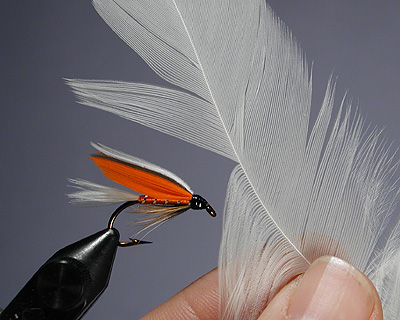 |
|
|
|
|
Modern genetic hen capes - neck hackles - have a lot in common with their dry fly neck peers. They have long stems in relation to their barb length giving tyers plenty of length to wrap along a fly's body. They also have nice supple stems that make them very easy to work with, unlike some of the chinese hackles or poor quality dry fly necks that people have used in the past. Genetic hen capes are a perfect match for a fly like a classic Wooly Worm. |
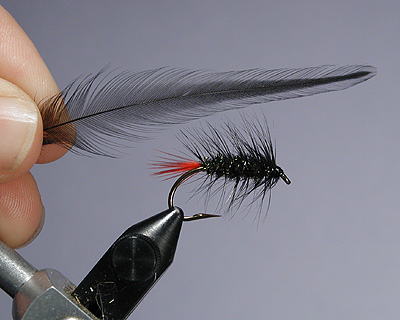 |
|
|
|
| For a wet fly that has both a palmered body hackle and a beard, the best option is to use a genetic hen neck hackle for the body, and a saddle hackle for the beard. | 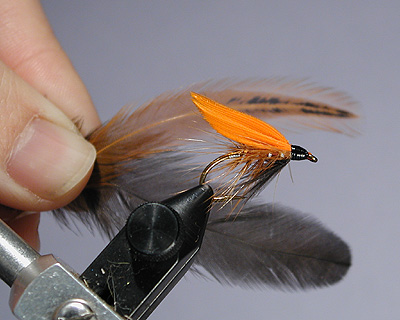 |
|
|
|
| The Whiting "American" hen saddles are available in a variety of intense colors. The dye jobs are excellent. | 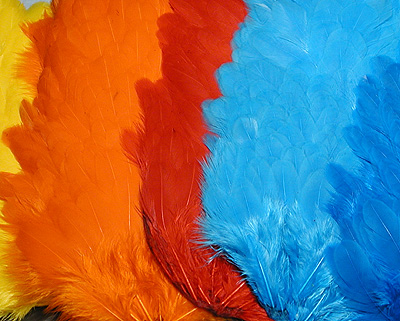 |
|
|
|
| The range of natural colors in the "Herbert/Miner" hen capes is excellent - from the lightest duns to rich blacks, with a good assortment of natural browns. | 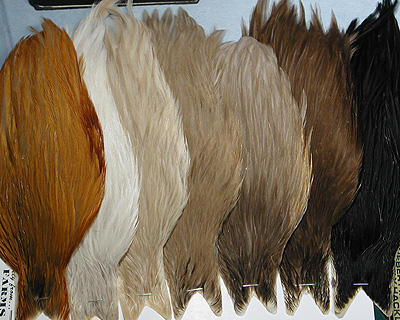 |
- Log in to post comments




This article is excellent
Bob, this article is excellent. I have used a lot of schappen for throats on streamers. I am thinking that the hen feathers might work well. (although they might not be long enough for the long shanked streamers) I have a few hen capes and saddles, mostly natural. (wingless wets) Thanks for this info. I enjoyed reading this, as well as all your articles.
Kelly
Not a review
Johnny,
This is as much an ad as any review of a good product. And the Whiting products ARE good! Simple as that.
Martin
A complete ad
wow, a complete ad for whiting hackles.
Well-written article
What a well-written article. Clear, concise explanations and great pictures! I appreciate very much your focus on a specific subject - "Hen Hackles and Wet Flies" - instead of talking about hen hackle in general. I've been perplexed by this subject for a while now, as most literature focuses on dry fly hackle.
Thank you Mr. Petti!
Wings on wet flies
Do any of you ever use hen hackle tips for wings on your wet flies? I see many on emerger patterns, but I also tie up traditional flies like Royal Coachman, Flight's Fancy, Red Ibis or Yellow Sally with hackle tip wings. They are very attractive and much more durable than quill wings. Nice option to try.
The fly tieing is fantastic
Just to say I think Bob Pettis style of fly tieing is fantastic. When I e-mail him he always get back to me, and has encouraged me to keep on tying.
Collins hackle
Have you ever dealt with hackle from Collins? They seem to be turning out excellent values, but I don't know how they stack up with the offerings from Whiting.
Widely available
Larry - the Whiting products are available from most online fly fishing retailers. Try Mike Hogue at www.eflytyer.com. If he does not have it in stock - I'm sure he can get it for you.
Just what I was looking for
This is just what I am looking for. I have the book on Atlantic Streamers but have not been able to find the right feathers, the hen saddles. The ironic part is that I live less than 40 miles from the Whiting Farms and visited once on a TU trip. Any suggestion on where I can buy these saddles?
No bull
good news no bull just simple info great
I really enjoyed your article
I really enjoyed your article. I am a novice, but I am learning. I really learning to enjoy the Whiting hackle. They have done a tremendous job with the genetics of the birds, turning what was once primarily a meat animal into a feather-making machine.
Great topic
Great topic, examples and photos Bob! Reminds me to tie up some Dr. Burke wets too...