
The garfish is a very common guest in many Northern European countries. It is normally a pelagic fish whose migration pattern is not known in detail. But one thing is for shure: these fish will return to spawn in shallow and rich areas along the coasts many places in Europe.

Garfish (Belone belone, hornfisk, hornhecht)
This section is the manuscript for chapter in a book on fly fishing in salt water in Northern Europe. The subjects covered here are also covered elsewhere on this web site. There are links to all relevant pages.
The garfish is a very common guest in many Northern European countries. It is normally a pelagic fish whose migration pattern is not known in detail. But one thing is for shure: these fish will return to spawn in shallow and rich areas along the coasts many places in Europe. The pattern of their behavior is well known in this respect, and normally they are very reliable, and will return precisely within days each year. In the outer Baltic area the season starts in the end of April and the start of May, and the fish can be followed towards south and east after this time. The fish will disappear again in less than a month and not return before the autumn where their appearance is less synchronized and fishing is much more sporadic.
Even though they come to spawn in the spring, they still eat, and because they are fast fish and avid hunters, they are a joy to catch. They are probably one of the strongest species per pound in our waters. But they do not grow big. A 0.5 kilo fish (1 lb.) is average while a fish of 1 kilo (2 lb.) is huge.
The tackle
The limited size of the fish should be reflected in the tackle. A 5 wt. rod is an excellent choice and even lighter is possible if the wind allows it. The most suitable line is a weight forward floating, as you do not need long casts and the fish are moving just below the surface. Garfish are not easily scared, so a fairly short leader of approximately 2-3 meters (6-9') will be fine. The tippet should be 0.20 millimeters (3X) or 0.18 millimeters (4X) - not as much to hold the fish as to turn over the flies under windy conditions.
Flies
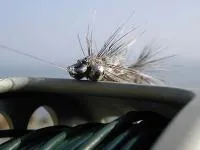
The flies for garfish vary a bit. Many fishers will recommend silvery streamer patterns in sizes up to 4 and 2, but if you really want to catch many fish, you should go towards sizes 10, 12 and even 14. These small hooks will set much better in the hard bill of the fish. Garfish have a very good eyesight and will easily spot the small flies from great distances.
One of the most successful colors for garfish is orange, and almost any small, orange fly will catch them. A size 12 unweighted Woolly Bugger i an excellent choice, but some people use flies as simple as orange yarn wound on or tied to a small hook. An orange San Juan Worm will probably serve you well. Use very sharp hooks such as specimen hooks or even small dry fly hooks. These will easily penetrate the hard bill and give a nice, clean hookup in the corner of the mouth. The traditional stainless salt water hooks are hard to get in the smallest sizes, so be prepared to trash some rusty flies.
If you do not have any small flies handy, you can also try traditional patterns: streamers, scud patterns and even shrimps in larger sizes. The garfish will probably attack them, but setting a larger salt water hook can be quite difficult.

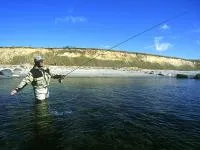
The result of an hour or two with a fly rod: lots of fish and lots of fun.
The tactics
The fish are mostly active in the daytime and even more so on mild, sunny days. This makes the first warm spring days in May ideal for a garfish outing. Choose a day with light wind as it enhances your possibilities of seeing the fish in the water.
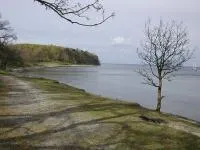
They can be found everywhere from the deeper parts of the open ocean to the inner fjords. Normally you can spot them either moving over light bottoms in shallow water or tumbling in the surface during their mating ritual. They are not willing to bite while engaged in that ritual, but both right before and right after. Also mating fish will be a sign of other fish in the vicinity and it's a good idea to stay in an area with surface action.
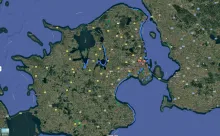
If you see no fish, try looking for sandy bottom on depths of 0.5 to 1.5 meters (1.5-5') cut by patches of sea weed, sand bars, stone reefs or other significant 'landmarks'. The fish will often follow these natural corridors on their way. You can also look on a map to find places like points or narrow sounds that the fish have to pass on their way into the Baltic. These are bound to hold garfish.
If you see fish, just cast to them and let your fly sink a bit. Then retrieve slowly, maybe in small jerks. The figure-of-eight retrieve comes in handy here. Contrary to what many people think, this fast moving fish isn't only stimulated by fast moving food items. The fish will go for the fly and often miss a couple of times. Have patience and strike lightly on any feeling of weight in the rod. Keep on retrieving even if you have felt or have missed a fish.
When you have fish on, be prepared for some wild runs and jumps. Even a 0.5 kilo garfish will take line off a 5 wt. rod. Also be prepared to loose a few fish. They are hard to hook properly.
The fish are excellent food - don't be scared by their iridescent green bones, they are absolutely harmless - but keep in mind that you can only eat so many fish, and release the majority on a good day.
- Log in to post comments

Good article, very handy
Good article, very handy. Have saltwater fly fished for flathead and whiting before and generally got a pretty good feed.
I fish the south coast of new south wales australia at kiama. Tried the wholly bugger and even some red wool , both worked well. I had to wait until mid afternoon on a rising tide, but essentially a good afternoons fishing all fish approx 10 to the kilo.
Melbourne, Victoria, Australia
I live nar Port Phillip Bay , near Melbourne, Victoria, Australia.
I use a weight 3/4 floating fly line and small foam emerger flies do really well on calm warm evenings in the summer months casting around the rocks along the sheltered bays during a rising tide.
Good spots
Hello Martin,
By the time I read this article last year the garfish season had already passed. So, I decided that I'd be in Denmark for garfish fishing in 2010. Now I have everything ready, including my flight ticket to Copenhagen. Can you recommend me some good spots that can be reached by bus or train from the capital? I've been to Dragør and it looks promising. Would you recommend that town for garfish? Thank you in advance.
Another kiwi here
Kiora,
Another kiwi here Hemi, yes we call them Piper but the Aussies call them Garfish Totally different to what the Texan is referring to. Little bits of left over soft baits work O.K. particularly scented one like Gulp, I use baits such as PIPER!(the best), pipi,dough, small silver or white fly's, haven't tried orange yet. Sabaki rigs work great we use a small pencil float on the end of the rig to keep the hooks at or very near the surface which also keeps them out of weed if any. Plenty of burly e.g. wet sand chopped sea grass mixed with porridge bread crumbs and maybe fish meal, ( fish flavour cats biscuits buzzed in a blender work great to). This lot usually brings in the odd Pororae as a bonus. I no that if it is windy or rough it's time to go elsewhere like up a creek and target Mullet. Easy cook if not baking or bottling is gut and stick spear through in front of tail and quick fry turning once e.g 30 secs on top 20 secs bottom.
Different gar
Hi M. Cooper
You're definitely talking about a different kind of gar. From what I've seen around the Internet, what you need is an 8-9 weight setup, a wire tippet, and some large streamers--sounds just like pike fishing if you ask me, I think the same setup will work.
Gar in Texas
I really like this sight and I have been trying to find new and fun ways on how to catch Gar. Around the April/ May Gar begin to spawn in Texas. I like to know what size fly rod & reel would I need? Also how heavy of a line and leader that I would need to use as well?
I live in Texas
I live in Texas and we are known for having the largest Gar. I mean you have to understand everything is bigger in Texas. I mainly catch Alligator and Long-nosed Gar. I use deep sea fishing poles. I thought it may be intersting catch a Gar on a fly rod. Any suggestions and /or techniques to use to try to catch an Alligator Gar that weighs over 50 lbs using a fly rod?
Good fishing spot in Holland
Hallo !
What is a good fishing spot in Holland. for garfish.
Thanks for the info.
Some great info
Yes some great information and in good English. I stay in Denmark every year for six months arriving at the beginning of May. For the other 6 months I live in New Zealand where there are no Garfish except tiny cousins called PIPER, but plenty of other exciting species to catch. We net these. What I am interested in other ways of catching Garfish. For instance do they take the "Softbait" optiions like "Gulp". Do they take fish bait situations. I heard from the Tackle Shop assistance that they can be targeted during the summer in deeper water situations. Can someone comment on these. For the present moment I am using a very light spinning rod and reel and the typical danish spinner without the hook and an ORANGE silk bundle. I find this excellent in a weedy situation.Thanks for the webpage and the right to ask questions..