
If one particular fly was to be celebrated as the Mother of all the typical Danish, gray, nondescript hackle flies it would have to be The Magnus. Originated in 1973 in Denmark it has become a goto-fly for Many Danish as well as foreign coastal anglers.


If one particular fly was to be celebrated as the Mother or Father of all the typical Danish, gray, nondescript hackle flies it would have to be The Magnus. OK, we have The Grey Fred, Slagterfluen, Nullermanden, Sandhesten and a wealth of other similar flies, but the Magnus is the real classic if you ask me. It might look like it has its legacy in the Woolly Bugger, but it was more inspired by traditional palmer hackled wet flies such as the Chilimps and the Red Tag Palmer.
1973
It is originated by Magnus Ting Mortensen from Funen back in 1973 and was first made popular by a local shop, which took it up as a stable fly and since by magazines and books that mentioned this excellent all round, Danish coastal fly and spread its name.
And I need not put emphasis on "Danish", because the fly is so universal that it would be able to catch almost any salt- and freshwater species that eats shrimps, small fry and other small, grayish food items. The fly has caught sea trout, steelhead, salmon, bonefish, tarpon and a number of other species - and these are just the ones that I have direct knowledge of.

Not an imitation
According to the originator, the fly wasn't conceived as an imitation of anything special, but more like a generic, living thing. Access to hares - Magnus Ting Mortensen also hunts - and Plymouth Rock feathers - a friend raised chickens - dictated the two main ingredients of the fly: hare's wool and grizzly hackle. So a simple body hackled fly saw the light of day in the spring of '73.
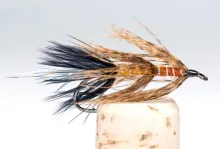
The eyes add weight and a jigging motion to the fly, and red color over the eyes of the original was more like an ornament than a deliberate effect as such, but have become one of the hallmarks of the really classical version of the fly. The specimen that you see here, tied by Ken Bonde Larsen, just uses red tying thread to give the red accent on the fly. The original is smothered in red nail polish over the bead chain eyes and head.
The originator actually caught his first fly caught sea trout on the fly after having been skunked on the spinning gear by fish very close to the shore, which weren't tempted by the lures.


1-2-4 hackles
As you will see in the tying steps, the fly shown here is just tied with one hackle, while the original used two: a body hackle and a front hackle. The length and nature of modern hackles makes this unnecessary. You simply start the hackle in the front of the fly behind the eyes, and take a few extra turns with the larger part of the feather to form a front hackle before doing the body hackle.
One reason for the two feathers of the original fly, might have been the use of two hackle tips for the tail. That left you with two feathers for hackling. We recommend using separate feathers for the tail and the hackle. Most necks have lots of small feathers, which are perfect for the tail on a fly like this. Having the full feather makes it a lot easier to position them correctly. Tie them in curving away from each other to form the Magnus' typical splayed tail.
If you want to paint the eyes, do it before you tie any hair or feathers on the fly. Simply tie the eyes on the hook, whip finish, cover with nail polish and let dry. Prepare a bunch, and when they are dry, tie on the rest of the materials. Magnus Ting Mortensen ties his eyes under the hook shank, but the fly is seen with the eyes on top of the hook just as often.
Blood-polar-disco
The popularity of the fly has led to numerous variations of which the Blood Nosed Magnus, The Polar Magnus and the Disco Magnus are probably the best known. The first variation is tied with a red front hackle and bright pearl dubbing, the second with a pink front hackle, while the last one uses a bit of blue flash in the body and a kingfisher blue front hackle. The fly color can be varied endlessly as you can imagine, and orange, white, olive and black versions have been seen regularly.


|
|
|
|
|
|
|
|
|
|
|
|
|
|
|
|
|
|
|
|


The Magnus has been covered on GFF many times before. All these are really old, so forgive the quality of the pictures:
- Log in to post comments


Wow thanks for this.
Wow thanks for this. I'm from BC and I just happened upon this pattern, it looked buggy so I tied a couple up. Sure glad that I did as the trout around here seem to really like it.
Ken Bonde, thanks
Ken Bonde, thanks for your answer. I will test it during my trip to Denmark in March together with Partridge CS11.
I used to tied all similar flies on Kamasan hooks but they seems to me too heavy.
Tiemco`s TMC 777SP
Pike....
The hook I used for Magnus and Grey Fred is Tiemco`s TMC 777SP - a very nice shaped hook, and very SHARP:-) But any other "medium-length" streamerhook might do the work..
Ken Bonde
Ttype (brand) of hook?
Martin, would you be so kind and could you tell me the type (brand) of hook you use for this fly? I have noticed, the same type is used for Grey Frede too and I really like it.
Thanks a lot.
Never tried
Helge,
Never tried tying a Magnus with copper eyes. I used to paint the eyes on my Magnuses, but these days I use unpainted silver beads and even black thread. I have kind of hybridized it with the Grey Frede, but it's still one of my most productive patterns.
But I'm sure it would catch equally well with copper eyes.
Martin
Butter and bread fly
Dear Martin,
beautiful always beautiful I like these butter and bread fly. Did you try copper eyes as well??
best regards
Helge