
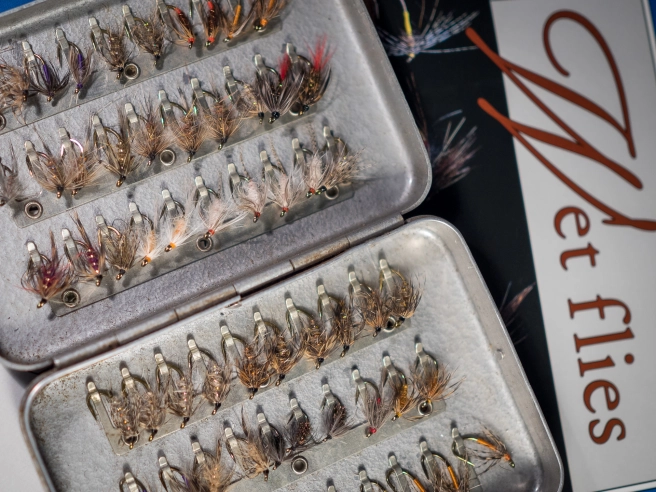
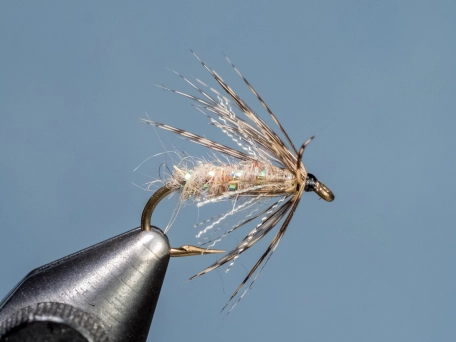
The soft hackles – North Country Spiders – have proved their worth through many decades, and still do.
The more I fish, the more I’ve settled into predictable patterns of behavior. Gone is the drive to explore and conquer and push the boundaries. I seek out familiarity and comfort and raw pleasure - where I can relax and let the angst of the world fade away and just enjoy the moments.
My knees can’t handle pounding up a mountain stream for hours anymore – or wading into deep heavy current. I just wanna fish the way I wanna fish - and if the trout are cooperative - so much the better. If not - I go home refreshed and relaxed anyway and eager to return next time.
Simplification
This has led to a great simplification in how I fish, how I prepare for the day, and how I stock my fly boxes and fishing vest. I see guys now coming to the water with bulging chest packs and two rods strung up and I can’t help but chuckle - simultaneously thinking “they’re really nuts” but also “I would have done that back in the day”.
North Country Spiders
I don’t fish often - once a weekend and a rare mid-week evening - mostly during the “nice weather” stretches of the year. I fish early - leaving the house as early as I can get out of bed - avoiding the crowds. I like to get everything ready the night before - and that includes stringing up a rod and putting it in my car so the next morning all I have to do is put on my waders and vest and grab the rod and go. Since I’m usually going to familiar waters - and I have a good idea what the conditions are - it’s kinda easy to know what fly to start off with. The past several years I would guess ninety percent of the time that fly would be a soft hackled wet fly - or as they’re known in the UK “North Country Spiders”.
They proved their worth
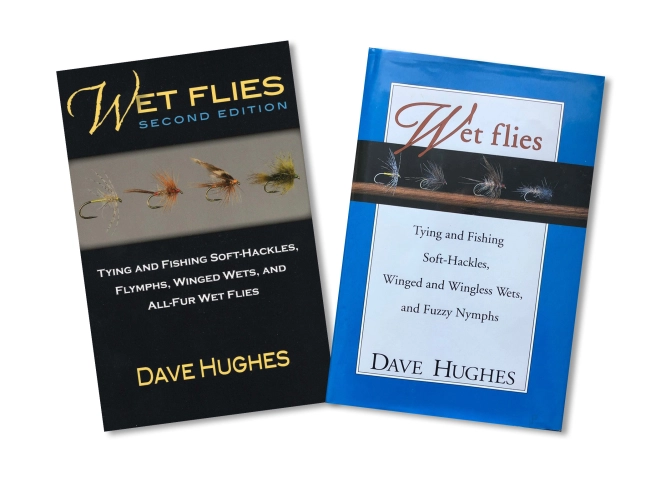
I don’t remember exactly when I started carrying soft hackled flies in my fly boxes - but it must have been after reading “Wet Flies” by Dave Hughes which came out in 1995 - so it’s been awhile.
His writing is SO good it’s hard not to become a believer. I do clearly remember one day where it all clicked and they proved their worth to me. Fishing a slow stretch of the Black River in the southern Adirondacks along a shoreline where the water dropped away quickly and a hill rose up behind us, there wasn’t much room for casting or wading. With my limited roll casting skills, I could just shove the fly line out into the current and hope for the best. We could see fish working, and from the bridge upstream we could spot quite a few, so we knew they were up in the water column and active. What prompted me to tie on a Partridge and Orange I don’t recall, probably a story in Dave’s book, but first drift I got a “bop” and there was a feisty little rainbow.
Several more followed - while my friend and fishing mentor was getting shutout. That NEVER happens - in the three and a half decades we’ve fished together - I’ve never been on the good side of such a lopsided success rate, lol. That’s probably why I remember it so clearly.
Game on!
Another time - fishing the Beaverkill in some lively pocket water - I was swinging a Gray Hackle Peacock in the holes and slack spots when I saw a splashy rise a bit downstream. I put the fly in his house, and this time rather than a little bop from a small rainbow, I got a strong tug and a swirl from a decent sized brown. Game on!
There are more stories - but you get the point. I catch fish on wet flies because I fish wet flies - but it’s not just hope and pray. I know they work. I’ve seen them work. I have faith in them working. And most often - if they’re not working - it’s just not my day and I’ll dabble with other things without much confidence before reeling in and heading home.
One wet fly on the point
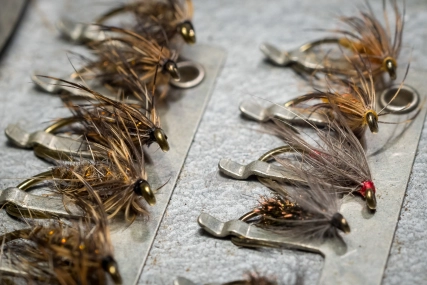
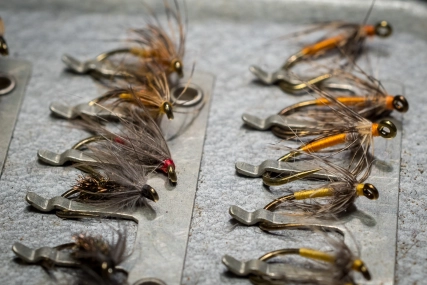
Normally I fish one wet fly on the point, down and across on a swing, holding the fly in the current for a while at the end of the drift before lifting for a new cast. Positioning is critical, as that “hang” has to be in fishy water or it’s not of much use. That’s where being familiar with the location comes into play - I know from years past where the fishy spots are and make sure I’m always drifting the fly through those areas as much as possible. Casting this way is pure joy – a nearly weightless fly with no wind drag is fly fishing at its most pure form (to me). That’s the grace the writers go on about when waxing poetic about the beauty of fly fishing.
The core set is consistent
Occasionally I’ll put a second fly on a dropper - at least if it’s not windy. Untangling flies is no fun. If I’m nymph fishing - Euro nymph fishing at least - I’ll use a soft hackle as a dropper above the nymph - as I take zero pleasure in casting two weighted flies. If I’m dry fly fishing - I will sometimes put a soft hackle on a dropper underneath the dry fly which is very effective for upstream fishing. Soft hackles find their way into my fishing nearly every time I’m out in one way or another.
My selection of soft hackles varies a bit year to year as I trip over new patterns (or old – some soft hackled patterns are ancient) or luck into some new feathers, but the core set is consistent from season to season.
Patterns covered in this article
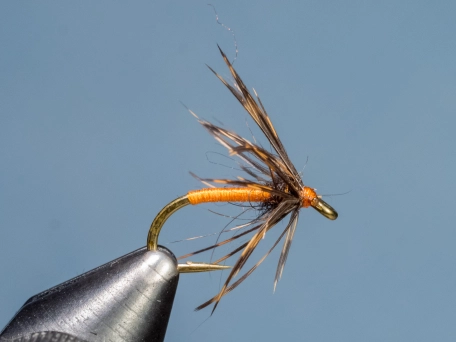
- Grouse And Orange
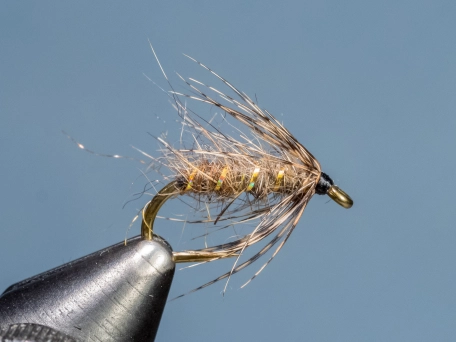
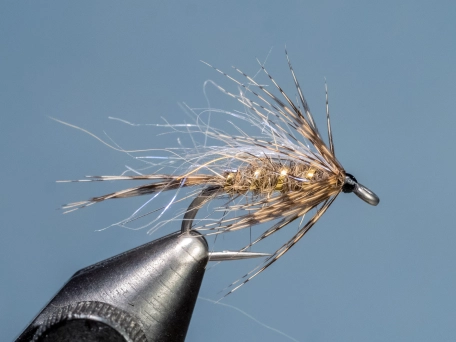
- Partridge And Hare’s Ear
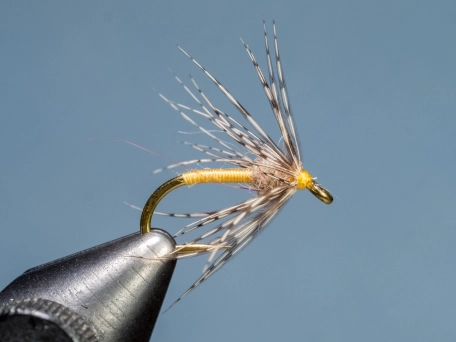
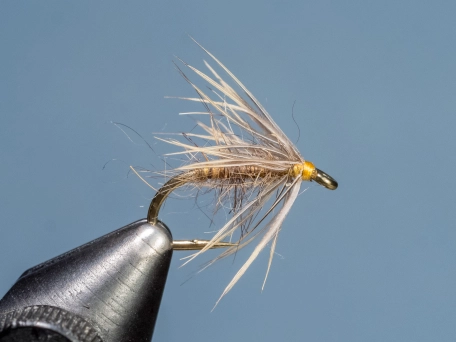
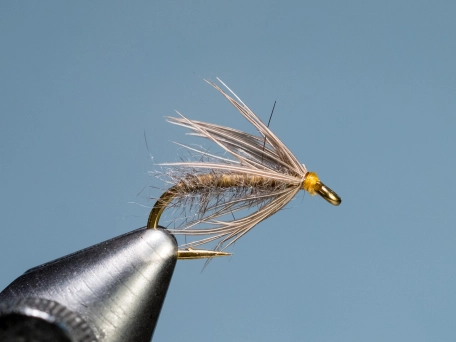
- Partridge And Yellow
- Gray Hackle Peacock
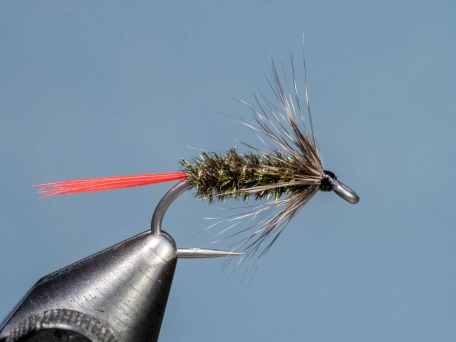
- Starling And Herl
- Hare’s Lug And Plover
- March Brown Spider
- Waterhen Bloa
- Organza Partridge
Click the links to see a full materials list for each pattern.
Tying Notes
- These are all quick to tie utilizing just a few ingredients - but as some of the hackle stems can be quite fragile you have to be on your game and employ a very gentle touch. You’ll snap a lot of stems - just keep trying and that first wrap will eventually take and you’re home free. Sometimes it’s better to use your fingers vs hackle pliers - if you have enough feather to handle.
- Less is more with these flies - two or at most three turns of hackle is enough. Every feather is different so you have to make a judgement and try to get a consistent density of hackle. Some tyers exaggerate this by just a single turn and go for ultra sparse, but I always remember what Oliver Edwards says: “Some people do think that a north country spider is only correct if it's got about six hackle barbs sticking out. That's no good at all, because the fish will have a fly like that down to a hackle-less fly in no time at all.”
Less is more with these flies
- In addition to just a couple turns of hackle - I try to select feathers with barb length that will reach from the eye to the hook point, give or take a little. That’s my rule of thumb. That makes it difficult to tie ultra small soft hackles since the feathers from game birds don’t lend themselves to tiny barb length like a Whiting dry fly hackle. There are tricks to use larger feathers on small hooks - but I’ve never tried it. If the fish are active and hungry, they’ll smack a reasonably sized fly readily and consistently.
- Most of mine are 12’s and 14’s on Mustad 3906 hooks, using Pearsall’s Gossamer silk where specified. Some of the new threads are just as good - but I’m lucky to have a stash of the original Pearsalls on those small wood bobbins. Unfortunately Mustad no longer makes their wet fly hooks in that wonderful dark bronze color - which certainly was a factor in the thread choice as silk becomes translucent when wet and on top of the dark hook shank presents a very distinct color profile. Now with this silly matte gray - who knows. It won’t be the same. I shop for old Mustads, but they’re getting hard to find.
- You will also see that I follow Dave H’s advice about putting a little blob of dubbing behind the hackle. This is optional - as a lot of the historical patterns are just the thread body and the hackle - but I like it and fish these flies with confidence.
- Dave Hughes was an advocate of tying the hackle in first, by the butt of the feather, binding the stem down underneath the body. The hackle was then wrapped rearward, the tip caught in thread which was then wound forward through the hackle to form a head. The thought was this reinforces the hackle somewhat. I’ve tied the flies shown as a normal hackle collar is tied - after the body and thorax, tie in the hackle by the tip, wind forward, and tie off. I’ve done both ways and found no real difference fishing, and tying a normal collar seems easier to me. Try each way and decide for yourself. I will say winding a game bird covert feather rearward using hackle pliers to grab the tip will test your patience - and if something breaks you’re in a bind as the hackle stem is underneath your body.
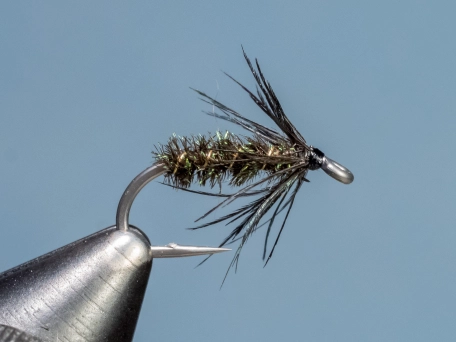
- Although this might be heresy, on flies such as the Partridge and Hare’s Ear, I put a layer of lead tape under the body. It’s a miniscule amount of weight, but it does get the fly to drop through the surface film quickly and it stays down better on a swing and the “hang” at the end of the drift. The black thread is my indication that the fly has weight. These are good point flies, with an unweighted or thread body fly on a dropper above.
- A lot of the old patterns call for hackles that are either unobtainable or very very scarce. Don’t go nuts here - use what you think is a close substitute and go fishing. I was lucky enough to get some Golden Plover years ago from Blue Ribbon Flies at one of the big shows in New Jersey and I can still use it today - but if I had to get on a waiting list and pay the current prices, I’d go with something else. There are references out there that offer advice on substitute feathers - even Davie McPhail has a video on the subject. Don’t feel lost if you don’t have Moorhen or Plover or some other arcane bird feather.
- Thread color is only mentioned in the pattern when it has a meaningful role in the fly. Otherwise - use whatever you like.
- The reference to Gray and Brown partridge refer to feathers from the same bird – a Hungarian Partridge (which fortunately is easily obtainable). The difference is where on the bird the feathers are taken from - some of the hackles have a distinctly brown hue with striking bars. Hens also tend to be more brown than gray.
- For flies like the Hare’s Lug and Plover and the Waterhen Bloa, where the pattern calls for silk thread lightly dubbed with fur, I use a touch dubbing technique. Rub the stickiest wax you have along a few inches of the thread and just drag a ball of dubbing along the thread. The fur will stick to the wax in a way that would be difficult to achieve with “roll on between fingers” method. I then twist the thread to affix the dubbing a little more and wind up the body. It’s a good method to have in your bag of tricks.
It’s a good method to have in your bag of tricks
- Log in to post comments




Soft Hackle Flies
Nicely done article, Bob. Yes, with maturity comes wisdom, as well as unsteady wading. No need to push it anymore. Let the flies do their work and hang on. No extra glitze, just natural goodness with a lot of soul.... that's soft hackles. Cheers!
Old School Wet Flies still work
Thanks Bob, this article is particularly interesting. I'm increasingly using old school wet flies with success for brook trout fishing in rivers.