
Juro Mukai is a old aquaintance from the Flyfish@ mailing list. I had the pleasure of fishing with him in the Seattle area, and was intrigued by the 'modular' line setup that he uses on his two hand spey rod for steelhead.
Juro Mukai is a old aquaintant from the Flyfish@ mailing list. I had the pleasure of fishing with him in the Seattle area, and was intrigued by the 'modular' line setup that he uses on his two hand spey rod for steelhead.
I'll let Juro himself explain all the possible bits and pieces of this setup. This text was posted as a reply to Andre Lorenz' inquirey about a good line setup for a St' Croix 9/10 wt 14' rod:

I have very good luck with a DT9F line cut well beyond the taper and looped with a custom loop...
- cut and strip 1.5 inches of coating using a wire-stripper of the right gauge diameter -or- some guys use the nail polish remover.
- snake a piece of 30# braided nylon running line (same as slip-on loop material) over the exposed core so that a little hangs over the remaining coating and over the end of the core
- fold and form a loop no larger than you need to make connections
- nail knot with 12# maxima so that the bite of the knot hits the coating on one side and secures the loop against itself on the other
- trim all extra stuff to make a neat compact loop
- coat with aquaseal thinned with cotol to cover knot and trim ends
This loop is my original recipe and has been adopted by all my fishing partners. I have not had one let go when properly made, which is more than I can say for store-bought.
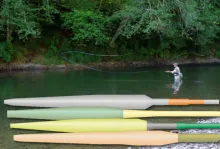
Then do the same for the cut tip, to get back to a DT9F at any time. Also buy a type IV 30' tapered (on both ends) shooting head, and cut 12 feet from the front, make loops on both square cut ends and you have three tips. I also buy a type II to complement the set with five tips, type III is nice as well as one of those cheap Jim Vincent things for dredging in rocks (not that I do this) VBG. This is quite an arsenal with only one spool.
The IV, II and floater fill the bill pretty completely IMHO.

The problem with the DT is that only the 12' tip and the dry tip casts well. There is only so much line that a rod can work without shooting line, and DT lines don't shoot worth beans. This is about 60-70 feet for my open motion and a DT line in my hands.
That's when the head system comes into play.
In this case, a section of DT12F is used, cut so that the total head length is around 30-35 feet depending on rod and casting style. This is looped onto a running line of .038 or something like that. You want a balance between shooting ability (low diam) and line control (larger diam). I started with 22 feet of DT12F and a 12' type IV, eventually trying a shorter 12wt Head body at 20' for a 32' total head including the 12' type IV tip. This casts well using a launch Spey cast as opposed to an open style for the DT, once you get it you'll be amazed! The rod is tilted back over the casting shoulder to cock the shorter line length in an arc and a crisp push-pull with a very high abrupt stop sends the wedge for the far bank. You may have already found this groove, I will never forget the day I found it.
The key is different strokes for the two lines. I found that the 10wt 15footer really throws the big head a mile, but it's nothing like the classic Spey motion for a DT. I prefer a light and agile DT when possible though, no loops or stripping.
Heads require that one strips all of the running line into the guides so that the cast can be made, which can take some getting used to.
The head will overhead cast like a rocket.
I also have an in-between head made with an 11wt DT body a bit longer than the 12, which casts well too but since it requires the running line to be stripped in it doesn't offer much to the scene. It does allow for the 18 foot section of the type IV to be cast easier than the DT9F though. I don't use this head much anymore.
I recommend that both DT casting styles and head casting styles be learned so that you are more able to meet the diverse conditions of rivers. My favorite is the totally dry DTF, on crisp fall days using a skating caddis... but the tip arrangements usually produce more fish during other times of year (like now).
In big rivers, it makes a lot of sense to use the distance casting capabilities of the head systems. In cold conditions, although the stripping to cast is a pain the fat head let's you throw as much as 10' or more of 550 grain DWE if you should ever have such a need.
In most cases, the 12' type IV fished on either system has been by best friend. Speed of presentation and seductive appeal of the fly are more important than depth three of four seasons, and even in winter the fish get rowdy now and again.
Have fun, catch fish,
Juro
- Log in to post comments



Chedd,
I don't kn
Chedd,
I don't know who manufacturers the DT sinkers, but they are around. You may be right that they are more common in the UK (and perhaps Scandinavia) than elsewhere.I would check out a place such as Mullarky's in the UK, which has been a good source for cheap DT lines for my for years.
Martin
I may have missed it
I may have missed it in this article, but who sells DT sinking lines other than UK manufactures?