GFF logo


Better fishing pictures: fishy, fishy!

We naturally take a lot of pictures of fish, and a few tricks can make these much better and more appealing than the average fish picture seen.

By Martin Joergensen

  
Ambience and closeness
 Ambience and closeness 
Martin Joergensen
Surroundings
 Surroundings 
Martin Joergensen
 
Of course we want to capture our fish in two ways: first on the hook and then in the camera. Once the fish has been hooked many of us already envision the poster on the wall, the image in the online gallery or just a print to show to the fishing buddies.
And preparing mentally is a good idea, particularly if the fish is going to be released. That will give you precious little time to get your picture taken, and if you’re alone a bit of thinking ahead can be the key to getting that great image.


Short dry spell
 Short dry spell 
Martin Joergensen
Steady now...
 Steady now... 
Martin Joergensen
 
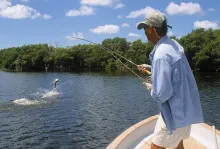
C&R fish are to be handled as little as possible and should not be in contact with hands, rocks, weed or sandy bank or beach too long—if at all. Some species are more robust than others and particularly many fresh water coarse fish as well as some predators are very enduring and can be out of the water for minutes. Fish, which have fought hard, should only just be lifted out of the water for a few short shots and then released. Take several images of the fight and landing as well as the angler presenting the fish. And shoot a couple of frames of the release too.

Dead fish are much easier to handle, but remember that pictures of dead fish should be taken at waterside and not back in the garden, backyard or (yikes!) in the kitchen. And please take them before you gut the fish! Many fish will loose their bright colors or silver shine the minute they are dead, so be quick about taking pictures as soon as the fish is out of the water.

Killing fish for the pan is common in most parts of the world, but just because the fish is dead doesn’t mean that it has to be held vertically in the tail, carried with a finger in a gill lid or hung by a piece of string through the mouth.
Handle the dead fish in such a manner that it presents itself nicely. Support it under the tail and belly and hold it in front of you. Clean off sand, grass and dust and make sure you take the picture before colors or silver shine fades as already mentioned.

You can also arrange the dead fish in the ground with the gear next to it. These still lives can fall out really stylish and beautiful.

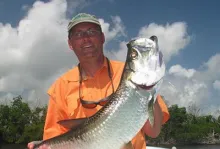
Snap as many images as you can get before a C&R fish is released or the angler tires. Take some full frame images, some close-ups and some detail shots. Get some where the angler smiles into the camera and some where he or she is actively landing or releasing the fish.


And remember the previous advice: go close, go low and use a fill flash, and find inspiration in these three articles on tails, fins and heads. You can also visit 500th.net, which has much more on cameras, equipment and photography.


User comments
GFF staff comment
Comment to an article image
From: Martin Joergensen · martin·at·globalflyfisher.com
Submitted June 21st 2006

Shellan,

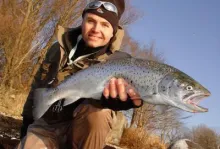
It's a coho salmon caught and photographed in British Columbia, Canada.

Martin

Comment to an article image
From: Shellan Miller · smiller·at·missoulahousing.org
Submitted June 21st 2006

where was this photo taken? what kind of fish

Comment to an article image
From: Anonymous
Submitted November 28th 2007

There's no head like steelhead!

Comment to an article image
From: BernardYin · lariver·at·aol.com
Submitted December 14th 2006

A "brown" agains "seaweed"/algae correct?
This is something that one never sees in California!
Beautiful!
THANKS!

GFF staff comment
Comment to an article image
From: Martin Joergensen · martin·at·globalflyfisher.com
Submitted March 10th 2007

Dear anonymous,

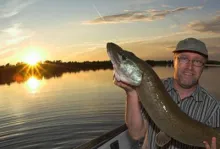
"Flap around" and "out of the water longer than is necessary" and "warmer months"...? Where does it say that about the above fish?

This fish was handled with utmost care, out of the water for about 20-30 seconds resting calmly on a weed bed about 2 feet from the water in the autumn and swam away with splashing vigour once I released it. Trust me, it was not harmed.

You are not the first person to question the robustness of pike, and I would like again to ask for some documentation of the fact that pike are more delicate than most other fish - apart from the fact that the sheer weight of large pike makes certain considerations necessary.

As you can read in my article elsewhere on landing and releasing pike, I generally consider pike a tough fish, which can endure a bit of handling. I do NOT recommend handling the fish for more than mere seconds in or out of the water, but specimen anglers have told me that pike can survive for very long periods rolled into a damp carp mat or kept in shallow water in a keep net.

Now, I do NOT endorse or recommend such treatment of any fish, but it just tells me that the few seconds that my pike are usually out of the water and the way that I handle them will hardly do them any harm.

Again: please refer me to some documentation that says otherwise and I will revise my way of doing things and writing about them.

Martin

Comment to an article image
From: Anonymous
Submitted March 10th 2007

Quote "Luckily the pike was quite calm. Pike are very robust and can endure quite a rough handling and several minutes out of water."

What a magnificent fish and what a disappointing comment. It is completely untrue, despite their appearence and predatory lifestyle Pike are actually one of the most delicate and sensitive fish and highly prone to serious damage when on the bank which can often be fatal if they are handled incorrectly, allowed to flap around on hard services and kept out of the water for longer thaan is necessary, especially so in the warmer months. To suggest that they are a hardy fish that can handle rough treatment on a fishing website is most irresponsible.

Comment to an article image
From: Ripley Davenport · admin·at·distantstreams.com
Submitted January 5th 2007

That's not a pike, it's a Russian Typhoon Class Submarine!
Ripley

Comment to an article image
From: Mike
Submitted January 5th 2007

awesome pic, should be in the wallpaper section!!!!

Comment to an article image
From: erkan baykal · erkanbaykal·at·yahoo.com
Submitted November 21st 2006

Ilike fishing and this page is very good


Want to comment this page? Fill out the form below.
Comment
Only comments
in English
are accepted!
Your name Your email
Notify me on new comments to this article on the above email-address.
You don't have to comment to start or stop notifications.
We excuse for any errors or inconvenience caused by this service, which has new features still in an experimental state. In case of faults, please notify Martin at martin@globalflyfisher.com, and explain the problem, and we will try to fix it as soon as possible. Thanks for your patience

All comments will be screened by the GFF staff before publication.
No HTML, images, ads or links, please - we do not publish such comments...
And only English language comments will be published.
Name and email is optional but recommended.
The email will be shown in a disguised form in the final comment to protect you against spam
You can see other public comments on this page

 
Did you find the above interesting?
People who looked at the above also looked at:

The Zuddler

Question: What to you get when you combine elements of a Muddler...

Jump!

Getting a picture of a jumping fish is not as easy as you may th...

Backgrounds

The fly photo article series continues with a section on selecti...

Aux Outardes River Pike

Pike fishing is not only possible in lakes. Some rivers offer gr...
These other stories on "Photography - About taking the best fly fishing and fly tying pictures" might also interest you:
More about Photography
A few random articles for your entertainment